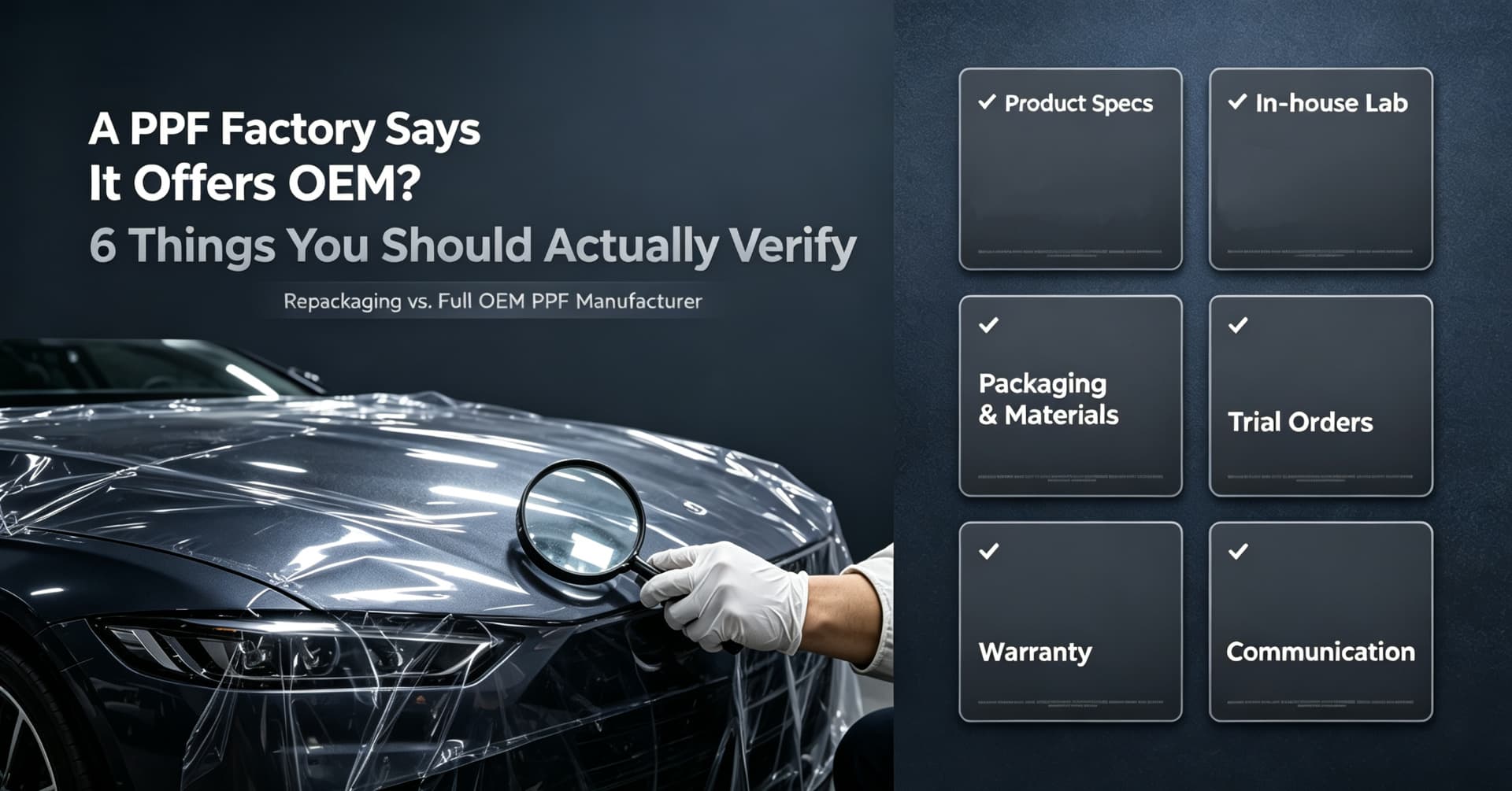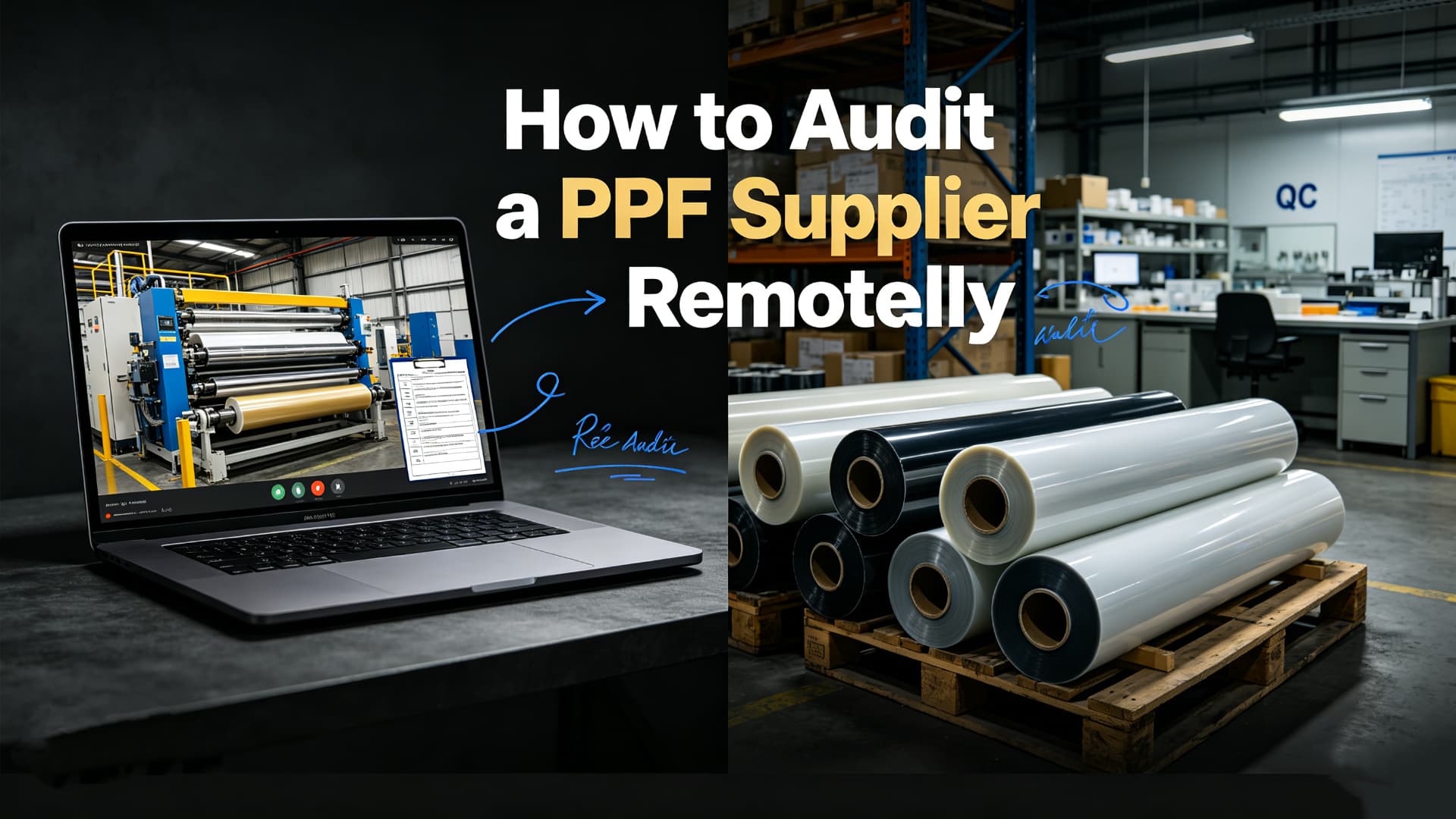
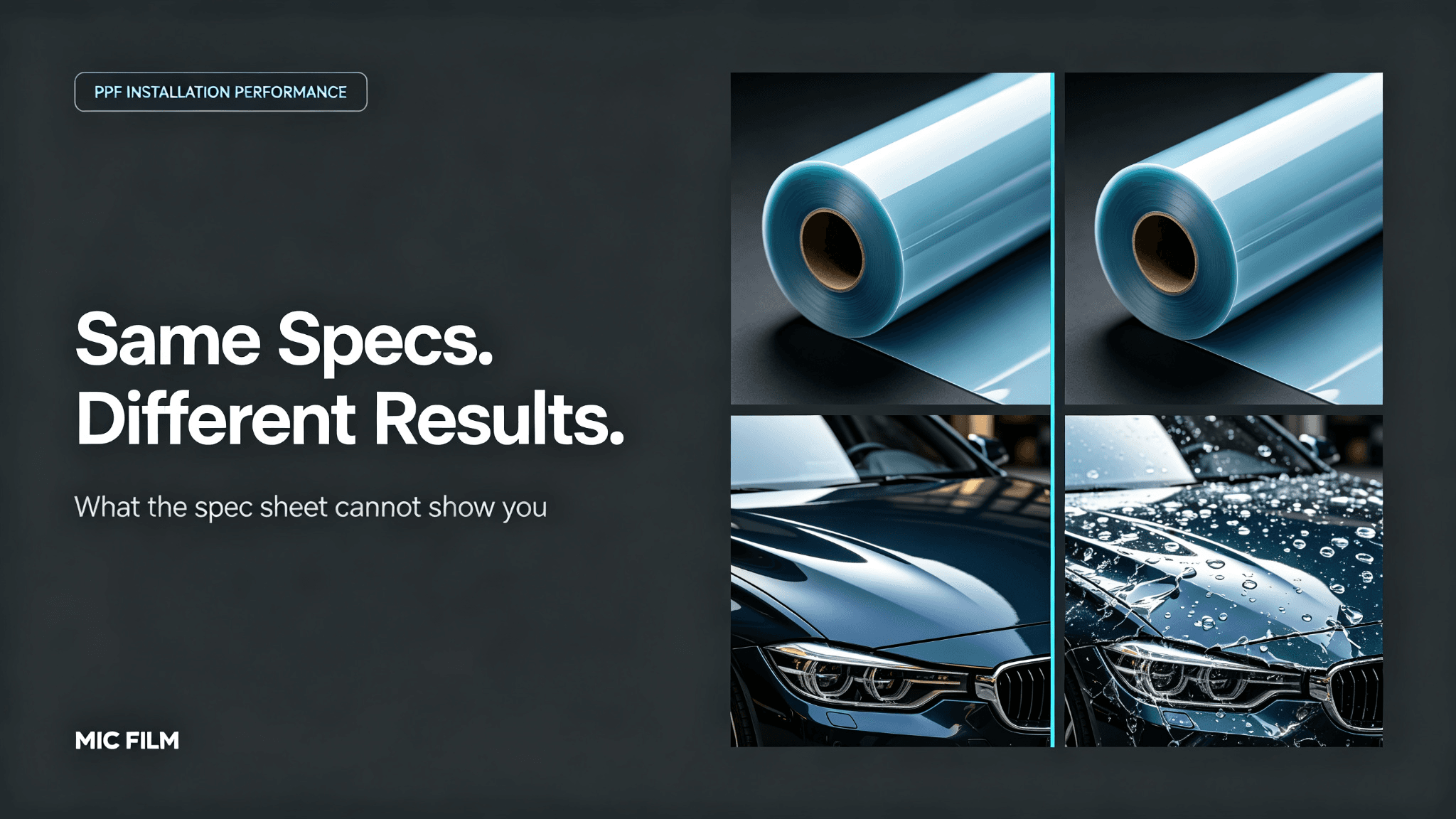
Two rolls of film sit side by side, both 7.5 mil thick. Line by line, their spec sheets look almost identical — elongation, self-healing, adhesive strength. But once installation begins, the first roll goes on smoothly, while the second one feels wrong no matter how you work it: the film is stiff when stretched, air does not evacuate cleanly, and the edges keep pulling back. After struggling for half a day and wasting half a roll, you start to wonder whether the installer’s skills have slipped.
The spec sheet is not lying. But there is only so much it can tell you.
This article is not about what is written on the spec sheet. It is about the things the spec sheet cannot show you — the things that genuinely affect PPF installation performance.
Spec Sheet Values Are Nominal — They Don’t Represent the Quality of a Whole PPF Roll
Let’s start with a reality check: the numbers on a spec sheet are mostly nominal values.
A listed thickness of 7.5 mil refers to the average or nominal thickness of the roll. In practice, thickness varies within a certain range across the roll, which is perfectly normal. A 300% elongation figure is laboratory data measured at a specific temperature and stretch rate; when an installer stretches the film at room temperature on the shop floor, it feels completely different. The spec sheet will not tell you the tolerance range, will not tell you whether the number came from sampling or full inspection, and will not tell you which batch the test report actually corresponds to.
There is an old saying in the film business: making a film thick is not the hard part — keeping it uniform across the whole roll is. Making a spec sheet look good is not the hard part — keeping every batch the same is. Keeping the thickness variation of a roll within a few tenths of a mil takes precision equipment and strict process control[1]; it is not something you get just by turning on an extruder.
Two factories can both write “7.5 mil, 300% elongation” on their spec sheets, yet their actual quality levels can be a world apart. That is why “same specs, different quality” is so common in this industry — the spec sheet is an entry ticket, not a guarantee of quality.
Same Specs, Different Quality: The Differences Lie in the Film’s Four-Layer Structure
A roll of PPF is not a single layer of plastic. Break it down from an installation perspective, and at least four layers are working together: the TPU substrate, the adhesive layer, the top coat, and the release liner.
A spec sheet usually lists only the overall thickness and one or two performance indicators. The true quality of each of these four layers is barely reflected on the spec sheet — but an installer’s hands know.
TPU Substrate: One Grade Down in Raw Material, a Clear Gap in PPF Installation Performance
They are all called TPU, but the raw materials can differ enormously. Aliphatic versus aromatic, virgin versus recycled, pellets from different suppliers — the films produced from them are completely different products. Aromatic TPU is cheaper, but it yellows after prolonged sun exposure; aliphatic TPU is more stable and is the mainstream choice for PPF.
What is trickier is the variation in formulations and pellet batches. Adjust the formulation even slightly, and the film’s hardness and extensibility change along with it. If a factory does not control its raw materials strictly, this month’s film and last month’s film will not feel the same — customers may not notice, but an installer who works with film every day can tell the moment he stretches it.
On the installation side, the most direct experience is stretching. Good TPU stretches evenly with controlled rebound; it whitens when over-stretched, but it will not tear suddenly. Film made from average raw material either resists stretching too much, or starts stress-whitening once it is stretched past a certain point — which causes particular trouble on complex curves like bumpers and mirror caps. This is what installers fear most: you stretch halfway, the film turns white, and you can neither peel it off nor leave it on.
The Adhesive Layer: The Key Factor Behind PPF Installation Feel and Air Release
Whether installation feels smooth or not is largely decided by the adhesive.
With high initial tack, the film grabs the panel the moment it touches, making repositioning difficult. With low initial tack, the film slides around, but you can lift it and reapply if it is misaligned. The ideal state is moderate initial tack, smooth air release, and stability once positioned. Finding that balance is exactly where a manufacturer’s formulation and coating expertise show.
Adhesive problems usually come down to uniformity. Adhesive is applied by coat weight, and the coating weight directly determines peel strength, repositionability, and long-term removability. On film with poor coating control, tack varies from spot to spot — some areas will not bond, others stick the instant they touch, and air bubbles simply refuse to be squeegeed out. Whether the adhesive is formulated in-house or sourced externally, and whether the coating process is stable, will not show on a spec sheet — but an installer understands all of it within five minutes of working with the film.
The Top Coat: PPF Quality Differences That Do Not Show on the Spec Sheet
Hydrophobicity, self-healing, and stain resistance are each just a single line on the spec sheet, yet in practice the gap between products is huge.
Film with an inadequate coating formulation or curing process will either lose its hydrophobicity quickly or self-heal slowly. There is an even more subtle problem: after installation, under the light, the surface shows uneven bright and dark patches — known in the trade as “cloudiness.” This is not caused by installation; it is the result of uneven coating thickness. Customers do not understand that; they just think “the film is not glossy enough” and take it out on the installer.
The Release Liner: The First Layer to Affect Installation Performance, and the Easiest to Overlook
Many people overlook the release liner, yet it is the first thing touched during installation. If the release liner’s release force is inconsistent between batches, the installer’s peeling feel varies — peel too fast and the film wrinkles; peel too slowly and it slows the workflow. A poor release liner can also pull away part of the adhesive when peeled, reducing edge adhesion and leading to edge lifting later on.
These all look like small matters, but they add up to rework and claims in the end.
Batch Consistency: A More Important PPF Quality Indicator Than Single-Roll Data
When two rolls with the same specs perform differently, it is often not that “one of the rolls is bad” — the problem lies in batch consistency.
PPF production goes through several processes — raw material, coating, lamination, and winding — and any fluctuation in any step carries into the finished product. One thing the industry weighs heavily when judging whether a factory is reliable is whether every roll performs consistently: adhesion, thickness, and working characteristics must not vary from roll to roll.
Factories that achieve this rely on raw material management, inline inspection, and final checks before shipment. Those that do not will always have beautiful spec sheets, but their actual performance swings from good to bad. The scariest part of working with such a factory is not that this roll is bad — it is that you never know when the next roll will be.
For buyers, PPF quality cannot be judged from just one or two sample rolls. Ask the factory for test reports from different batches, or simply open two or three rolls at once and compare them side by side. A good-looking sample is not a skill; consistent performance batch after batch is.
When Installation Performance Is Poor, First Determine Whether It’s the Film or the Installation
To be fair, many failures blamed on “the film” are actually installation problems. Over-stretching, insufficient heating, and a dusty working environment can all cause edge lifting, orange peel, and hazing — these should not be blamed on the film. There is a long-standing truth in the industry: the installer is part of the product. No matter how good the film is, it can fail if something goes wrong during installation. Ultimately, the price difference in PPF comes down to three things combined: the film itself, installation quality, and installation technique.
But the reverse also holds: with the same installer, the same environment, and the same technique, if a different roll of film works smoothly, the problem is very likely the film. The method is simple — control the variables. Do not blame the installer’s skill right away, and do not rush to judge the film either. Keep the environment and technique constant, compare roll by roll, and the answer will reveal itself.
Three Practical Tips for Buyers: Avoiding the “Same Specs, Different Quality” Trap
The three tips below come from lessons that buyers have verified and paid for with real mistakes. Follow them and you will avoid most of the traps.
Test Installation Performance on an Opened Roll Before Discussing Price
The spec sheet is worth reading, but before placing an order, open an actual roll and test it: stretch and elongation, rebound, air release, and the feel of peeling the release liner. Have an experienced installer test-fit a panel.
Installation performance is the most honest test of PPF quality. Spec sheets can be padded; the feel of the film cannot.
Ask About Raw Materials and Batch Control — Don’t Judge PPF Quality by the Spec Sheet Alone
Ask the factory directly: whose raw material is the TPU, and what grade? Is the adhesive formulated in-house or purchased? Is there inline thickness inspection and final inspection before shipment? Can they provide batch test reports?
A factory that answers these questions promptly usually has confidence in its batch consistency. If it hesitates, you will want to be extra careful.
Start with a Small Trial Order — Confirm PPF Quality Is Stable Before Scaling Up
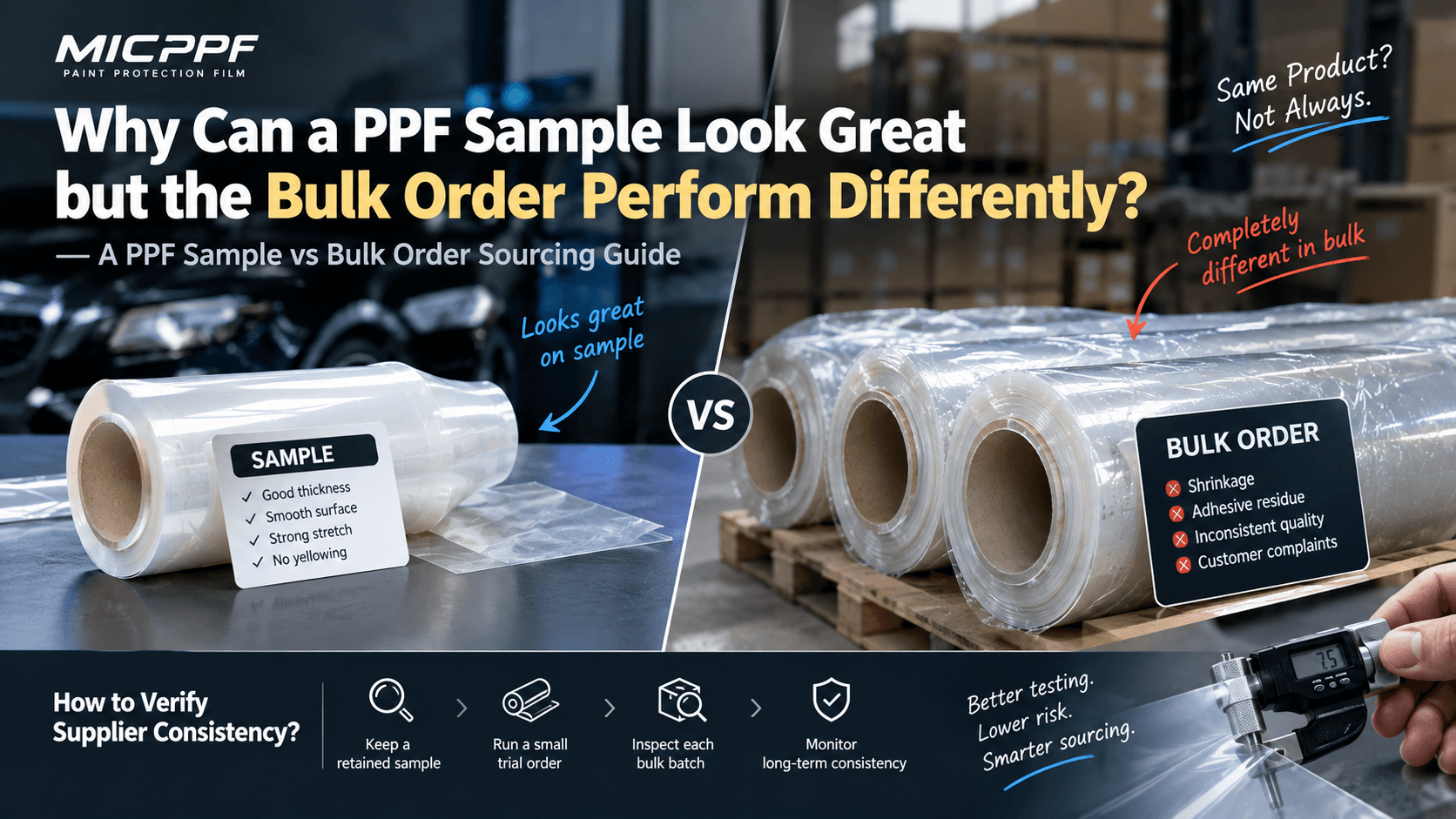
A good sample does not mean the whole batch will be good — a point we covered in detail in our earlier article, “Why Do Samples and Bulk Orders Perform Differently?”
The safe approach is to place a small trial order first, and scale up only after several consecutive rolls prove stable. What this step saves you is usually the most expensive rework down the road. Do not chase a little extra payment terms or discount — a stable supply is worth more than anything.
If you are looking for a stable PPF supply, you are welcome to talk to us. We do PPF OEM and wholesale, and we will walk you through our raw materials, processes, and batch control openly. We can also send samples first so you can test them on an opened roll. Anyone can write a spec sheet; installation performance does not lie.
FAQ
1. Why do two PPF rolls with the same specs differ so much in price?
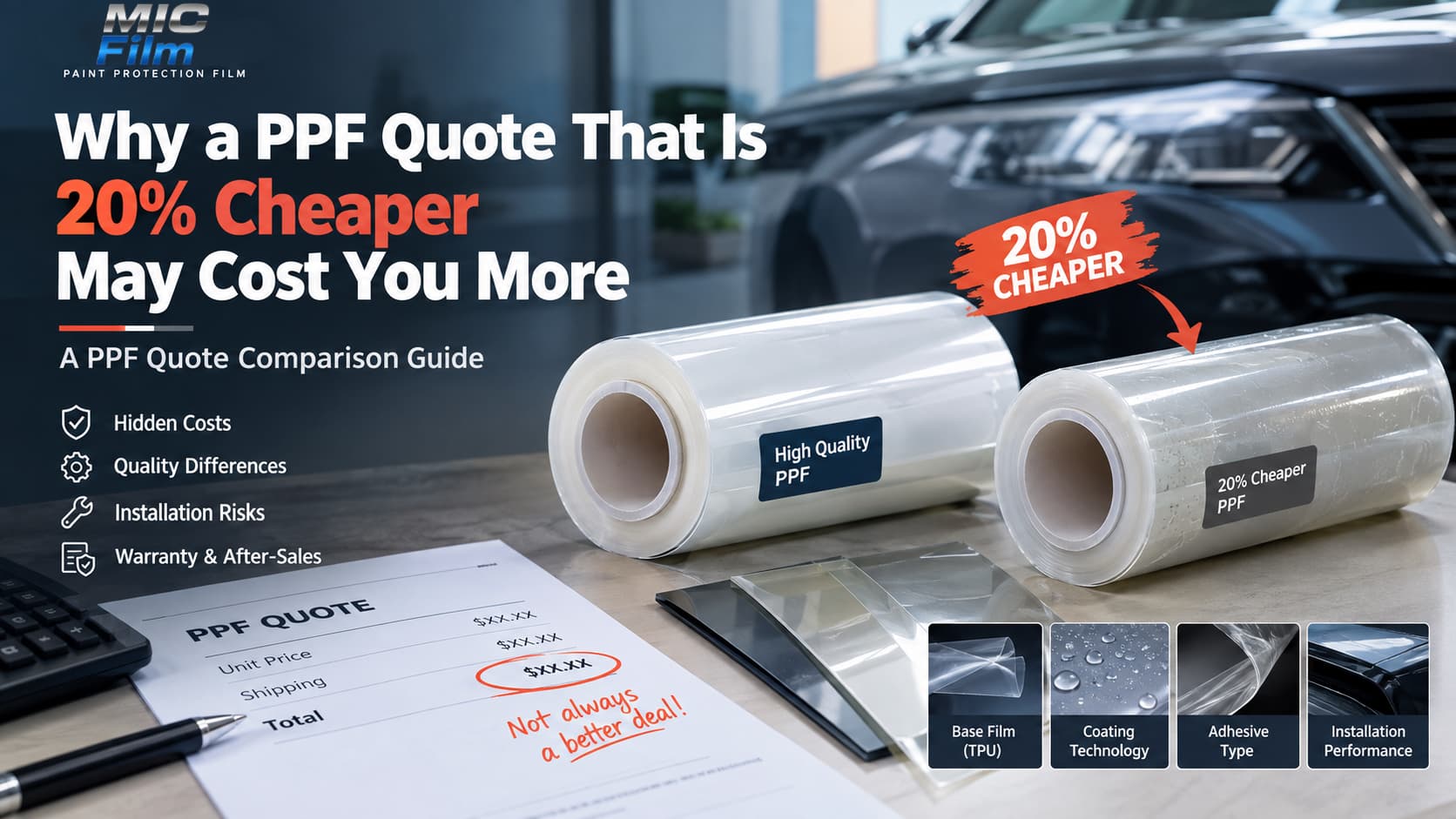
The spec sheet reflects nominal performance. The real cost difference comes from raw material grade, adhesive formulation, coating process, and batch consistency — these “invisible factors” are the main source of the price gap. A price difference almost always means a quality difference, with basically no exceptions.
2. How do you tell whether the adhesive on a roll of PPF is good?
The most direct way is actual installation: moderate initial tack, smooth air release, the ability to lift and reapply when misaligned, and edges that do not lift. Before purchasing, you can also ask the factory directly about the adhesive source and coat weight control. If they cannot answer, do more testing yourself.
3. Is it normal for PPF from the same factory to feel different from batch to batch?
No, it is not. Batch consistency is a core capability of PPF quality control. If the feel varies from batch to batch, it means the factory’s process control has problems — be cautious about sourcing from them.
4. Is the thickness on the spec sheet accurate?
Thickness is a nominal value and comes with a tolerance range. More important than thickness is uniformity — film with poor uniformity thins out locally when stretched, compromising both protection and installation performance.
5. What reports should buyers request from a PPF factory?
At minimum: TPU raw material information (grade and source), COA (Certificate of Analysis), batch test data, and weathering test reports (such as UV aging tests). If a factory cannot even provide these reports, weigh the risk yourself.
References
- KSB Window Film — How Paint Protection Film Is Manufactured (PPF manufacturing and quality control process)
- MTek PPF — Best Paint Protection Film (PPF) Brands 2026: Professional Installer’s Guide to Quality & Value (batch consistency and installation characteristics)
- Highcool — PPF Thickness: 9 Shocking Truths Most Buyers Miss (the relationship between installation quality and film quality)