I once accompanied a friend to audit a factory in southern China. The sales rep pounded his chest and said, "We can do anything in OEM." When my friend asked whether they could make an 8.5 mil matte film, the rep said, "Let me check with our technical team." When asked for the test reports of the last three batches, he said, "Let me find them." A look around the workshop showed it was just a slitting and packaging line — the film was brought in from elsewhere, and they shipped it out after putting it in a new box and printing a logo on it.
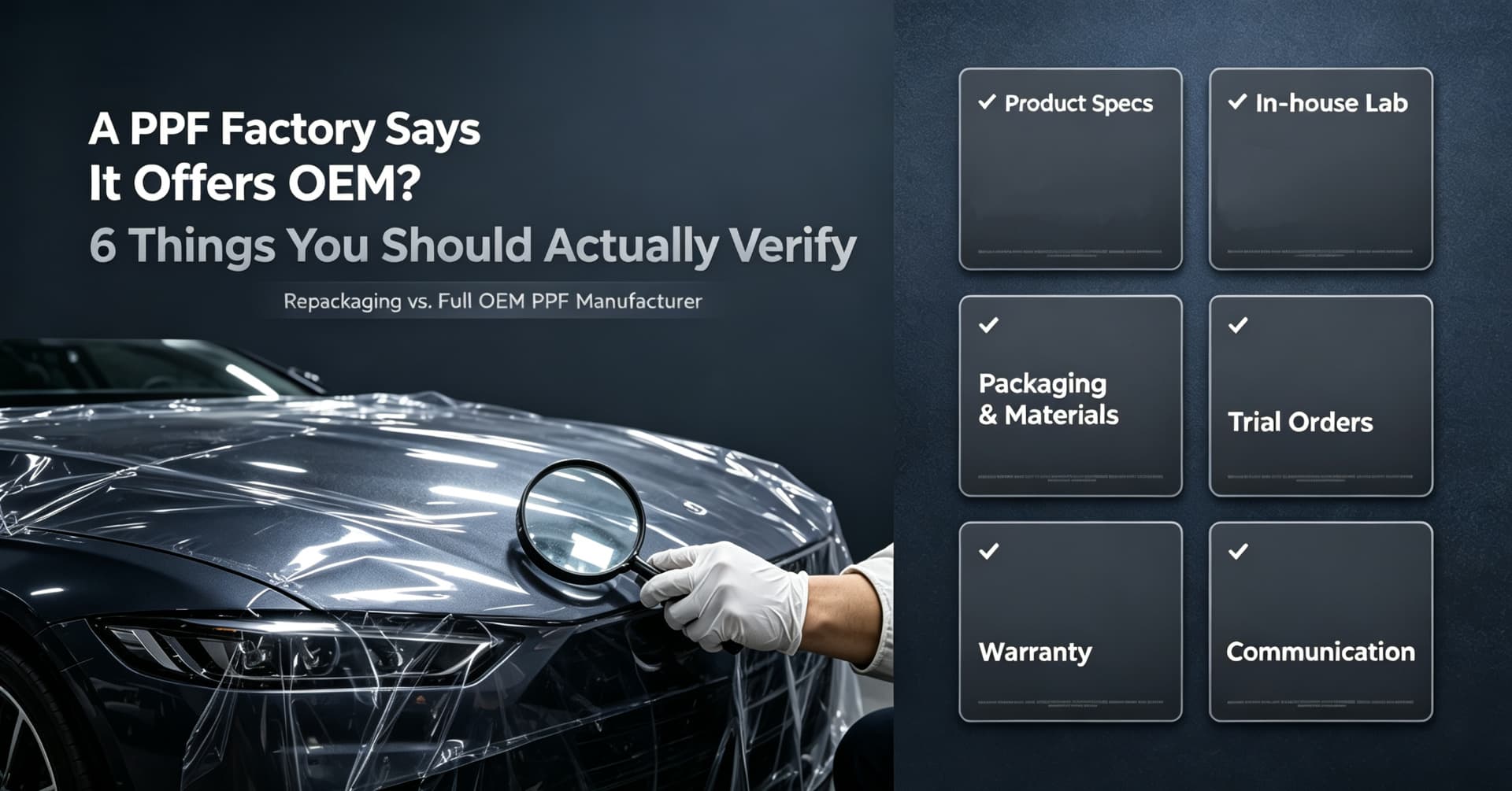
Factories like this are everywhere. Ask ten PPF suppliers and nine will say "we can do OEM" — but the substance behind that claim varies wildly. Some only repackage; others can work through your entire requirement, from film thickness to installation toolkits. Before you source, these are the 6 things you must verify.
1. Why "We Can Do OEM" Says Almost Nothing
Printing a logo has a low barrier — anyone can do it. But the essence of OEM is manufacturing to your requirements: adjusting thickness, changing the adhesive, producing a full set of packaging materials, and supporting small-batch trial orders. Few factories can do all of that. Don't mistake "we can print your logo" for "we can run a full OEM program." Instead, ask how deep their OEM capability actually goes.
To tell a real factory from a trading company, see our guide:Factory vs. Trading Company: How to Tell
2. Can They Adjust the Product Specs? An OEM PPF Factory Is More Than a New Box
The core question: can the film itself be adjusted to your requirements?
A repackaging-type supplier only lets you pick from existing stock film — thickness, finish, and adhesive cannot be changed. A full OEM PPF manufacturer can tailor the film to your market: thickness options of 6.5, 7.5, 8.5, and 10 mil; finishes in gloss, matte, or satin; and fine-tuning of topcoat hydrophobicity, adhesive strength, and anti-yellowing formulation.
Ask these three questions directly:
· What thicknesses and finishes are available? Is there test data for each spec?
· Can the adhesive or topcoat be adjusted for my market? What is the MOQ for changes?
· Whose TPU raw material do you use?
Raw material matters. Globally, the TPU used in PPF comes mainly from a handful of chemical companies, and Covestro is one of the largest suppliers. A factory that can name its raw material source is far more reliable than one that vaguely says "imported raw material."
Our Master Series TPU PPF uses Covestro raw material, offers four thickness options, and supports OEM customization and small-batch trial orders:Master Series TPU PPF product page
3. Do They Have an In-House Lab and Batch Consistency Control?
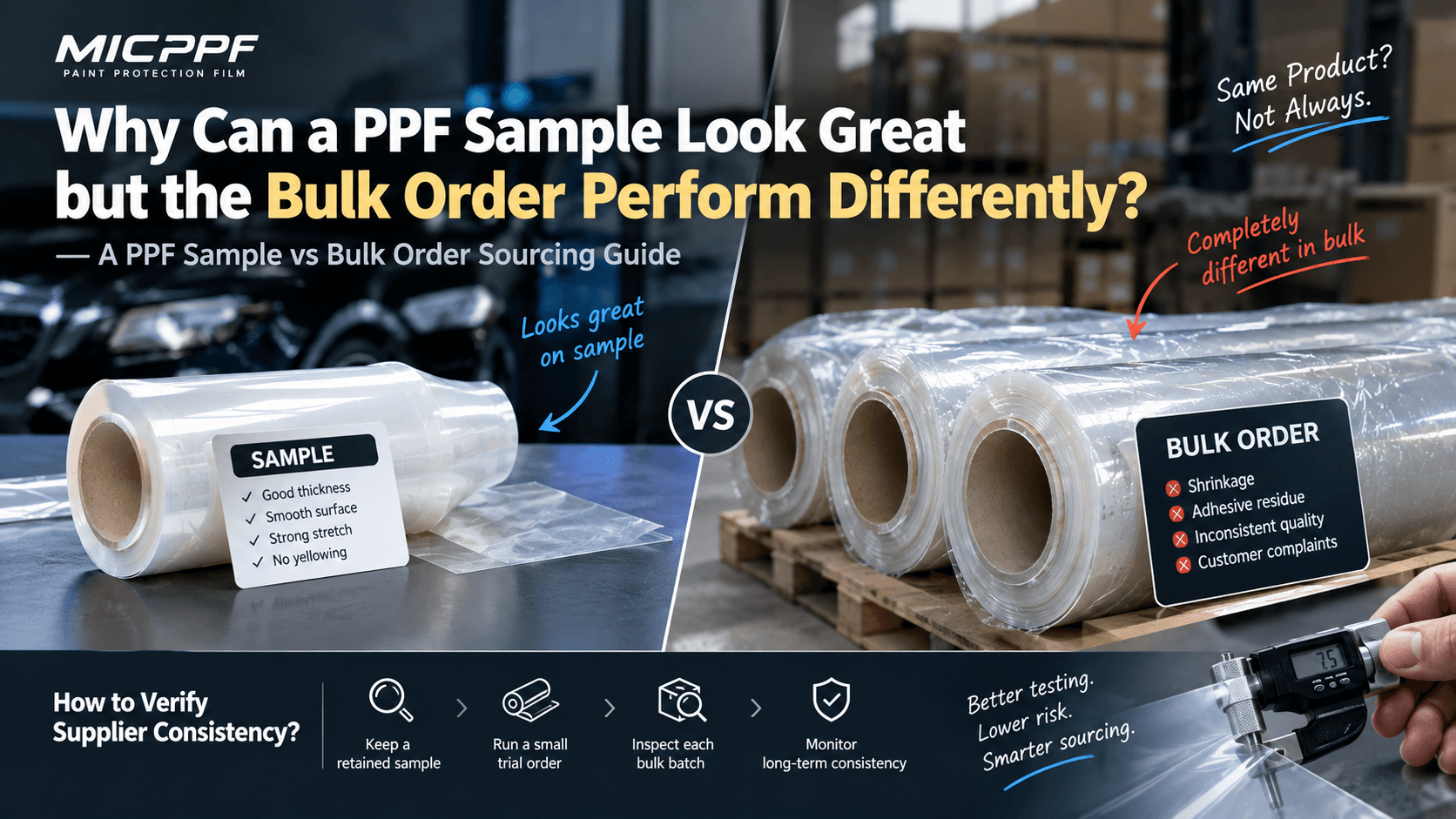
A good sample does not mean consistent bulk production — this is the most common pitfall. The sample looks great, but when the bulk order arrives, the orange peel is heavier and the adhesive smells different. The factory says "minor batch variation is normal." That is nonsense — wide variation means no quality control.
A genuine OEM PPF factory has an in-house lab running weathering tests (QUV and xenon-arc aging), yellowing index, adhesion, and chemical resistance tests, with reports for every batch. Ask three questions: Is there a QC report for every batch? What is the variation range of key indicators between batches of the same model? How do they handle it when bulk goods differ from samples?
4. Can Packaging and Printed Materials Meet Your Standard? The Full Package for Private Label PPF
Many people think OEM is just printing a logo, but packaging and printed materials are actually where problems most often occur. I have seen a client receive bulk goods with warranty cards printed with the wrong model and instruction manuals on paper so thin the text showed through — the factory said "that is the printer's problem," and they argued for a month.
A complete package includes the full hierarchy of inner box, master carton, export packing, and pallet standards; stickers, QR labels, warranty cards, and manuals; plus installer and dealer kits such as squeegee sets and showroom samples. A repackaging-type factory can only do simple carton printing — complex materials are either out of scope or outsourced. A full OEM factory assigns dedicated staff to manage the process end to end.
For how to allocate your first investment in a private label PPF brand, see our cost breakdown:
Private Label PPF Startup Cost Breakdown
5. Small-Batch Trial Orders and Flexible Supply
Nobody wants to commit a large stock investment up front. A repackaging-type factory has a high MOQ — hundreds of rolls to start. Ask for 30 rolls to test the market, and they will say "minimum 200." A genuine OEM PPF factory supports small-batch trial orders, so you can test the market first and scale up later.
Confirm four things: What is the MOQ? What are the lead times for trial orders and formal orders? Is replenishment stable? Is capacity guaranteed during peak season? Our Master Series supports small-batch trial orders, with standard rolls of 1.52 m × 15 m:Master Series PPF product page
6. Who Bears the Warranty and After-Sales Responsibility?
The film carries your brand, so when problems arise, customers come to you. I have seen a brand owner with one batch of film yellowing extensively; the factory blamed "installation and environmental issues." After half a year of disputes, the brand owner paid out over a hundred thousand on his own — because there was no written warranty. The sales rep had said "10-year warranty" verbally, but verbal promises count for nothing when problems actually occur.
Confirm: How many years of warranty (5–10 years is typical in the industry)? Which defects are covered? What evidence is required for a claim, and how long does the process take? Is compensation paid in replacement film or deducted from the next order? Is there a dedicated after-sales contact? A full OEM factory puts the warranty in writing in the contract; a repackaging-type factory keeps terms vague and shifts blame.
For MIC Film's OEM services and warranty system, see our About Us page:About Us (OEM services and warranty)
7. Communication Response and Project Cooperation
OEM is project-based with many details. With a factory that communicates poorly, you will have to chase them three times at every step, and the project can drag you down. Good factories reply within half a day, proactively raise issues with you, and are willing to work overtime to hit a trade-show deadline. Bad ones take three days to reply, and when they do, it is just "let me check." After three chases, they finally say "we cannot do it" — where were they all along?
Check: Is there a dedicated point of contact? How fast is the email/WhatsApp response? Can they work around your timeline? Do they communicate proactively when problems arise, or wait for you to chase them? If they are slow to respond at the sampling stage, do not expect things to improve with bulk orders.
Currently evaluating suppliers? Feel free to contact us and talk directly:Contact Us
One Table: Repackaging vs. Full OEM PPF Manufacturer
Compare the six dimensions in one table — take it with you when sourcing, and you will know right away which item a supplier cannot answer:
Dimension | Repackaging-Type OEM | Full OEM PPF Manufacturer |
|---|---|---|
Product specs | Only existing stock film; cannot be changed | Thickness/finish/topcoat/adhesive tailored to your market |
In-house lab | Usually none | Weathering/yellowing/adhesion/chemical resistance tests with per-batch reports |
Packaging & materials | Carton printing only | Full inner-box/carton/export/pallet system plus printed materials |
Dealer kits | Basically none | Warranty cards/toolkits/showroom samples provided |
Trial orders | High MOQ; not supported | Small-batch trial orders supported; test market first, then scale |
Warranty backing | Vague terms; shifts blame | Warranty in the contract; clear process and responsible party |
Project management | No dedicated follow-up | Dedicated contact; timely response |
Conclusion: Finding an OEM PPF Factory Is Not About "Can You" but "How Deep Can You Go"
Next time a factory says "we can do OEM," go through all six dimensions one by one. Those that can answer, back it up with data, and support small-batch trials are the real deal. Those that know nothing and only repeat "our price is competitive" are most likely the repackaging type — and when the film fails, you carry the burden alone.
MIC Film provides full OEM/private label support: Covestro raw material, per-batch QC before shipment, and warranty of up to 8 years. Contact us for samples — test first, then talk business:Contact us for samples and OEM solutions
FAQ
Q1: What is the difference between OEM PPF and private label PPF?
OEM emphasizes manufacturing to your specifications, while private label emphasizes selling under your brand. In the industry, the two are often used interchangeably: OEM leans toward product specification customization, and private label leans toward brand and packaging customization. A complete project usually includes both — what matters is how deep the factory's capability goes.
Q2: What is the typical MOQ when sourcing from an OEM PPF manufacturer?
It varies widely. Repackaging-type factories usually start at several hundred rolls, while genuine OEM factories typically support small-batch trial orders. It depends on the specifications and packaging complexity — confirm your requirements directly with the factory before discussing MOQ, and do not rely on a vague number.
Q3: How do you tell whether a PPF factory can truly do OEM or just repackages?
Ask three questions: Can they adjust the product specs? Do they have an in-house lab and per-batch QC reports? Can they do small-batch trial orders? If none of these can be answered clearly, they are most likely just the repackaging type. For more detail, see our guide:
Factory vs. Trading Company: How to Tell
Q4: How does OEM PPF warranty usually work?
In the TPU PPF industry, warranties are typically 5–10 years, covering production defects such as yellowing, cracking, delamination, and bubbling, but not improper installation or man-made damage. Before cooperating, make sure the factory provides written warranty terms and put them in the contract — verbal promises are not binding.
Q5: Where should I start with my first private label PPF project?
Start by testing samples from several factories (clarity, orange peel, hydrophobicity, adhesive, stretchability), shortlist 2–3 candidates, then discuss specifications, packaging, MOQ, lead times, and warranty. Finally, place a small-batch trial order to verify bulk quality. Do not commit to large stock up front. For the first-investment breakdown, see:
References
- https://www.covestro.com/en/company/covestro-worldwide/taiwan/media/covestro-will-expand-its-paint-protection-film-capacity-in-2023
- https://www.covestro.com/press/covestro-inaugurates-new-production-line-and-launches-new-desmopanup-tpu-series-for-paint-protection-film-in-the-automotive-and-wind-sector/
- https://solutions.covestro.com/.../tpu-brochure--putech-india.pdf