A practical checklist for distributors: verify the manufacturer's storage terms, protect the roll in your warehouse, and keep the evidence you need if a roll misbehaves on the install bay.
Paint protection film is an adhesive-coated, liner-backed product. Its performance at installation depends as much on how the roll was stored as on how it was made. Adhesive behaviour, liner release and film clarity can all be affected by moisture, heat and sunlight — and when a roll misbehaves, the distributor usually absorbs the cost: replacement film, freight, installer downtime and the relationship.
The commercial risk is simple. If you buy wholesale rolls without a written storage and shelf-life position from the manufacturer, you have no defensible basis for a claim later. The manufacturer's current technical data sheet (TDS) or product data sheet (PDS) is the reference — not a sales email, not a verbal answer, and not a number carried over from a previous product generation.
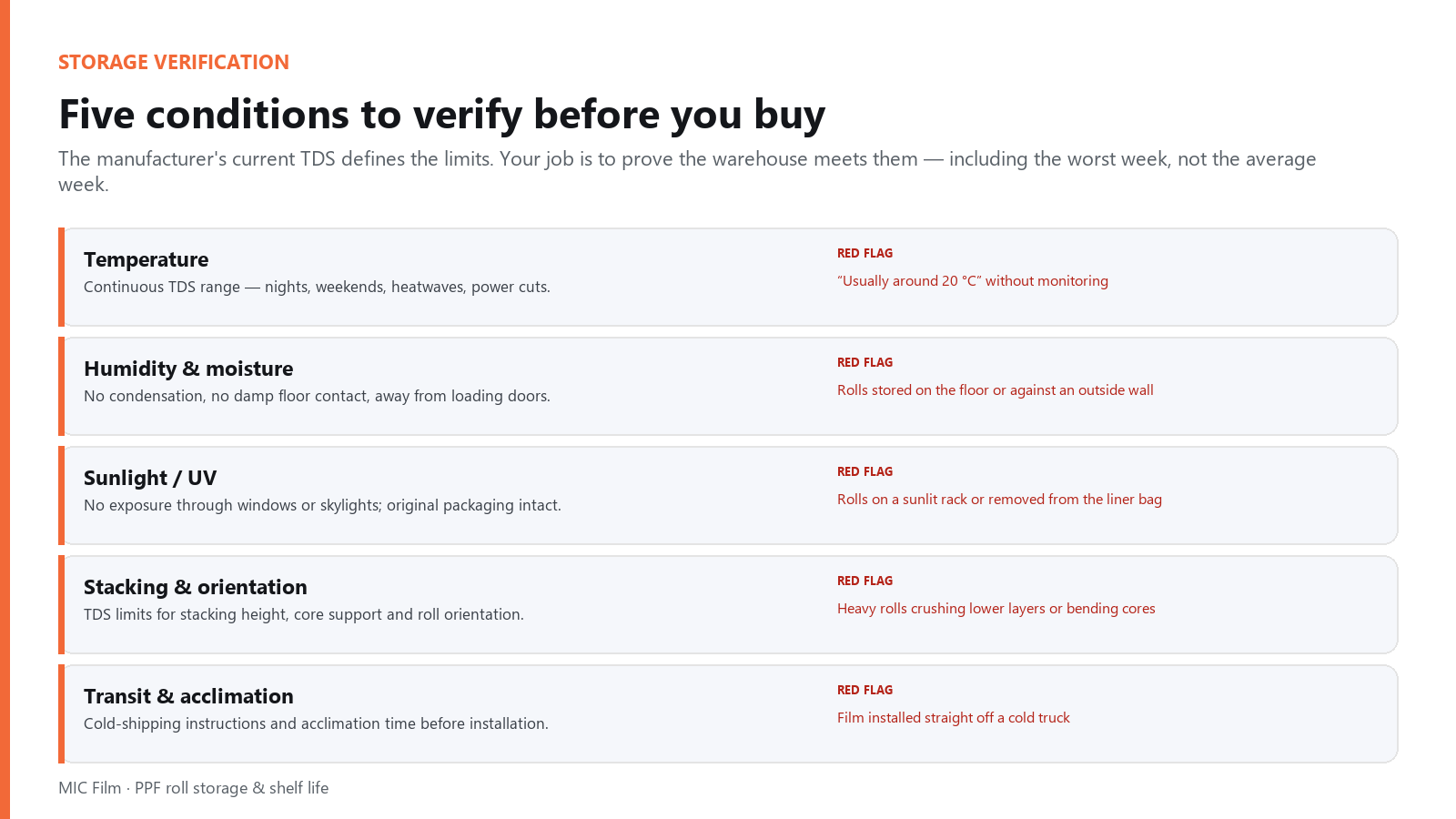
Figure 1 — Verify these five conditions against the current TDS, not against an average week.
What shelf life actually means
Shelf life is the period the manufacturer defines for a product to remain usable under stated storage conditions. It is not a universal number, and it does not restart when the roll changes hands.
Three points matter for a distributor:
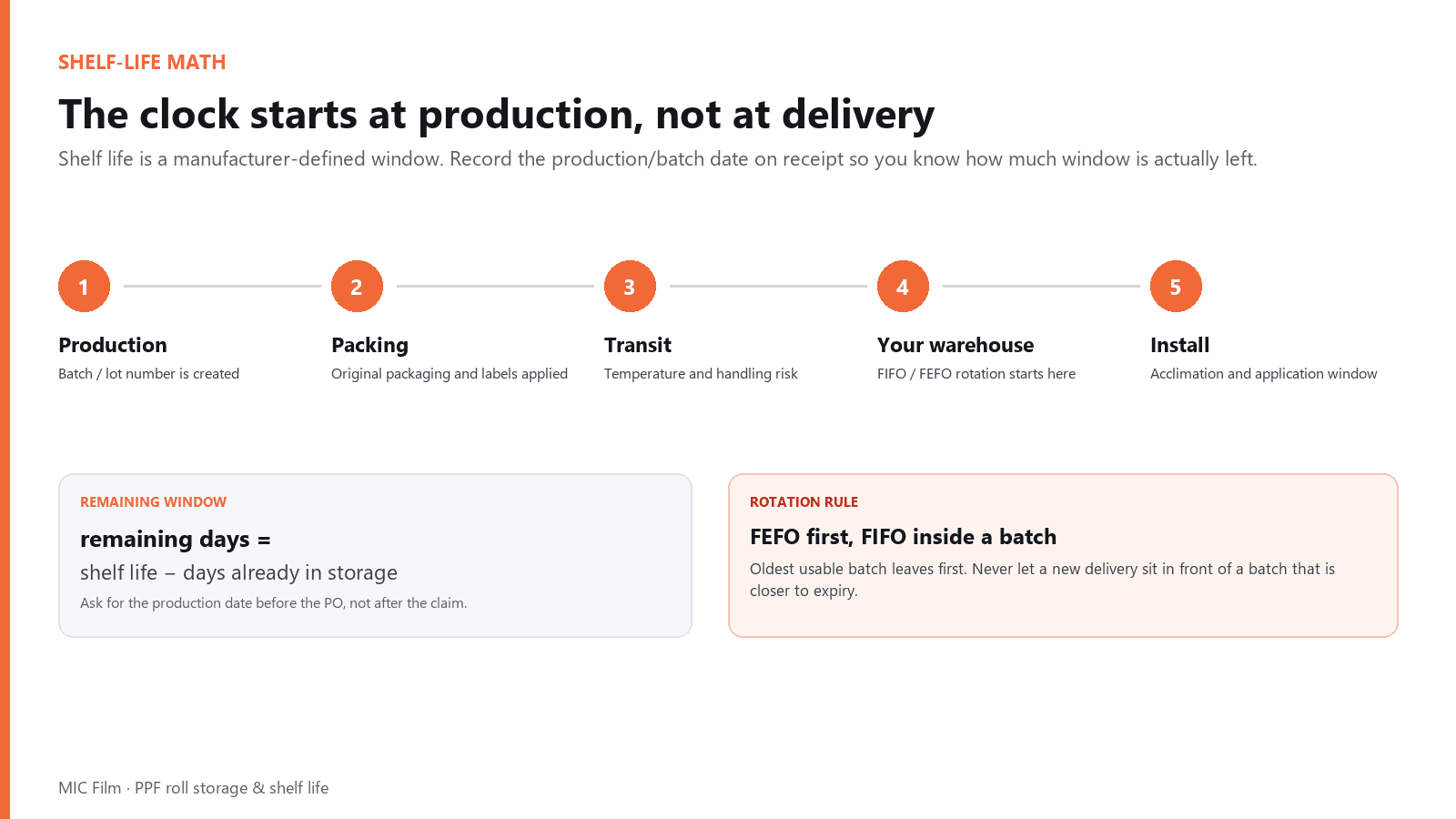
- The clock starts at production, or at the point the manufacturer defines. Ask for the production or batch date, not just the delivery date, so you know how much window is left.
- The TDS defines the storage conditions that keep the shelf life valid. A warranty that assumes controlled storage is only useful if you can prove controlled storage.
- A batch or lot reference is the link between the roll in your warehouse and the production run. Without it, a claim becomes a conversation about opinions. The same evidence discipline is what a remote supplier audit is built on.
When you buy a new product generation, request the current TDS revision. A storage number from last year's sheet may not apply to a new adhesive or liner.
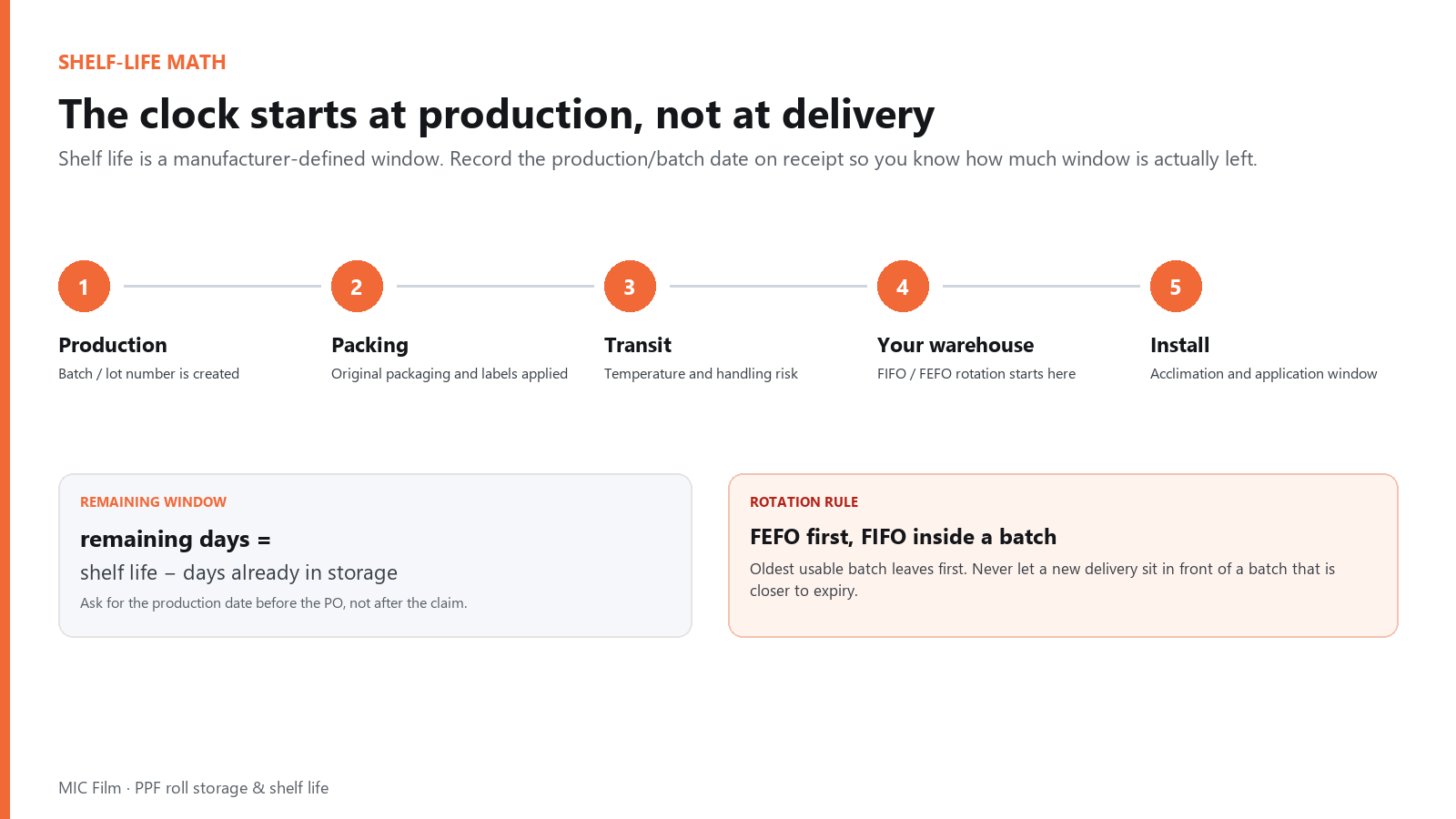
Figure 2 — Shelf life runs from the manufacturer's defined start point; rotation starts when the roll enters your warehouse.
Five storage conditions to verify
The specific limits — temperature range, humidity, maximum duration, roll orientation and stacking height — must come from the manufacturer's current TDS. Do not publish your own numbers to installer customers. What you can do is verify that your warehouse actually meets the stated limits.
| Condition | What to verify | Red flag |
|---|---|---|
| Temperature | Continuous TDS range — nights, weekends, heatwaves and power cuts included | "Usually around 20 °C" with no monitoring |
| Humidity and moisture | No condensation, no damp floor contact, away from loading doors | Rolls on the floor or against an outside wall |
| Sunlight and UV | No exposure through windows or skylights; original packaging intact | Rolls on a sunlit rack or removed from the liner bag |
| Stacking and orientation | TDS limits for stacking height, core support and roll orientation | Heavy rolls crushing lower layers or bending cores |
| Transit and acclimation | Cold-shipping instructions and acclimation time before installation | Film installed straight off a cold truck |
Two practical checks distributors skip:
- Audit the worst week, not the average week. A warehouse that meets a temperature range in spring may fail in a heatwave, a cold snap or a long weekend with the HVAC off. Use a data logger and review the minimum and maximum, not the daily average.
- Check the transit chain. Ask the manufacturer whether film should acclimatise after cold shipping, and pass that instruction to installers in writing. A roll that sat in a cold container overnight is not the same roll at the moment it is unloaded.
If your market imposes additional rules — insurance, customs or customer specifications — document them alongside the TDS. The stricter requirement wins.
Warehouse layout that makes FIFO automatic
Storage discipline is a layout problem before it is a paperwork problem. If the rack does not tell the picker which roll to take, the oldest batch will stay at the back until it is too late.
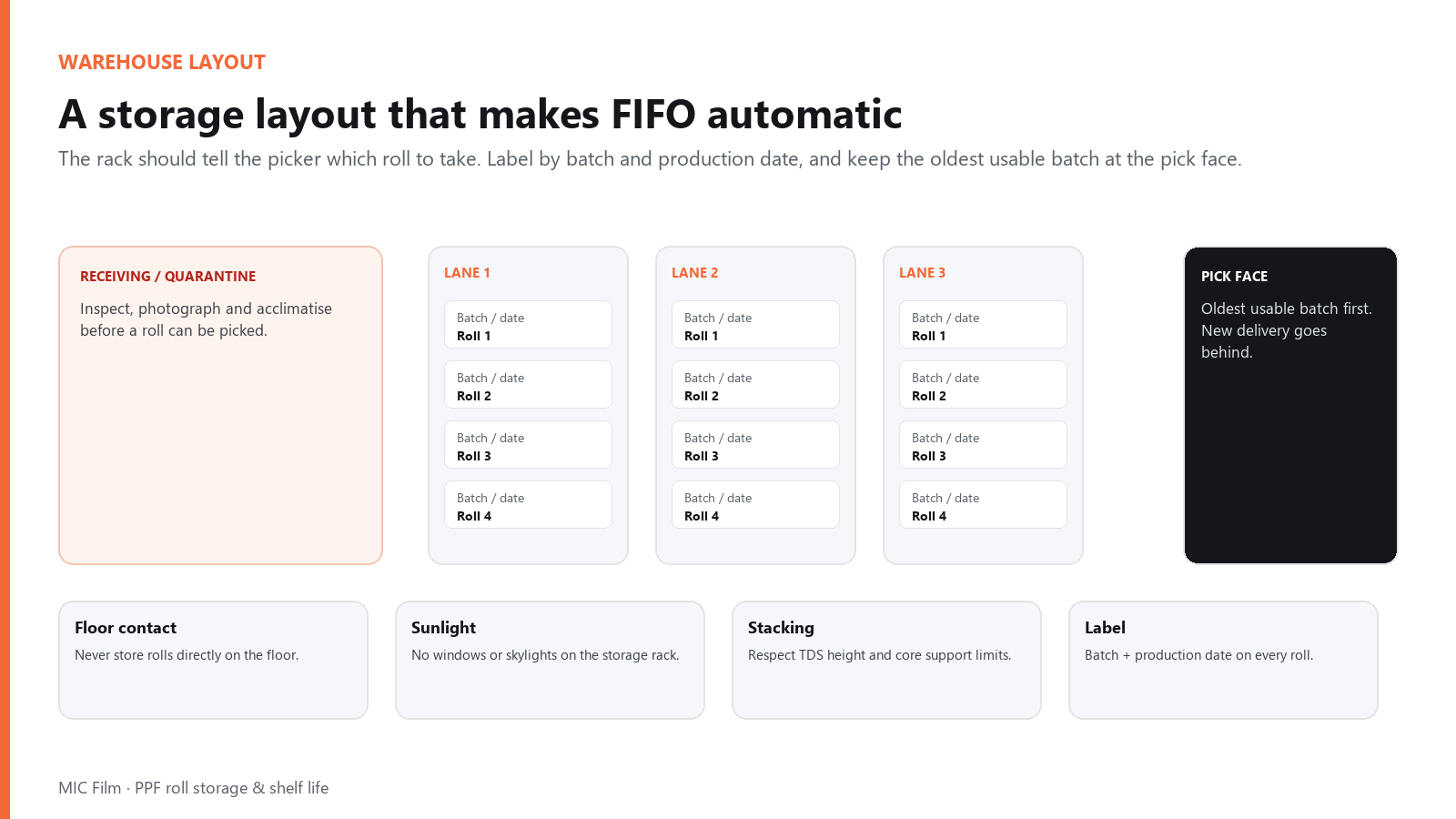
Figure 3 — Separate receiving/quarantine from saleable stock, label every roll by batch and date, and keep the oldest usable batch at the pick face.
A workable layout has four zones:
- Receiving / quarantine. Rolls are inspected and acclimatised here; nothing is picked until it is released.
- Storage lanes. Each lane labels the batch and production date, not just the SKU. New deliveries go behind the current pick face.
- Pick face. The oldest usable batch sits here. FEFO (first-expired, first-out) wins over plain FIFO when batches have different remaining windows; inside one batch, FIFO is enough.
- Non-saleable / claim area. Damaged or suspect rolls are quarantined with photos and paperwork attached, not returned to the rack.
Label every roll with: product code, batch/lot, production date, receipt date and remaining shelf-life window. A label that only says "7.5 mil clear" cannot support a rotation decision.
Receiving inspection: six checks before a roll enters saleable stock
Do this at goods-in. Once the film is installed, you lose the ability to demonstrate that the fault arrived with the shipment.
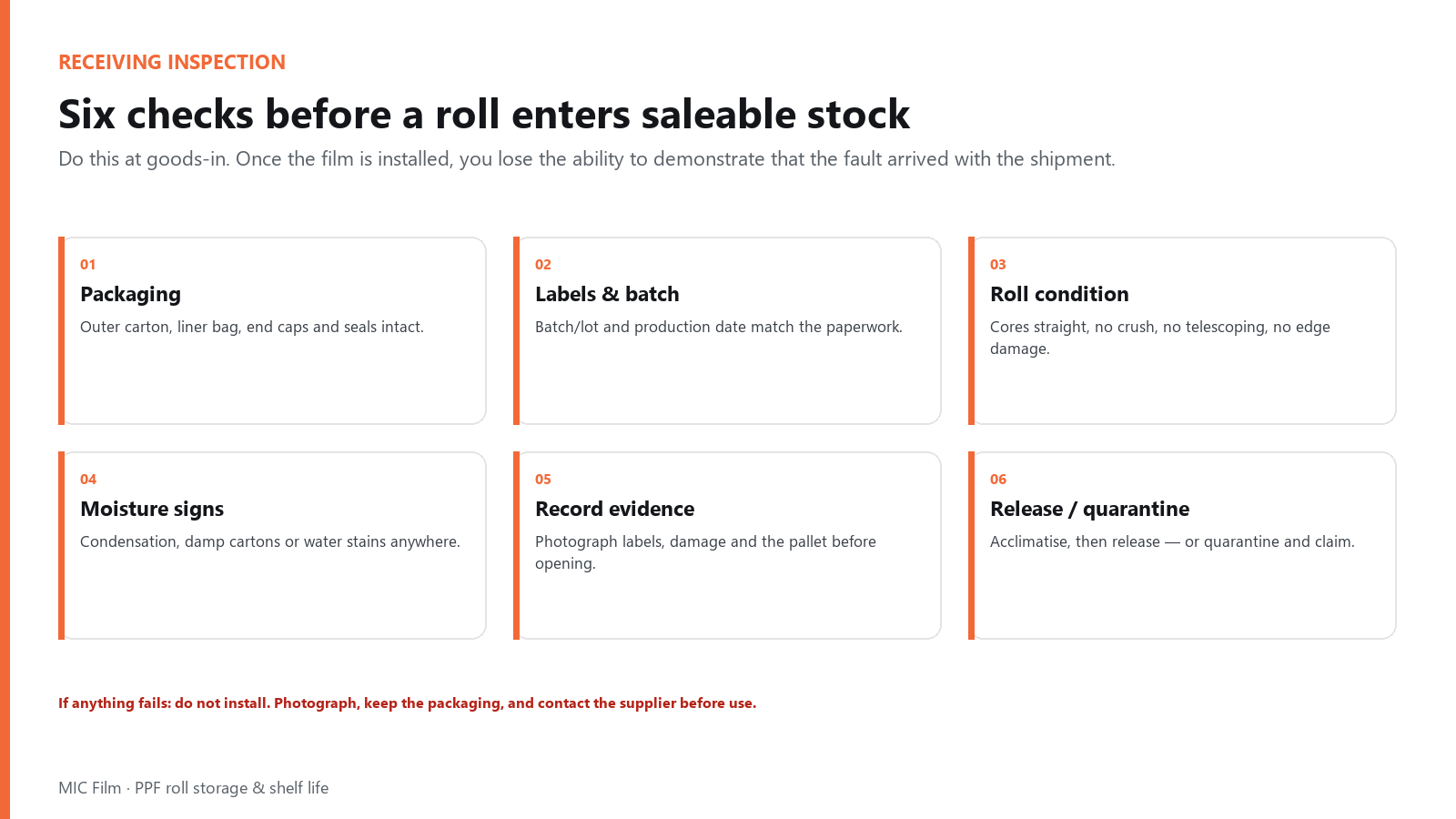
Figure 4 — Photograph the labels and any damage before opening; that evidence is the difference between a resolved claim and a write-off.
- Packaging. Outer carton, liner bag, end caps and seals intact. Note any crush or water stain on the pallet.
- Labels and batch. Batch/lot and production date match the packing list and the TDS revision you ordered.
- Roll condition. Cores straight, no crush, no telescoping, no edge damage. Check a sample from each pallet, not only the top roll.
- Moisture signs. Condensation inside the liner bag, damp cartons or water marks are stop signs. Do not assume the film is fine because the outer wrap looks dry.
- Record evidence. Photograph labels, the damaged area and the pallet before opening. Keep the photos with the purchase record.
- Release or quarantine. If everything matches, acclimatise per the TDS and release to stock. If not, quarantine and contact the supplier before use.
The pre-order document pack
Before confirming a wholesale order, request and file the following. Each item should be current, dated and specific to the product and batch you are buying.
| Document | What it gives you | What to check |
|---|---|---|
| TDS / PDS | Storage conditions, shelf life, handling, installation environment | Revision date and product generation match the order |
| Written shelf-life statement | The manufacturer's position for this product | References the TDS revision and the batch/production date |
| Warranty terms | What is covered, what storage conditions the warranty assumes | Claim window, exclusions, required evidence |
| Roll specifications | Width, length, thickness, core and packaging | Matches the quote and the purchase order |
| Batch traceability | Batch/lot on the roll and on the paperwork | Lets you tie a problem roll back to a production run |
| Storage and transport guidance | Acclimation, stacking, cold-chain notes | Passed to your warehouse and installers in writing |
Keep this pack with the purchase record. If a claim arises, the difference between a documented order and an undocumented one is usually the difference between a resolved claim and a write-off. The same documentation discipline applies when you compare film specifications before committing to a range and when you calculate the real cost of buying direct versus through a distributor.
Common storage mistakes
- Trusting a verbal shelf life. If it is not in the current TDS or a written statement, it is not a term you can enforce.
- Storing on the floor. Floor contact invites moisture and condensation; pallets and racking exist for a reason.
- Letting sunlight reach the rack. UV through a window or skylight is easy to miss and hard to reverse.
- Ignoring the worst week. A single heatwave or cold snap can exceed the TDS range even when the monthly average looks fine.
- Selling without a remaining-window number. The installer needs to know how much shelf life is left, especially for a large project.
- Installing a suspect roll to "see if it works". That removes your ability to demonstrate the fault. Quarantine first — the same rule applies to two rolls that look identical on the spec sheet.
- Treating shelf life as a warranty start date without checking the terms. Shelf life and warranty are different clocks; read both documents.
A 30-minute storage audit for your own warehouse
- Pull the current TDS for your top three SKUs and write the storage limits on one page.
- Review the data logger for the last 90 days: minimum, maximum and any excursions.
- Walk the rack: floor contact, sunlight, stacking height, labels, expired batches.
- Check three random rolls: batch, production date and remaining window.
- Review the receiving log: photos, batch references and quarantine decisions.
If any item fails, fix the physical condition first, then the paperwork. A perfect shelf-life statement cannot protect a roll that was stored on a damp floor.\n\n## Next step\n\nIf you are shortlisting suppliers, ask for the current TDS, the written shelf-life statement and a batch sample before you raise the purchase order. Our PPF range and contact page list the documents and samples we can provide; ask for the same pack from any supplier you compare.
FAQ
Q1: How long can PPF rolls be stored?
There is no universal figure. Shelf life is defined by the manufacturer for each product and stated in the current TDS. Use that figure, and record the production date and the date the rolls enter your warehouse so you can calculate the remaining window.
Q2: Can I store rolls in an unheated or uncooled warehouse?
Only if the space stays within the manufacturer's stated temperature and humidity range. Verify this with monitoring rather than assumption, and account for seasonal extremes, weekends and power interruptions.
Q3: Does shelf life reset when the roll is shipped to me?
No. Shelf life runs from the point the manufacturer defines, not from your receipt date. Ask the supplier for the production or batch date so you know how much storage window remains.
Q4: What should I do if a roll arrives out of specification or damaged?
Do not install it. Record the batch reference, photograph the packaging and roll, keep the packaging, and contact the supplier before use. Installing the film removes your ability to demonstrate the fault.
Q5: Who owns the storage rule — manufacturer or distributor?
The manufacturer defines it in the TDS. The distributor's job is to meet it and to be able to prove it with records, monitoring and training.
Q6: What is the difference between a TDS and a PDS?
A technical data sheet (TDS) carries the technical detail, including storage, handling and installation conditions. A product data sheet (PDS) is often a shorter commercial summary. When they disagree, use the current TDS revision for storage and warranty questions.
Q7: How should I monitor warehouse conditions?
Use a calibrated data logger with min/max recording and an alarm, placed at the rack — not only at the office wall. Review the log monthly and after any heatwave, cold snap or power failure. Keep the logs with the batch records.
Q8: Can I sell a roll that is close to the end of its shelf life?
Disclose the remaining window to the buyer, follow FEFO rotation, and check the warranty terms before you sell it. A short remaining window is a commercial decision; hiding it is a claim waiting to happen.