If you run an installation shop, chances are you have asked yourself the same question: it is all PPF, so why not buy directly from the factory? The factory price is right there, noticeably lower than going through a distributor. Why let a middleman take the spread?
The question itself is fair. But over the years I have seen plenty of shops get excited about bypassing distributors to deal directly with a factory, only to come back around after going through the whole ordeal. It is not that the factory product is bad; it is that they did not count all the costs.
Buying direct from the factory does save money, but only if you can handle three things: purchase volume, inventory pressure, and local service. This article breaks the two routes down using these three cost items. If you want to see what our product line looks like first, feel free to browse our homepage.
1. Why the factory price is lower
Let us start with how a "factory price" comes about. The PPF wholesale logic is straightforward: the higher the volume, the lower the unit price. Factories ship by the roll and by the pallet. They do not have to support a sales team, stock regional inventory, or provide local service. Part of the cost savings gets passed on to you. Cut out the distributor layer, and in theory you get the factory-gate price.
The PPF market has been growing over the past few years. Grand View Research puts the global PPF market at roughly USD 528 million in 2025, with a projected 4.3% compound annual growth rate from 2026 to 2033; Fortune Business Insights shows a larger market size and faster growth. The material mix is also concentrated—Market.us reports that TPU paint protection film accounts for about 75% of the market. With the market heating up, it is no surprise that more installers want to cut out the middleman and buy PPF directly from a factory.
But a "factory price" comes with strings: you have to meet the factory's threshold. MOQ, payment terms, and lead time—miss any one, and that cheaper price does not apply to you. Walk in with 5 rolls and ask for a wholesale price, and the quote you get probably will not be cheaper than going through a distributor.
2. PPF wholesale: the MOQ is the first hurdle
The factory minimum order quantity (MOQ) is the first hurdle. Many factories set a relatively high MOQ; exactly how many rolls depends on the product and packaging requirements. If you only move a dozen or twenty rolls a month, to hit the MOQ you often have to take on specs you do not normally sell.
I have seen shops do the math carefully: the factory quote really is cheaper, quite a bit off per roll. But when the first shipment arrived, they realized they could not actually move that many SKUs. In the end, they saved on unit price and lost on inventory.
The calculation is not complicated. Pull your shipment records from the last three months, work out how many rolls you average per month, and count how many specs actually sell regularly. Shops with stable volume and high per-spec throughput have the leverage to negotiate with factories. Shops with low volume and mixed specs are better off ordering as needed from a distributor—buy what you use, and do not tie up cash.
3. Inventory and cash flow: the costs people forget
This is where most shops trip up. Buying directly from a Chinese factory by sea freight, from order placed to goods arriving at port, a month is the baseline. If you ship only a few rolls by air, the price saving can easily get eaten up by logistics. I have seen one of the most troublesome shops split a shipment—half sea, half air—trying to cover both ends. In the end, freight plus container rental cost more than buying through a distributor.
Replenishment cycles shift from "by the day" to "by the month," and the most direct consequence is stockouts. When a fast-moving spec runs out, customers go to the shop next door, you lose the order, and you earn a reputation as "that shop that cannot even keep film in stock."
Then there is the cash. A full container sitting in your warehouse eats into your working capital, and the shop renovation, tools, and labor—none of it comes free.
What a distributor actually does, in plain terms, is carry the inventory risk for you. Aftermarket channel research has spelled this out: distributors stock in bulk and push product out regionally, so downstream shops always have product on hand and can replenish as needed. Whether you save that spread depends on how much one stockout costs you.
Side note: some factories now run local warehouses in Europe, with replenishment in three to seven days—an order of magnitude faster than traditional sea freight. If your volume is solid and stockouts are your biggest fear, just ask "do you have overseas warehouses" when you approach factories; it does not hurt to ask.
4. Local service: who handles problems
Film is a semi-finished product; what customers actually pay for is the finished installation. Installation training, plotter patterns, installation issues, and after-sales disputes—none of these are solved by a roll of film on its own. Buying direct from the factory, you are mostly on your own with these. The factory is in China, you are in Europe or North America—time difference, one after-sales round trip, and several days have gone by.
Another reason distributors exist is localization. When film has a problem, you have someone you can actually reach, local stock you can swap from, and a peer network you can ask. These things look minor day to day, but when a customer is standing in your shop demanding compensation, you will know what they are worth.
5. Distributor vs. factory: which kind of shop are you?
Not every shop is a fit, but some clearly are. Run through this list:
· Stable monthly volume, high throughput on a single spec, able to meet the factory MOQ;
· Your own brand, doing private label or OEM, and need factory support on customization;
· Comfortable with monthly order cycles and able to carry inventory pressure;
· You can handle after-sales yourself, or your customer base is price-sensitive and less demanding on service.
Conversely, if your shop has low volume, mixed specs, and lives on quick replenishment and local reputation, the distributor channel is your safety net—do not cut it lightly.
You see this split in the industry too: chain systems, with volume on their side, increasingly buy direct from factories; independent small shops band together for group purchases, trading volume for price. It is not about face—it is about whether the math works. Saving the spread, some shops actually save it; others save it only to find a bigger hole.
6. Do not rush to pick a side: start with a small trial order
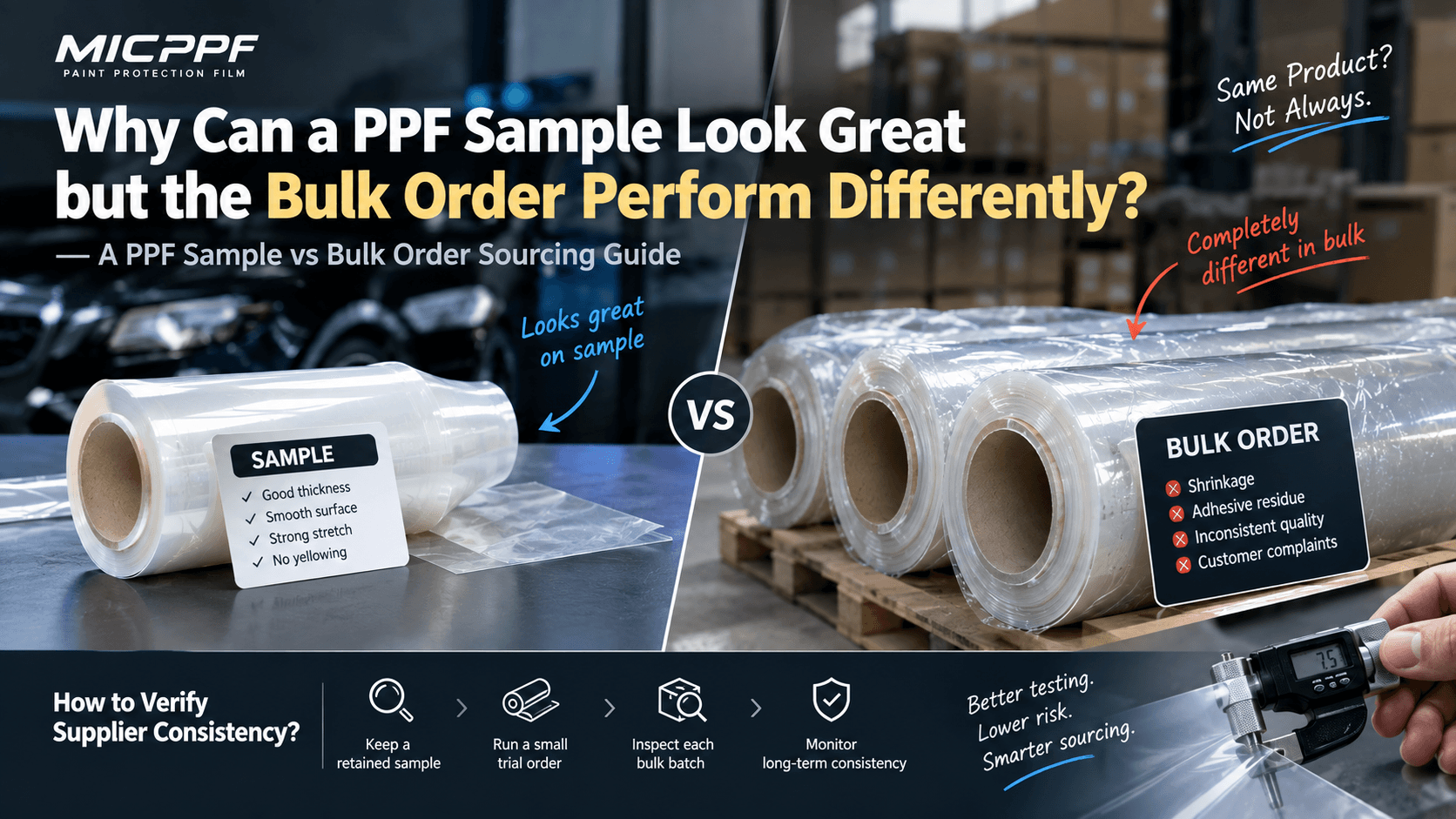
You do not have to go black and white. The safe play is: keep the distributor channel as your baseline, while getting samples and small trial orders from one or two factories. A trial order is the cheapest way to vet a factory—a good sample is only the first gate; the real test is whether bulk production matches the sample, and whether batches are consistent. Once that step holds up, then decide whether to move your volume over.
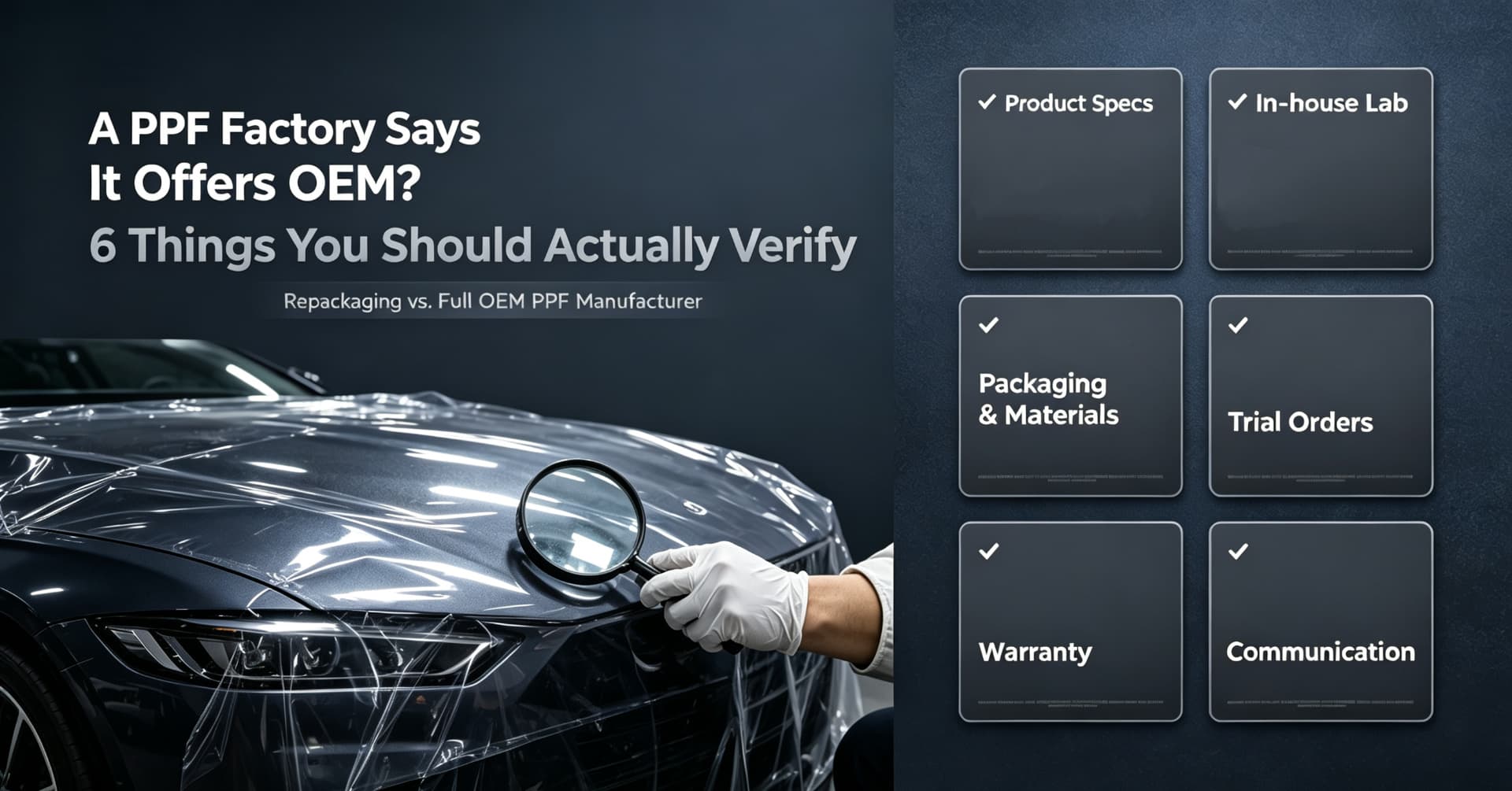
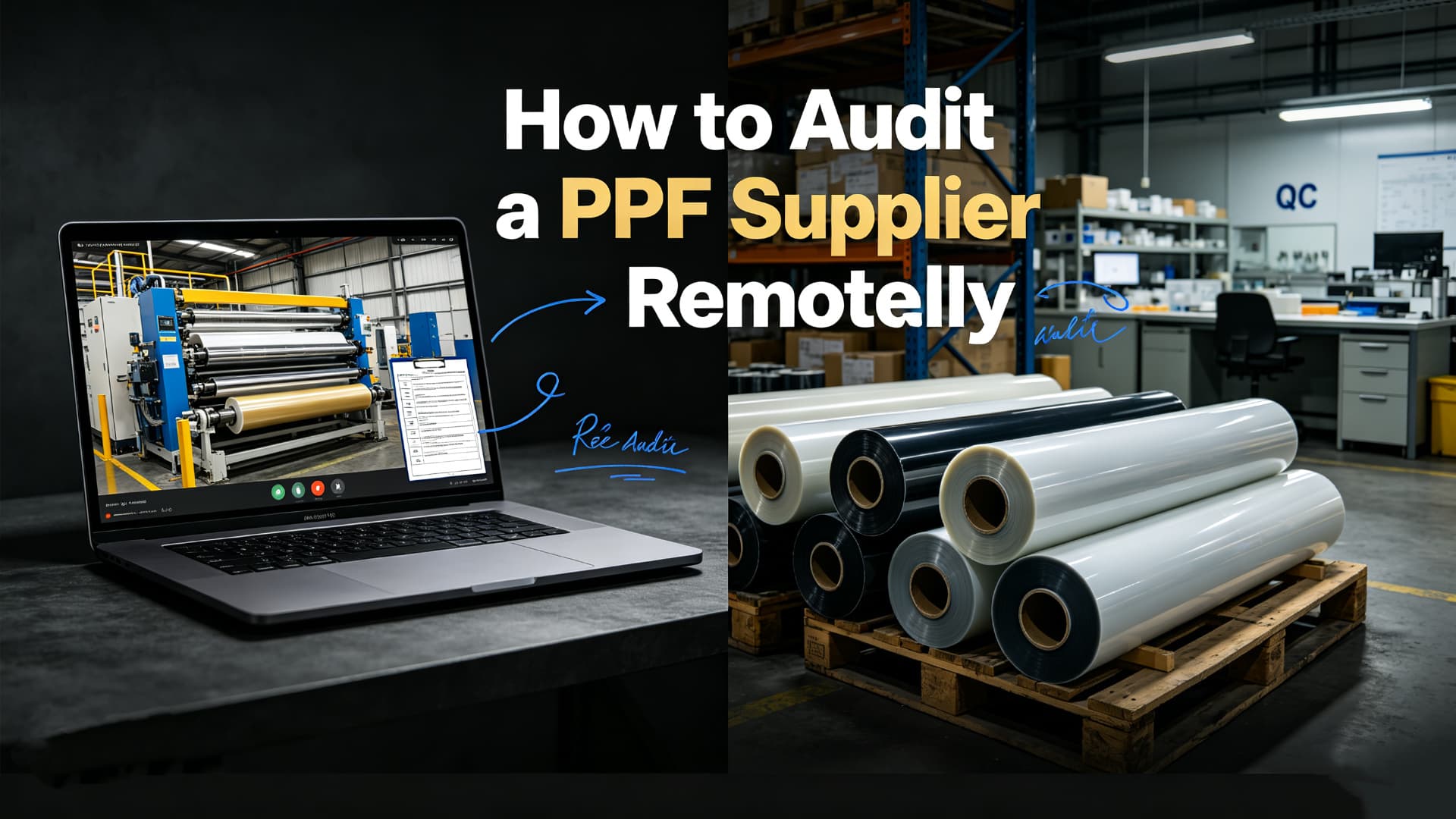
While you are at it, vet the factory: real factory or trading company, their own production line or not, whether specs match, and whether after-sales terms are in the contract. We covered how to tell these apart in our blog—give it a read.
If your volume genuinely supports going direct, focus on these when picking a factory: whose TPU raw material they use, whether the thickness range is complete, whether they will take small trial orders, and how after-sales compensation works. Our PPF line supports small trial orders, with all four thicknesses—6.5, 7.5, 8.5, 10 mil—in stock; the specs are on the PPF product page. Warranty and OEM partnership are laid out clearly on About Us. Whether it is worth working with us, that is your call.
Conclusion: run your own numbers first
Back to the opening question: should installers buy from a distributor or go direct to the factory?
My answer: purchase volume decides whether you are even qualified to negotiate; inventory and cash flow decide whether the negotiation is worth it; local service decides whether the savings are enough to cover the risk. All three check out, and going direct really does save you a chunk. Miss one, and staying with the distributor does not necessarily lose you money.
Do not change channels on impulse because someone says "factory price is always better," and do not write off distributors entirely because someone says "distributors are all a rip-off." Run your own shop's numbers, and the answer shows itself. When you are ready to talk, ask for samples, request a wholesale quote—reach out to the factory directly: contact us.
FAQ
Q1: What is the typical MOQ when buying PPF direct from a factory?
There is no universal number; it depends on the factory and the spec. Repackaging-type suppliers tend to set a higher MOQ; actual manufacturing factories may support small trial orders. Before you start talking, work out your monthly volume, then ask about MOQ and trial-order policy—do not open with price.
Q2: Roughly how much is the price difference between buying through a distributor and direct from a factory?
There is no standard answer; it depends on volume, spec, and region. The spread comes from the middle layer markup. The bigger your purchase volume, the more meaningful that spread; at low volume, the saving may not even cover the extra freight and inventory carrying cost.
Q3: How do you tell a real factory from a trading company?
Ask three questions: can they adjust product specs? Do they have their own lab and per-batch QC reports? Will they take small trial orders? If they cannot answer any of these clearly, they are most likely a trading company or repackager. For a more detailed method, see our blog post comparing factories and trading companies.
Q4: Is it worth a small installer contacting a factory directly?
You can, but start with samples and a small trial order, and keep the distributor channel as your baseline. Do not go straight for a big shipment—small shops cannot afford to have inventory stuck and not moving.
Q5: If I buy direct from the factory, who handles after-sales?
This has to be confirmed before you place the order. A proper factory puts after-sales terms in the contract: how many years warranty, what is covered, how to file a claim, and how compensation works. Verbal promises do not count—that holds every time.