Having been in this industry for over five years, the question we hear most often from overseas customers is: without visiting the factory in person, how do you know if a supplier is reliable?
To be honest, there is no 100% certain answer to this question — even if you fly over, if the supplier cleans up for two days in advance, you may not be able to see through the surface. But when done well, a remote factory audit can filter out at least 90% of unreliable suppliers.
Below are practical lessons we have learned through trial and error with our customers over the years. Simply follow these steps.
Step 1: Remotely Verify a PPF Factory in China — First, Distinguish Between a Factory and a Trading Company
Don't start by asking "Are you a factory?" — it won't help. Every supplier will say yes, including pure trading companies, and some trading companies have websites that look more like a factory than actual factories do.
What really works is asking about details. After three sets of questions, you will have a pretty clear picture:
· Ask about product specifications: Ask whether they use TPU or TPH, the thickness in mil, roll width, roll length, and which top-coat supplier they use. A real factory can answer these immediately, and may even volunteer details like "We use Covestro material for this line, with a shrinkage rate of approximately X and an application window of X to X degrees." A trading company will start hesitating when asked about specific parameters, repeating only "high quality, low price."
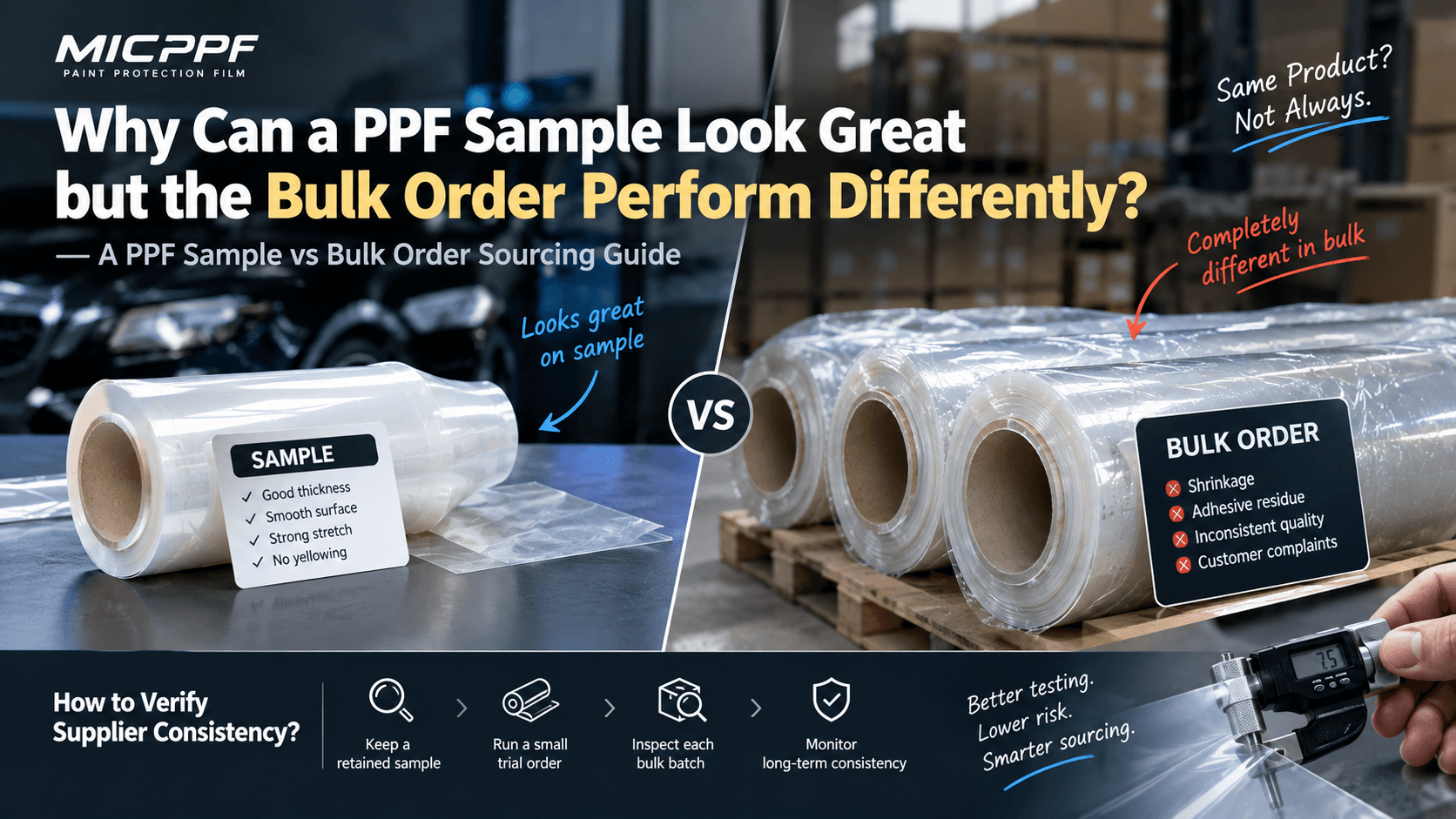
· Ask about the transition from samples to bulk orders: A real factory has a clear process — after sample approval, production is scheduled according to the approved specifications, QC inspects against the same standard, and retained samples are kept for every batch. A common practice among trading companies is to source samples from Factory A and bulk orders from Factory B, so mismatches are the norm; when you ask, they simply say "normal batch variation."
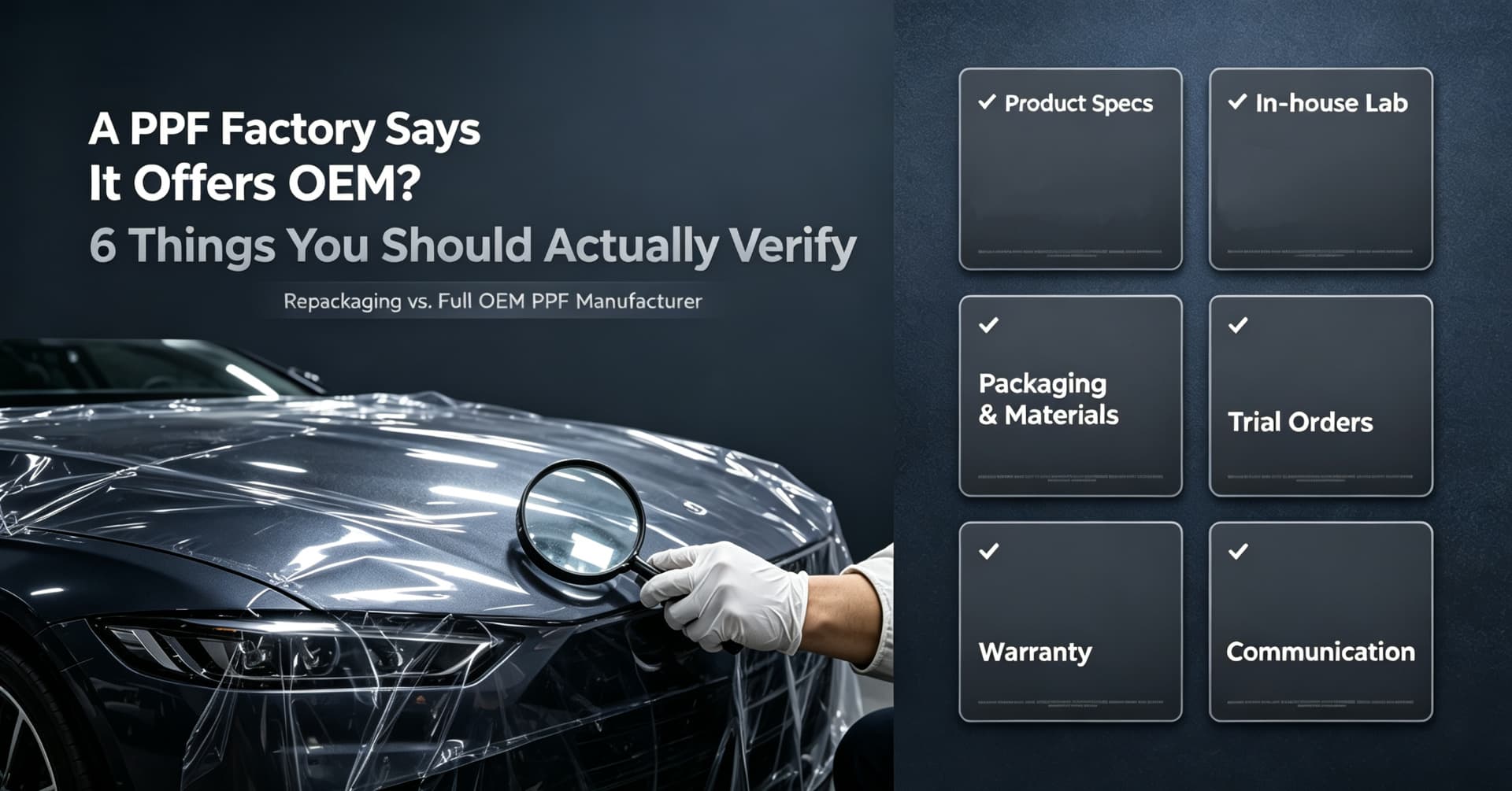
· Ask about OEM capabilities: A real factory can give you a clear list — branding design, film specifications and surface finishes, colors, packaging materials, printed materials, and installer toolkits, including what can be customized and the minimum order quantities for each. A trading company will most likely only be able to change the packaging and labels, and cannot explain anything beyond that.
We previously wrote a dedicated article with a more detailed guide, including complete methods and common talking points. You can read it here: How to Tell Whether a China PPF Manufacturer Is a Real Factory or a Trading Company.
Step 2: Document Review — Audit a PPF Supplier by First Requesting Documentation
After the conversation, if you believe the supplier is most likely a factory, don't rush into a video call yet. Ask them to send documentation first. This step costs the least and can immediately filter out suppliers who cannot even provide basic documentation.
· Business license: Focus on the establishment date. Both craftsmanship and quality control in the PPF industry require time to develop. Be extra cautious with companies established for less than one year.
· ISO 9001: This is the basic threshold for manufacturing. Having it does not guarantee good quality, but suppliers without it most likely have an inadequate quality control system.
Test reports: Focus on yellowing resistance (QUV accelerated aging), water contact angle (hydrophobicity), tensile strength, and peel strength. Prioritize reports from SGS and other third-party institutions; reports issued by the factory itself have limited reference value — you know how it works, when you test and write the report yourself, you can write whatever you want.
· Raw material procurement records: The core of PPF is the TPU material. Ask which supplier they use — Covestro, Mitsui, or Huntsman? Suppliers who can provide purchase contracts or invoices demonstrate stable raw material sourcing, rather than using materials from small factories that change from one day to the next.
· Factory photos: You don't need many — three to five photos clearly showing the coating line, raw material warehouse, QC lab, and finished goods warehouse will suffice. Pay attention to whether the company name or logo appears in the photos; images randomly scraped from the internet are easy to identify with a quick search.
A reminder: Documents can be Photoshopped, certifications can be purchased, and reports can be falsified. Therefore, document review is only the first filter — don't trust everything after reading it. The upcoming video audit and sample testing are the real touchstones.
Step 3: Video Remote Factory Audit — Where to Point the Camera and What to Ask
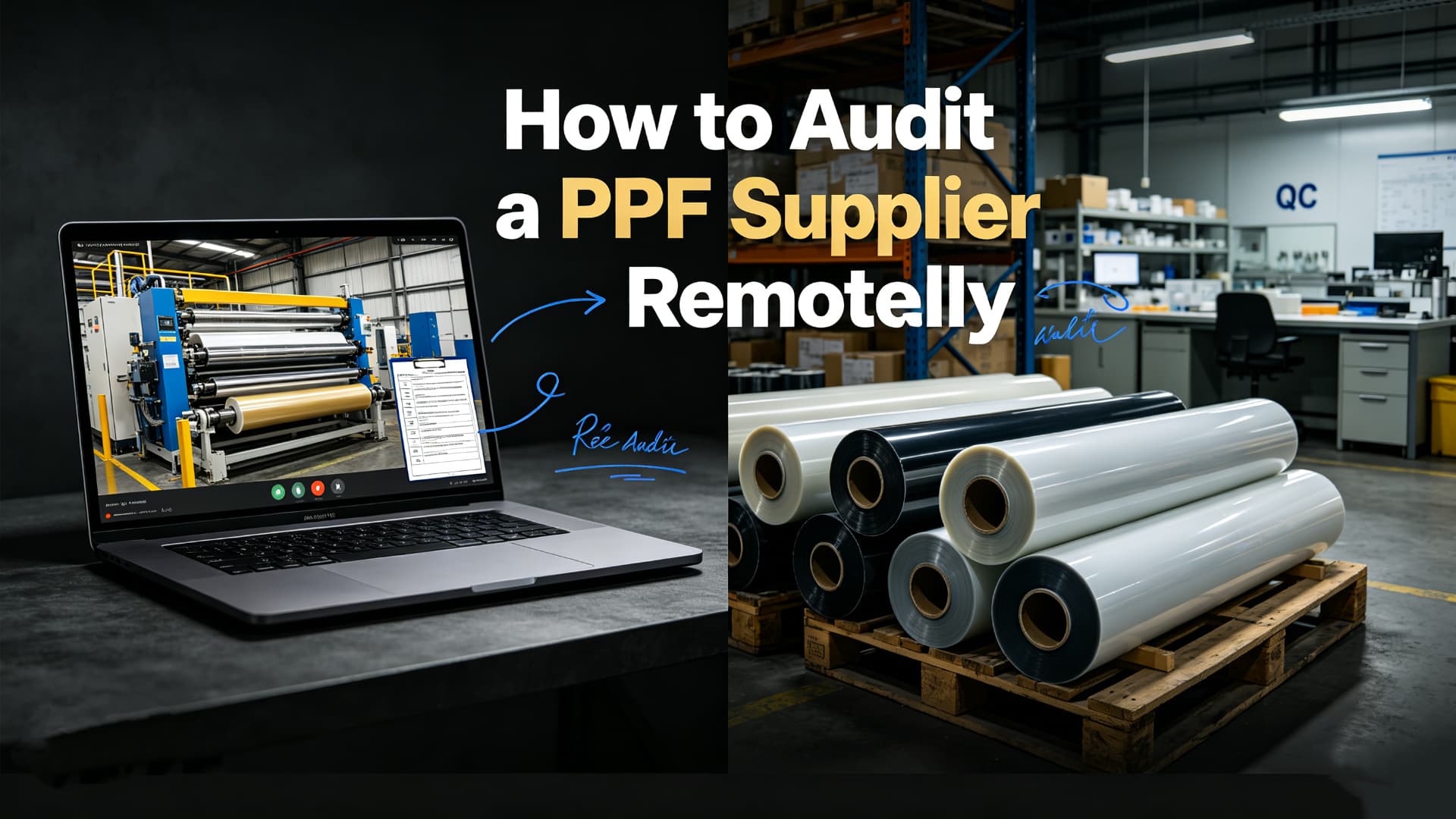
A video factory audit is the most critical step in a remote audit. WeChat and WhatsApp both support video calls now — ask the supplier to walk you through the facility with a phone. But don't only look at what the supplier voluntarily shows you — they will certainly take you to the cleanest packaging area and showroom. You need to actively guide the camera toward the "less presentable" areas.
Point the Camera at These 5 Areas
· Coating line: This is the most critical equipment in a PPF factory. Check whether it is running, whether there is material on it, whether operators are wearing uniforms, and whether the company logo appears on the equipment. A coating line that is genuinely in production will always have semi-finished rolls, ingredient buckets, and control panels around it — these details cannot be faked. If the supplier says "the line is not running today," ask them to film the equipment details and the surrounding environment. Equipment in a real factory shows signs of use, while a brand-new staged setup is obvious at a glance.
· Raw material warehouse: Check whether there is inventory of TPU rolls, coating chemicals, and release liners, whether they are stored neatly, and what brand names appear on the labels. Sufficient raw materials indicate normal production; be cautious if the raw material area is empty — it may be a trading company that has simply rented an office.
· QC lab: Check whether there is equipment such as a QUV aging tester, thickness gauge, water contact angle meter, and tensile testing machine. Having the equipment does not mean it is necessarily in use, but suppliers without any equipment are making empty claims about "batch-by-batch quality inspection." You can ask them to turn on the equipment live for you — equipment in a real lab is used every day, and this becomes obvious as soon as it is powered on.
· Finished goods warehouse: Check how finished rolls are stacked, how they are packaged, and the label information. Pay attention to the format of batch numbers, specifications, and production dates on the labels — write them down so you can cross-check when the bulk order arrives. If the label format on the delivered goods differs from what you saw in the video, the order was most likely not produced by this factory.
· Slitting and packaging area: Check the slitting machine, packaging tables, and the packing process. How PPF finished rolls are slit, packaged, and packed — these details reveal the level of standardization at the factory.
Ask These 4 Questions
· "How many coating lines do you have now? How many rolls can this line produce per day?" — See whether the answer is direct and whether the numbers make sense. People at a real factory deal with the production line every day, so these numbers come to them immediately.
· "When was this batch produced? Which TPU supplier did you use?" — Point randomly at a finished roll and ask, to see whether they can answer. A real factory has standardized warehouse management, so information about every batch can be looked up.
· "What does QC test for every batch? Can I see the records?" — Request to see paper or electronic QC records. A real factory generally has them; although they may not let you photograph the details, they can at least show them to you. If they cannot produce any records, "batch-by-batch quality inspection" is merely talk.
· "Are samples and bulk orders produced on the same line? How do you guarantee consistency?" — This question directly hits the weak point of trading companies. A real factory can explain the process clearly, while a trading company will most likely start beating around the bush.
A useful tip: Don't schedule the time in advance — initiate the video request spontaneously. If the supplier always says "not convenient now, let's do it tomorrow" and requires advance scheduling every time, you should raise a question mark. A real factory is not afraid of your surprise visit; on the contrary, they are afraid you won't look — because the production line runs every day, and there is nothing to hide.
Our production and quality control processes are detailed on our About page, including the coating line, QC lab, and production capacity. You can use this as a reference benchmark during your video factory audit — to see whether the supplier can meet this standard.
Step 4: Sample Testing — The Most Truthful Verification When Auditing a PPF Supplier
Documents can be falsified and videos can be staged, but the data measured from samples cannot lie. This is the final and most critical step in a remote audit — test the samples yourself, or have a third party test them.
· First, inspect the appearance and feel: Unroll the film and check whether the surface has gel particles, scratches, or orange peel. Feel whether the adhesive layer is uniform and whether the film is soft or firm. The feel of PPF is directly related to its thickness and TPU grade — 6.5 mil and 10 mil films feel noticeably different. Cross-check against the specifications the supplier quoted; if they do not match, there is a problem.
· Thickness must be measured: Use a thickness gauge to measure several points (middle, both sides, head and tail) to check consistency with the nominal thickness and overall uniformity. If the nominal thickness is 7.5 mil but the measurement comes out to 6.8 mil, pass on this supplier immediately — if they dare to falsely label the thickness, you can imagine what they do with other parameters.
· Self-healing test: Use a wire brush or brass brush to lightly scratch the surface, then apply a heat gun or warm water to see whether the scratches disappear and how quickly. Heat-activated self-healing films generally recover with warm water, while room-temperature self-healing films recover gradually without heating. Note: Some films show scratches disappearing immediately after brushing, but they reappear after some time — this indicates an unstable top-coat, so observe for several more days.
· Hydrophobic test: Drop water on the film surface and check whether the beads are round and whether they roll smoothly. The higher the water contact angle, the better the hydrophobic performance. A standard hydrophobic top-coat has a contact angle of approximately 90 to 100 degrees, while a good one can exceed 100 degrees. This is the simplest test, but also the most intuitive — with a poorly hydrophobic film, customers will feel after a period of use that "it never looks clean no matter how I wash it."
· Yellowing resistance test: This is time-consuming to test on your own. You can send it to a third party for QUV accelerated aging testing, and check the degree of yellowing after 1,000 or 1,500 hours. If budget is limited, at least place the sample outdoors for one to two months and compare it with a new film — if it yellows noticeably after one month, do not use it.
· Application testing is the most critical: If you have a partnering tint shop, give the sample to an installer to actually apply a roll, and check the shrinkage rate, stretchability, whether the adhesive shifts, and whether air bubbles release smoothly. An installer's feedback is more intuitive than any specification — installers prefer films that are easy to apply, while difficult-to-apply films lead to more complaints and higher rework rates, ultimately costing more when you do the math.
Sample testing has another function that many people overlook: establishing a retained benchmark. Keep the approved samples properly, and compare them against the bulk order when it arrives — gloss, feel, thickness, and self-healing speed. A quick comparison will tell you whether it is the same material. We have repeatedly told our customers that sample approval records must be kept in writing, with clear specifications, colors, and packaging requirements, to be cross-checked against repeat orders. This is the most effective way to prevent "sample-bulk mismatch."
If you are currently comparing suppliers, you can request free samples through our contact page and test them yourself — that is the most reliable approach. We are not afraid of your testing; we are afraid of you not testing.
Step 5: Cross-Verification and Trial Orders — Minimize Risk
After passing the previous four steps, do one final round of cross-verification, then start with a trial order:
· Check business registration information: Use tools such as Qichacha or Tianyancha to look up the company's business registration information, and check for legal disputes, administrative penalties, or business irregularities. Be cautious with companies that have a large number of sales contract disputes, especially where they are the defendant — this indicates frequent conflicts with customers.
· Check overseas reputation: Search the company's English name and brand name on Google to see whether there are complaints from overseas customers or negative reviews on forums. Of course, you cannot trust everything online — some reviews are malicious smears from competitors — but concentrated negative information definitely warrants extra caution.
· Request customer references: Ask the supplier to provide contact information for 2 to 3 existing customers, preferably in your region, and contact them directly by email or phone — ask how long they have been working together, whether quality is stable, whether delivery is on time, and how responsive after-sales support is. A real factory is not afraid of you contacting their customers; a trading company may not be able to provide real customers, or may give you "friends" as references.
· Trial order: Even after passing all the previous audits, do not place a large order right away. Start with a small trial order — 50 or 100 rolls — to check whether the bulk quality matches the samples, whether delivery is on time, whether packaging is standardized, and whether documentation is complete. Once the small order goes smoothly, gradually scale up. This is the safest approach. Many of our customers have gone through this exact process: samples, trial order, repeat order, large order — building trust step by step.
The 5 Most Common Pitfalls When Remotely Auditing a PPF Supplier
Finally, here are the most common pitfalls we have seen — avoid them in advance:
· Placing an order based only on the website and PPT: No matter how beautiful the website is or how professional the PPT looks, neither represents the true capability of the factory. You must go through the complete process of document review, video audit, and sample testing. Don't be fooled by surface-level efforts.
· Only watching what the supplier shows you during the video audit: If the supplier only films the neat packaging area and showroom with their phone, you might assume the entire factory is like that. You must actively request to see the "less presentable" areas such as the coating line, raw material warehouse, and QC lab.
· Forgetting about the samples after testing: If you do not retain samples or keep records after approval, you will have no benchmark for comparison when the bulk order arrives, and you will not be able to clearly explain problems — the supplier says "this is the quality," and you have no evidence to the contrary.
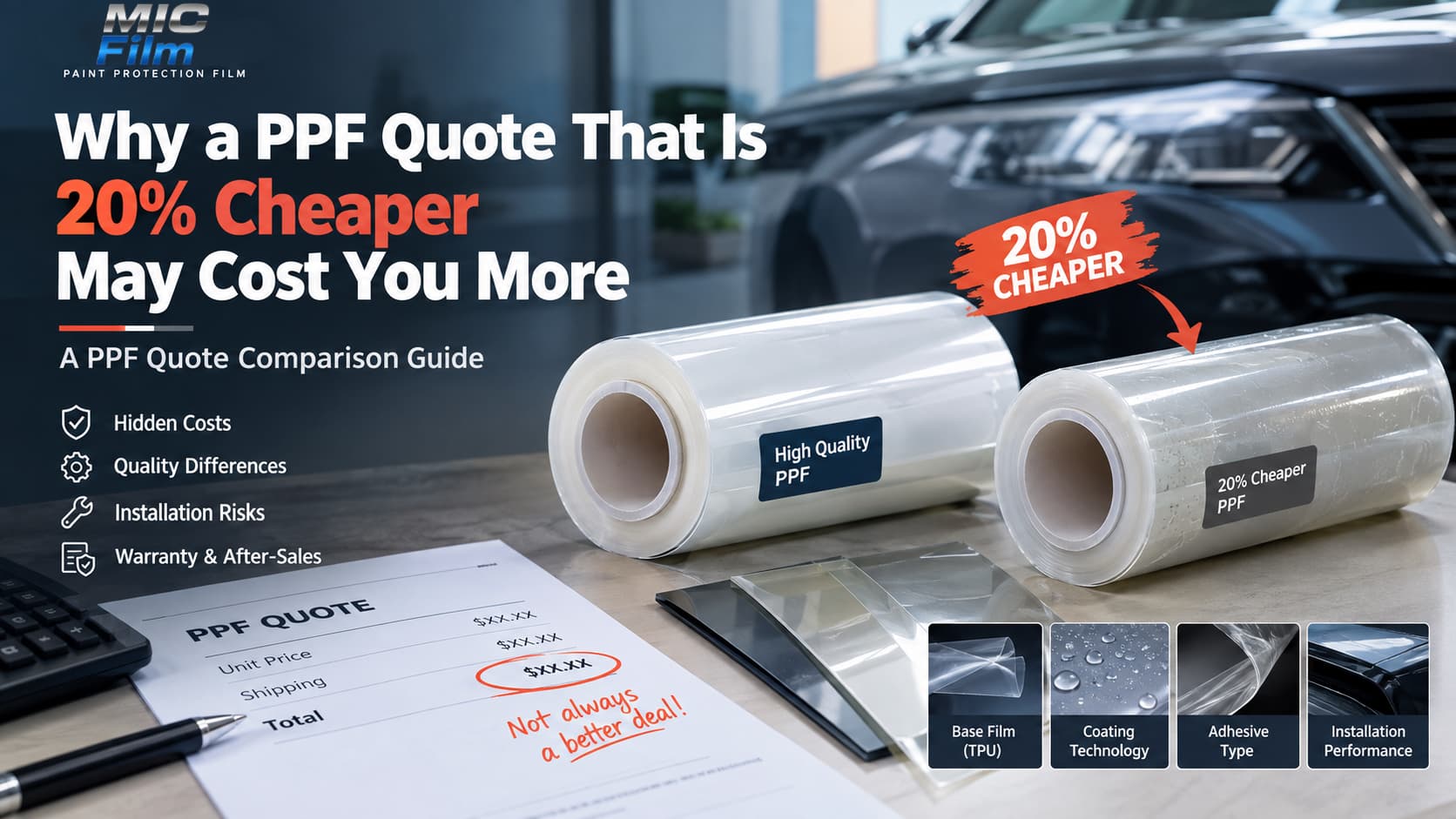
· Only comparing prices without checking quality: In the PPF industry, you get what you pay for. If a quote is significantly below the market price, it is either TPH masquerading as TPU, recycled material, or insufficient thickness. When a cheap film causes problems after application, the labor cost of rework is far more expensive than the film itself, and it also damages your own reputation.
· Ignoring after-sales and warranty terms: Before placing an order, be sure to ask clearly — what the warranty covers (yellowing, cracking, adhesive failure, self-healing failure), what it does not cover (human damage, improper application), how claims are handled when problems arise, and the response time. Put these in the contract; don't rely solely on verbal promises — verbal promises are worthless when problems arise.
Summary
A remote audit cannot guarantee zero problems 100% of the time, but it can help you filter out 90% of unreliable suppliers. The complete process has six steps: distinguish between a factory and a trading company, review documentation for qualifications, conduct a video audit to see real production, perform sample testing to verify real quality, cross-verify reputation, and start with a trial order and scale up gradually.
If you are currently looking for a PPF supplier, you are welcome to use us as a control group — documents, video, samples, trial orders — audit us however you want. We are not afraid of being audited.
Our PPF product range spans from the Master series with Covestro TPU, to the premium Apex series with Mitsui TPU, to the room-temperature self-healing Rapid series with Huntsman TPU. All specifications and parameters are clearly listed on our product page, and we are not afraid of your comparison. Customers looking for private label can also review our OEM and private label customization services on the About page — from branding design to packaging and printing to installer toolkits, everything we can do is listed there.
FAQ
Q1: When remotely auditing a PPF supplier, which step is the most critical?
Sample testing. Documents can be Photoshopped and videos can be staged, but the data measured from samples — thickness, self-healing, hydrophobicity — cannot lie. If you can only do one step, do sample testing, and be sure to test it yourself or have a third party test it. Don't rely solely on the test reports provided by the supplier.
Q2: What if the supplier keeps postponing the video remote factory audit?
If they postpone more than twice with "not convenient now, needs advance scheduling," you can basically pass on them. A real factory is not afraid of your visit — the production line runs every day and can be viewed at any time. Of course, if they give a reasonable reason such as "equipment maintenance today / power outage," you can reschedule, but if they postpone again after the rescheduled time, be alert.
Q3: Can trading companies never be suitable partners?
Not necessarily. For small-batch trial orders or when comparing multiple suppliers simultaneously, trading companies can actually be more flexible, and some trading companies have good relationships with factories and can source goods faster than the factory itself. However, if you plan to make long-term large-volume purchases or build your own private label brand, you must find a real factory — trading companies cannot control production and quality, the risk of sample-bulk mismatch is too high, and when problems arise they cannot solve them either; they can only go back to the factory, leading to endless back-and-forth disputes.
Q4: How do you prevent mismatches between samples and bulk orders?
Three methods: First, when approving samples, put the specifications, colors, and packaging requirements into a written record and have the supplier sign and confirm it — verbal confirmation does not count. Second, compare the delivered bulk order against the retained samples immediately upon arrival, and provide feedback right away if there are problems — don't wait until you have applied half of it to discover the issue. Third, start with a small-batch trial order, and scale up only after it goes smoothly.
Q5: After passing a remote audit of a PPF supplier, is it still necessary to visit the factory in person?
For suppliers with whom you plan to have long-term cooperation and significant annual purchase volume, we recommend visiting the site at least once. A remote audit can filter out most risks, but some things — such as the factory's true management level, employee morale, the degree of standardization on the production floor, and what kind of person the boss is — can only be truly experienced through face-to-face interaction on site. Of course, if the purchase volume is not large and the cooperation period is short, a remote audit plus a trial order is sufficient.