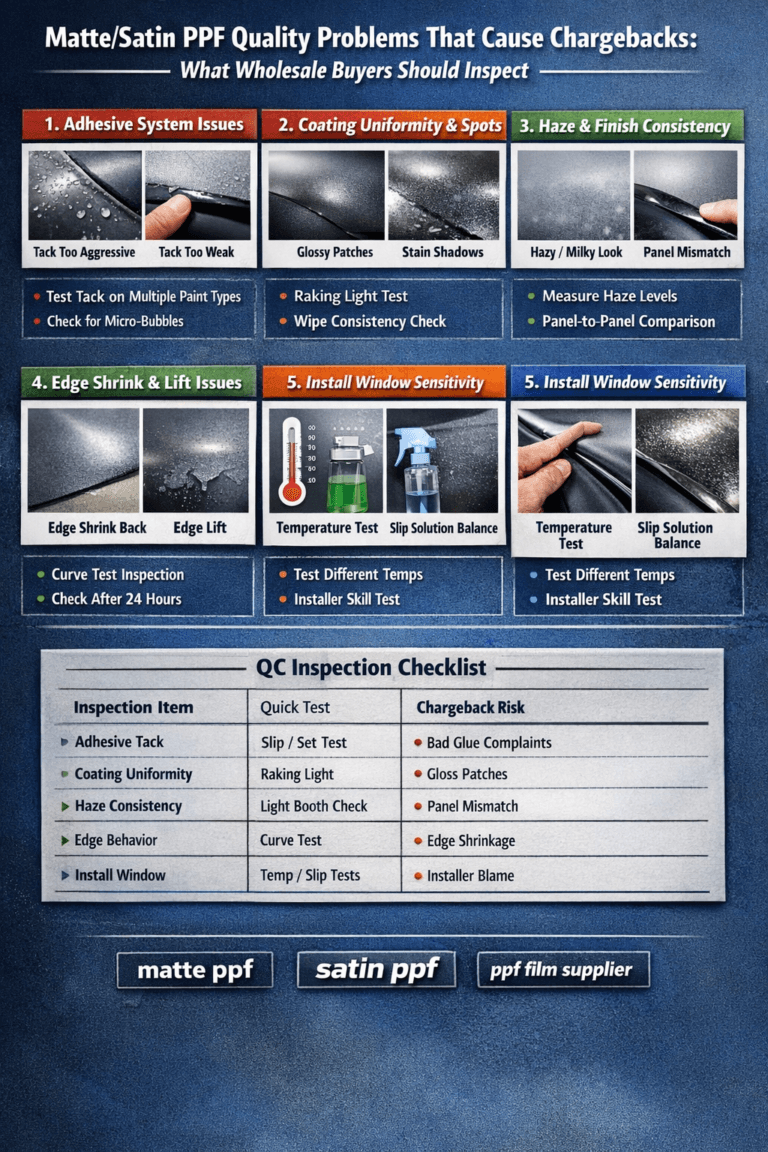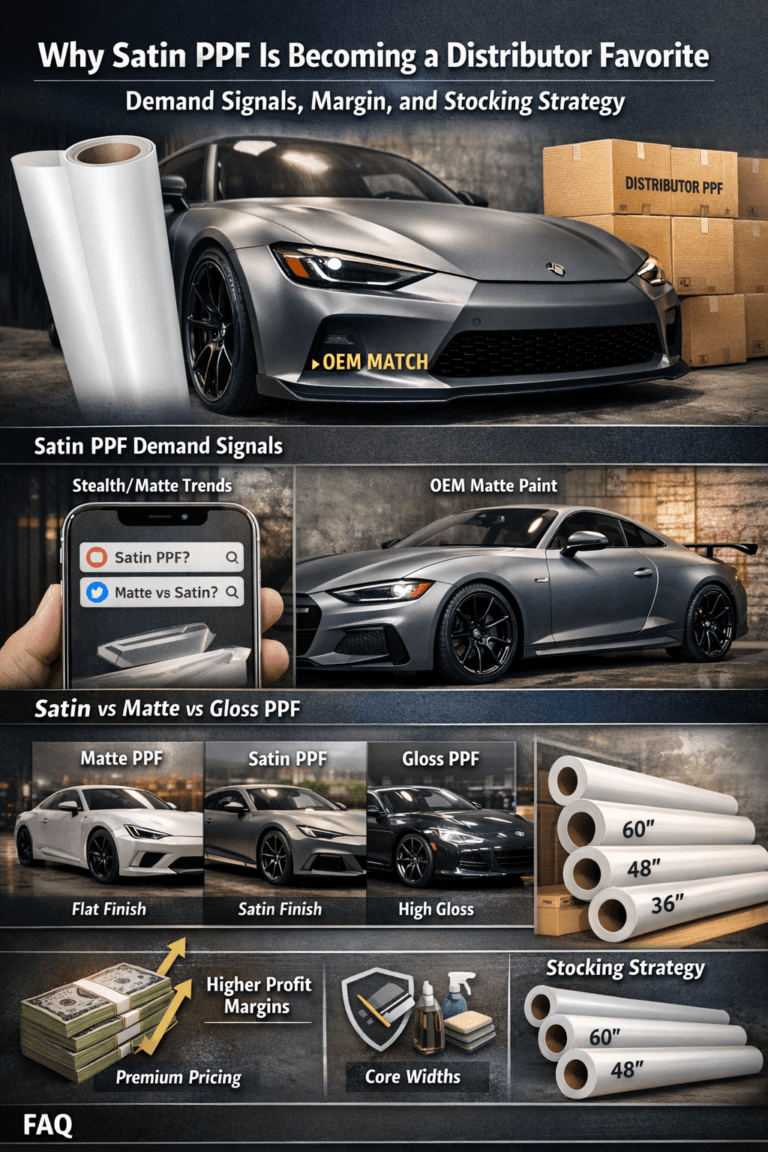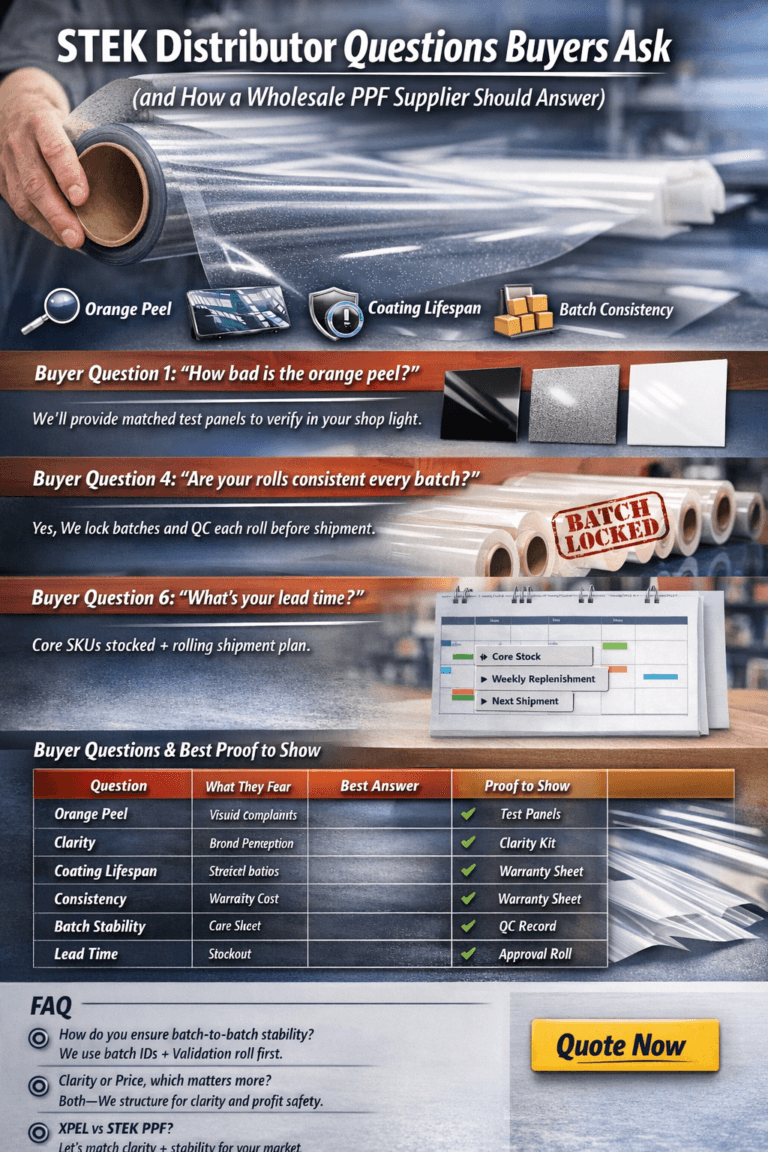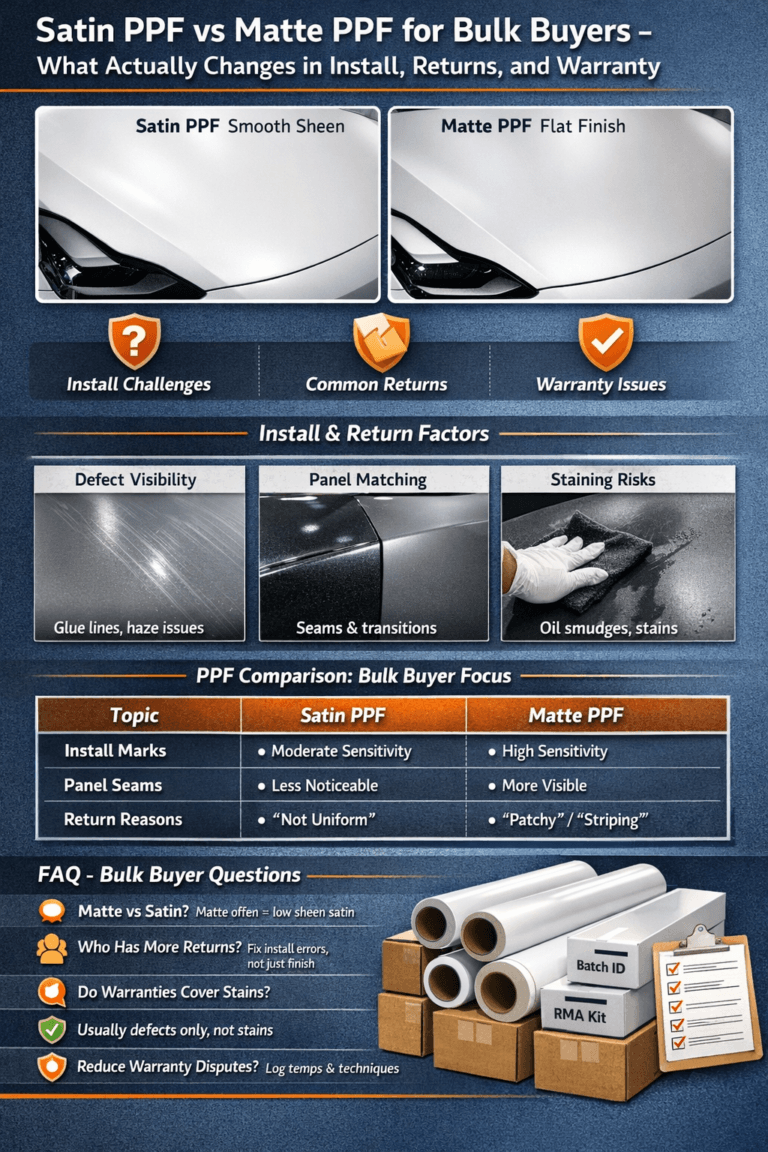
Why distributors should compare by checklist, not by brand debate
Brand comparisons get emotional fast. A wholesale roll decision should be the opposite: repeatable, evidence-based, and easy to audit.
A distributor checklist does three jobs:
- Prevents mismatch: stops “we thought it was X mil / Y warranty / Z finish” disputes before they happen.
- Predicts return reasons: most returns come from adhesive behavior, install difficulty, and finish consistency—not marketing claims.
- Improves claim success: warranty claims are paperwork-heavy; you win by documenting storage, batch, and installation conditions.
Avery Dennison and XPEL both publish technical documents for key PPF lines (Avery Supreme Defense / Supreme PPF Xtreme / Neo, and XPEL ULTIMATE PLUS variants). Use those documents as your baseline, not reseller summaries.
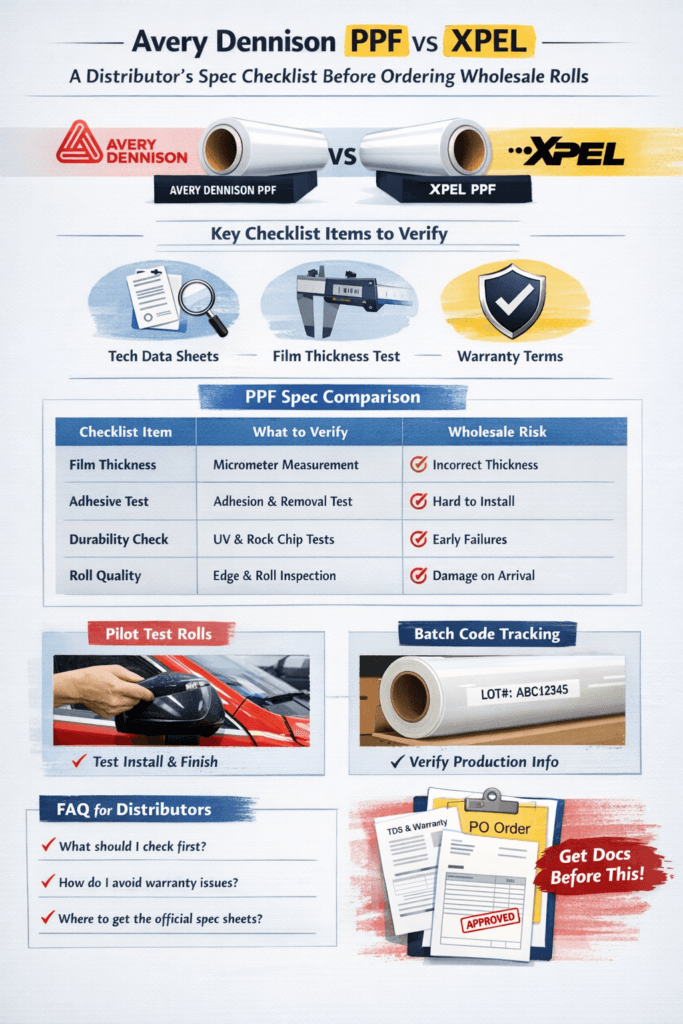
Distributor PPF checklist: what to request from any PPF film supplier (before you pay)
Ask for these before you confirm deposit or final PO:
- Latest Technical Data Sheet / Product Data Sheet for the exact SKU and region
- Warranty statement (what is covered, term, transferability if applicable)
- Roll spec sheet (width, length, core size, carton specs, label format)
- Batch/lot traceability (how to identify production batch on labels)
- Storage and shelf-life requirements (and whether re-certification applies after shelf life)
- Install guidelines (wet/dry notes, min temp, curve limits, recommended squeegee/solution)
For XPEL, shelf-life and storage conditions are explicitly stated in their technical data sheets.
For Avery Dennison PPF lines, product data sheets define uses, performance expectations, durability, and test references (like rock chip testing).
Spec Checklist Table: Avery Dennison PPF vs XPEL (what you should verify)
Use this table as a receiving standard for avery dennison ppf vs xpel wholesale orders. Replace “Pass/Fail” with your actual acceptance numbers after you run 2-3 pilot rolls.
| Checklist Item (Distributor View) | What to Verify (Proof) | Why It Matters (Wholesale Risk) | Pass/Fail Notes |
|---|---|---|---|
| Product line + exact SKU | Datasheet title + SKU code matches PO | Wrong SKU = wrong adhesive/finish/warranty | Require screenshot + PDF |
| Finish (gloss/matte/color) | Visual sample panel + SKU confirmation | “Looks different” is a top return reason | Compare under same lighting |
| Film construction type | Datasheet states polyurethane/TPU + topcoat claims | Predicts stretch, healing, stain behavior | Log by product family |
| Thickness (overall mil/micron) | Datasheet thickness + your micrometer spot-check | Thickness claims drive pricing and expectations | Define tolerance band |
| Warranty term + scope | Warranty statement per product/region | Disputes happen when distributors assume “10-year” applies to all | Keep warranty PDF with PO |
| Durability & exposure notes | Region exclusions / vertical vs horizontal durability | Customers install on hoods/roofs; you need clarity | Document climate caveats |
| Rock chip / abrasion reference | Test standard mentioned (e.g., SAE rock chip) | Explains real-world protection expectations | Use as sales boundary |
| Self-healing conditions | What triggers healing (heat/sun/warm water) | Reduces “it doesn’t heal” complaints | Train installers on conditions |
| Stain resistance positioning | Datasheet or official product page claims | Bug/tar stains trigger warranty debates | Require cleaning SOP |
| Adhesive behavior | Acrylic adhesive notes + install guide | Main driver of install time, lifting, silvering | Pilot on curves + edges |
| Conformability / compound curves | Any curvature notes + installer feedback | Distributors lose money on “too hard to install” | Run a “hard panel” test |
| Shelf life + storage | Temp/humidity requirements + shelf life window | Old stock becomes claims/returns | FIFO policy + storage log |
| Roll quality: edge, telescoping, liner | Incoming inspection + photo log per roll | Prevents “it arrived damaged” disputes | Define carton + core spec |
| Color PPF special checks | If color PPF line: color consistency + opacity + edge visibility | Color PPF returns are higher if batch varies | Lock to batch for projects |
Avery Dennison Supreme Defense PDS references durability expectations and rock chip testing, which you can align to your sales promise boundaries.
Avery Dennison also positions multiple PPF series (including Supreme PPF Xtreme and Neo color PPF) with separate documentation—treat these as different products, not “one Avery PPF.”
XPEL publishes technical data sheets for ULTIMATE PLUS variants and states storage/shelf-life guidance (including re-certification language on thicker variants).
How to run a “2-roll pilot” that predicts 80% of wholesale problems
1) The install stress test (fastest way to spot return risk)
Pick one easy panel and one hard panel:
- Easy: door skin (flat)
- Hard: bumper corner / mirror cap (compound curve)
Have two installers:
- One experienced, one average (your market reality)
Record:
- Install time
- Edge lift after 24h / 7d
- Need for extra tack solution
- Reposition behavior and liner release feel
This matters because most distributor complaints are installer complaints that become “film problem.”
2) The finish consistency test (what customers notice first)
Make 3 sample panels from:
- Roll start (first 2 meters)
- Mid roll
- Roll end
Check:
- Gloss/matte uniformity
- Haze/orange peel perception (visual)
- Surface defects under strong light
3) The documentation test (what wins claims)
For every pilot roll, store:
- Label photo (batch/lot)
- Storage conditions (basic log)
- Install conditions (temp, solution used)
If you cannot prove these later, your claim success rate drops.
“Avery Dennison vs 3M PPF” and where it fits in this checklist
Distributors often evaluate avery dennison vs 3m ppf and avery dennison ppf vs xpel in the same quarter. The trick is not to build three different processes. Build one checklist, then plug in each brand’s datasheet and warranty documents.
The checklist stays the same:
- You are verifying thickness, adhesive behavior, durability notes, and claim requirements—not debating brand identity.
Avery Dennison’s official PPF portfolio pages and product sheets are designed to separate product families (standard clear PPF, upgraded lines, and color PPF like Neo). Treat each family as its own SKU strategy.
Wholesale roll ordering notes (to protect distributor margin)
MOQ and stock strategy (practical, neutral)
- Start with your top 2 widths only (common market widths), then add niche widths after sell-through is proven.
- Lock one gloss hero SKU first; add matte/color after you have installer confidence and claim processes.
What to write on the PO (reduces disputes)
Add a “documents required” clause:
- TDS/PDS version date
- Warranty doc version
- Roll label format + batch traceability
- Storage/shelf-life statement
For example, Avery Dennison and XPEL documents clearly show revision dates; attach those PDFs to the PO packet so “spec changed” arguments don’t happen later.
FAQ (Distributor-focused)
1) What should a distributor check first in avery dennison ppf vs xpel?
Start with document matching (exact SKU + datasheet revision) and warranty scope, then verify thickness and adhesive/install behavior with a 2-roll pilot. XPEL and Avery both publish official PDFs—use those as your legal baseline.
2) Is thickness the most important spec for wholesale rolls?
Thickness matters, but it is not the top return driver. Adhesive behavior, edge lift, finish consistency, and install difficulty usually create more distributor pain. Still, you should spot-check thickness against the product sheet and define a tolerance band.
3) How do I avoid warranty disputes when I’m the ppf supplier/distributor?
Keep a PO packet with: the exact datasheet PDF, warranty PDF, batch/lot photo, storage log, and installer notes. XPEL’s sheets explicitly state storage and shelf-life guidance (and some variants reference re-certification after shelf-life), so documentation is not optional.
4) What changes when comparing avery dennison color ppf to clear PPF?
Color PPF has higher risk on batch consistency, edge visibility, and “expected vs actual” finish perception. Avery Dennison’s Neo PPF is documented as a color PPF line; treat it with tighter batch-lock rules than clear PPF.
5) Where can I find official spec sheets instead of reseller claims?
Use official manufacturer pages and PDFs. For Avery Dennison, their PPF product pages and PDS PDFs are the best starting point. For XPEL, their product specifications page links to official technical data sheets.
References
[1] Supreme Defense Paint Protection Film – Product Data Sheet (https://graphics.averydennison.com/content/dam/averydennison/graphics/na/en/documents/Product-Data-Sheets-NA-ONLY/supreme-protection-film/pds-grs-supreme-defense.pdf)
[2] Supreme PPF Xtreme Gloss – Product Data Sheet (https://graphics.averydennison.com/content/dam/averydennison/graphics/ap/en/Product-Data-Sheets/Vehicle_Wrapping_Materials/supreme-ppf/pds-supreme-ppf-xtreme-gloss-ap-en.pdf)
[3] Avery Dennison Paint Protection Film overview (https://graphics.averydennison.com/en/home/graphics-products/paint-protection-film.html)
[4] Supreme PPF Xtreme product page (https://graphics.averydennison.com/ap-en/home/graphics-products/vehicle-wrapping-films/paint-protection-film/supreme-ppf-xtreme.html)
[5] Neo Paint Protection Film – Product Data Sheet (color PPF) (https://graphics.averydennison.com/content/dam/averydennison/graphics/na/en/documents/Product-Data-Sheets-NA-ONLY/supreme-protection-film/pds-grs-ppf-neo.pdf)
[6] XPEL ULTIMATE PLUS – Technical Data Sheet PDF (https://www.xpel.com/web-assets/downloads/XPEL-ULTIMATE-PLUS-TDS-82019-V1-1.pdf)
[7] XPEL Product Specifications page (TDS links hub) (https://www.xpel.com/product-specifications)
[8] XPEL ULTIMATE PLUS 10 – Technical Data Sheet PDF (https://www.xpel.com/web-assets/downloads/XPEL-ULTIMATE-PLUS-10-TDS-V1.1.pdf)