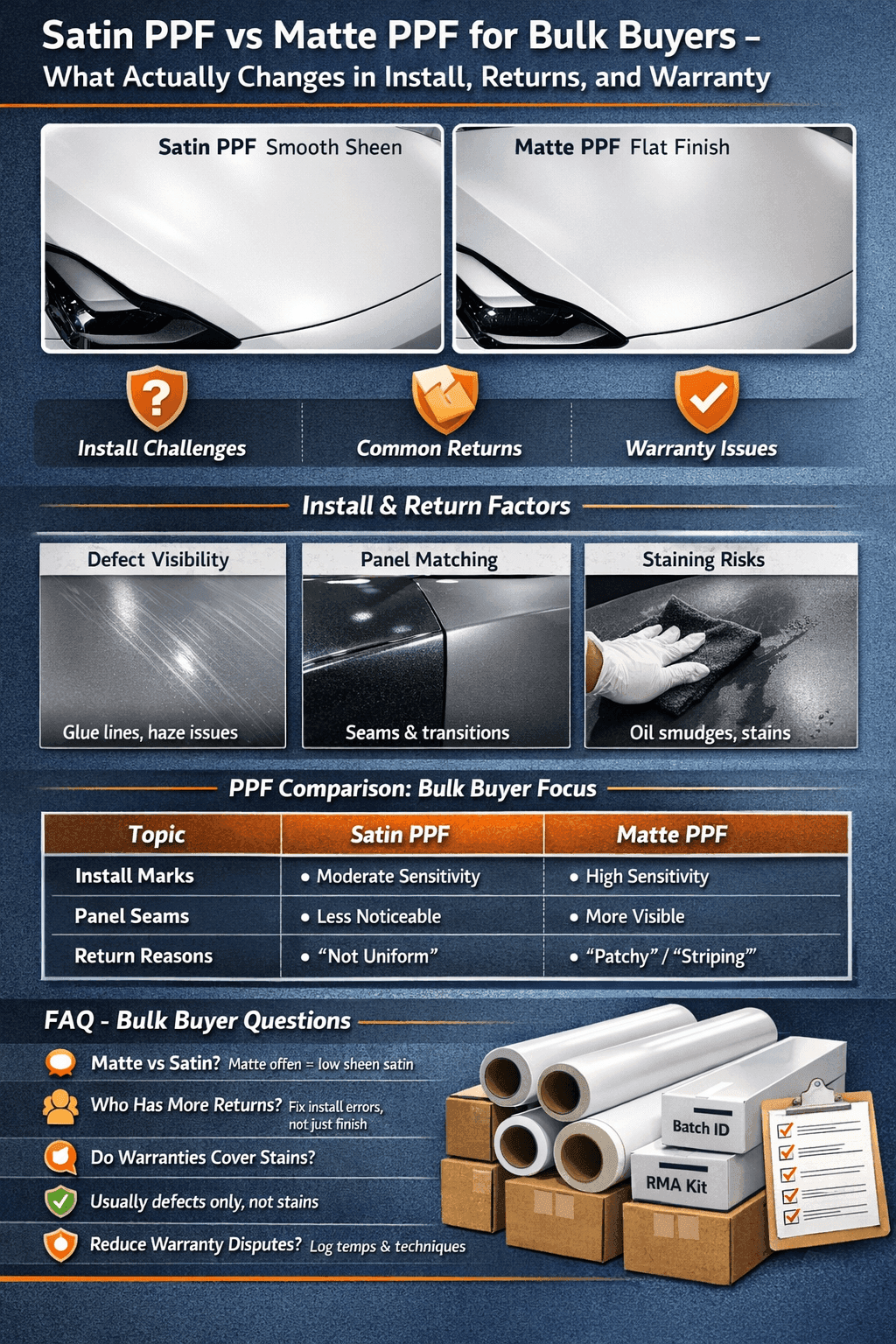
Satin vs Matte PPF – What “Finish” Changes Operationally
Bulk buyers usually see the finish decision show up in 3 places:
- Defect visibility during install: haze, glue lines, stretch marks, trapped solution, edge lift patterns
- Customer expectations: uniformity across panels, “match” to factory matte paint, perceived cleanliness
- Aftercare sensitivity: installer notes, wash/chemical compatibility, stain risk, touch-up behavior
Reality check: many “matte PPF” lines are actually “satin finish” products by spec or appearance, so your returns policy must define acceptance by measurable criteria (gloss units, color shift tolerance, visible lines under inspection lighting), not by marketing names.
image
What Changes in Install – Rework and Comeback Drivers
1) Squeegee marks and “wash-out” expectations
- Matte look buyers often expect a perfectly uniform scatter of light. Any directional squeegee pattern can look like “striping” under shop LEDs.
- Satin PPF still shows technique errors, but the low sheen can visually “blend” minor marks faster after cure.
Bulk takeaway: your training checklist should include a “finish-uniformity pass” (lighting angle sweep) before delivery, especially for full wraps.
2) Edge behavior and panel transitions
On satin/matte finishes, customers notice:
- Panel-to-panel mismatch (hood vs fender sheen difference)
- Overlap visibility (especially on complex kits or when you must seam)
Return trigger: “It looks patchy” is usually not a material defect – it’s a layout/coverage decision. Your ppf supplier should help by offering wider rolls, consistent batch control, and stable topcoat behavior to reduce visual variance.
3) Contamination and staining claims
Low-sheen surfaces can appear dirtier sooner because oils, installer fingerprints, and residues read differently in diffuse reflection. Many satin/matte PPFs advertise stain resistance or low surface energy behavior (e.g., XPEL STEALTH TDS highlights low surface energy and stain resistance) .
Return prevention: standardize install gloves, final wipe chemistry, and delivery instructions.
Returns – The Real Reasons Bulk Orders Get Sent Back
Most B2B returns fall into 4 buckets. Only one is truly “film defect.”
A) “Looks different than expected”
- Buyer thought “matte” = fully flat, but received “satin-like” low sheen (or vice versa).
- Fix: sample board sign-off with batch ID + finish label + inspection lighting notes.
B) Install-related (non-warranty) complaints
- Glue lines, haze, stretch distortion, silvering, edge lift due to technique or surface prep.
- Fix: distributor policy that separates install workmanship from material defect and requires photo set + install log for RMA submission.
C) Handling/storage issues
- Telescoping, edge nicks, creases, heat exposure in warehouse.
- Fix: carton spec, vertical storage rules, roll-end protection, FIFO.
D) Actual manufacturing defect
- Coating voids, liner issues, abnormal adhesive behavior, abnormal optical distortion.
- Fix: incoming QC (roll-start inspection, gloss/DOI spot checks, liner release consistency).
Warranty – What Claims Usually Look Like (and How to Reduce Them)
Warranties vary by brand and region, but many cover manufacturing-related failures such as yellowing, bubbling, cracking, delamination – and exclude misuse, misapplication, impacts, and ordinary wear. For example, 3M’s Scotchgard Pro Series warranty card lists coverage for defects including yellowing, bubbling, cracking for 10 years (US/Canada) and excludes misuse/misapplication and impact dents . STEK DYNOmatte states a 10-year warranty against delamination, yellowing, bubbling, cracking .
The 3 warranty hotspots for satin/matte programs
- Staining and contamination disputes
Often becomes “warranty” in customer language. Your policy should define: approved chemicals, wash frequency, decon methods. - Edge lift and peel
Can be adhesive, install technique, or surface prep. Bulk buyers should require installers to document:
- panel temperature
- slip/tack ratio used
- post-heat procedure
- Appearance mismatch vs “defect”
“Not matte enough” is not a defect unless the product spec is defined. Solve with measurable acceptance standards.
Comparison Table – Bulk Buyer View (Install, Returns, Warranty Risk)
Topic | Satin PPF | Matte PPF (often “low sheen”) | Bulk Buyer Risk Control |
|---|---|---|---|
Visual expectation | Low sheen, “factory satin” look | Flatter look expected, but varies by product | Sample sign-off + define gloss tolerance |
Install mark visibility | Moderate | Higher sensitivity to directional marks | Lighting sweep QC + installer SOP |
Panel transition/seams | Seams can still show | Seams and overlaps more noticeable | Wider rolls, smarter seam placement, pre-cut strategy |
Stain/oil appearance | Usually easier to “look clean” | Can show oils/residue differently | Standard delivery wipe + aftercare card |
Typical return language | “Not uniform under light” | “Patchy” / “striping” / “too shiny” | Photo checklist for RMA intake |
Warranty dispute frequency | Medium | Medium-high when expectations unclear | Separate “finish expectation” from “defect” |
Best-fit buyers | OEM-style satin demand, premium look | True matte vehicles, stealth aesthetics | Sell by use case, not by label |
Buying Checklist (B2B – Fast Decision)
Use this when ordering from a ppf film supplier:
- If you sell to high-volume installers: choose the finish with the lowest rework sensitivity under shop lighting, not the prettiest sample.
- If your market asks for “XPEL satin ppf / xpel stealth satin ppf”: your program must control customer expectations with demo boards + finish spec (don’t rely on the word “matte”).
- If you run distributor ppf warehousing: prioritize roll consistency, packaging, batch traceability, and a clean RMA process over micro-price differences.
How a Supplier Should Support You (Return-Reduction Package)
When you evaluate a satin or matte line, ask your supplier to provide:
- Batch traceability (lot ID, production date range)
- Incoming QC template (what to check in the first 2 meters)
- RMA evidence kit (required photos, lighting angles, install conditions)
- Installer SOP insert (slip/tack guidance, post-heat, final wipe)
- Warranty alignment (what is covered, what is excluded, claim path)
FAQ
1) Is satin PPF the same as matte PPF?
Not always. Many “matte” products are effectively low-sheen satin by spec/appearance, so define acceptance by measurable finish targets rather than names.
2) Which finish has fewer returns in B2B?
Returns usually come from expectation gaps and install technique, not the finish alone. If you standardize samples + QC + RMA rules, both can run low-return. Without standards, matte-labeled products tend to generate more “not uniform” complaints.
3) Do warranties cover stains or contamination?
Often disputed. Many warranties focus on manufacturing defects (yellowing, bubbling, cracking, delamination) and exclude misuse/misapplication. Set aftercare rules and document approved chemicals.
4) What should I require from installers to reduce warranty disputes?
A simple job log: panel temp, solution ratio, post-heat confirmation, photos under consistent lighting. This separates workmanship issues from material issues during claims.
5) If customers ask for “XPEL Stealth,” how should distributors respond?
Treat it as a finish expectation plus brand preference. Provide a comparable satin-finish sample board and publish a clear policy: what counts as defect vs install/expectation. (XPEL describes STEALTH as a satin clear coated film in its TDS.)