Satin PPF Demand Signals Distributors Should Track
Satin PPF demand usually shows up in “signals” before it shows up in purchase orders. If you’re a ppf supplier or distributor ppf operation, treat these as early-warning indicators.
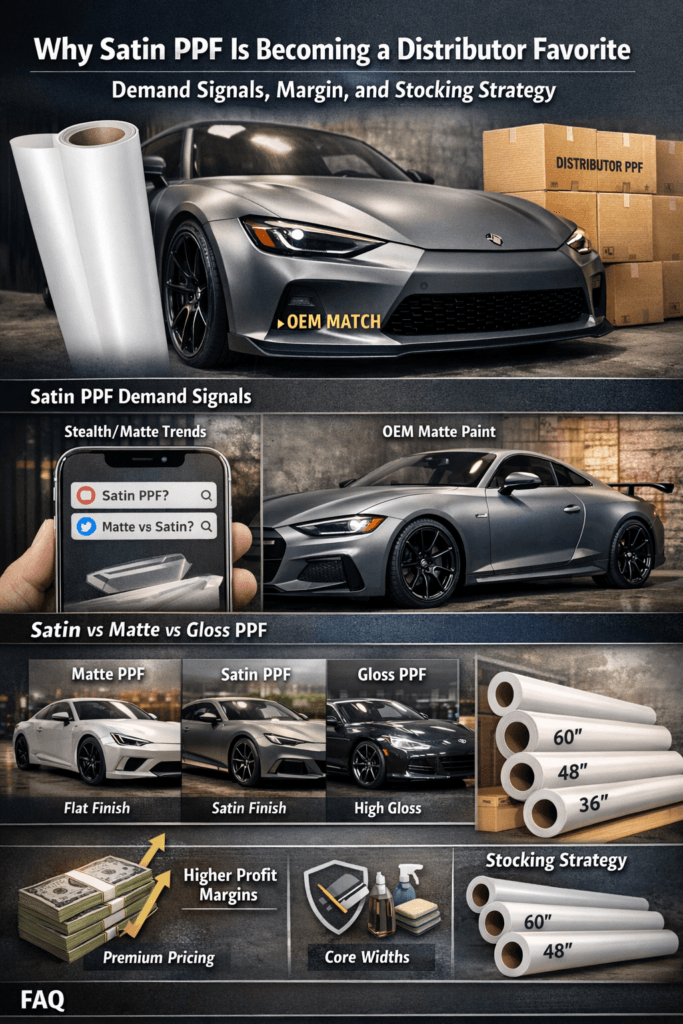
1) “Stealth / Satin” brand queries and installer inbound
When customers ask for “stealth” or “satin finish,” they’re not shopping by thickness – they’re shopping by look. That creates faster decisions and less price-only comparison. XPEL positions STEALTH as providing a “unique satin finish,” which mirrors how end users talk about the category.
2) OEM matte/frozen paint matching requests
A big satin driver is “I want protection that matches factory frozen/matte paint.” STEK explicitly markets DYNOmatte as a film that can create a satin-like sheen while keeping metallic flake visible, which is exactly the buyer intent you’ll see in the field.
3) “Matte vs satin ppf” comparison questions
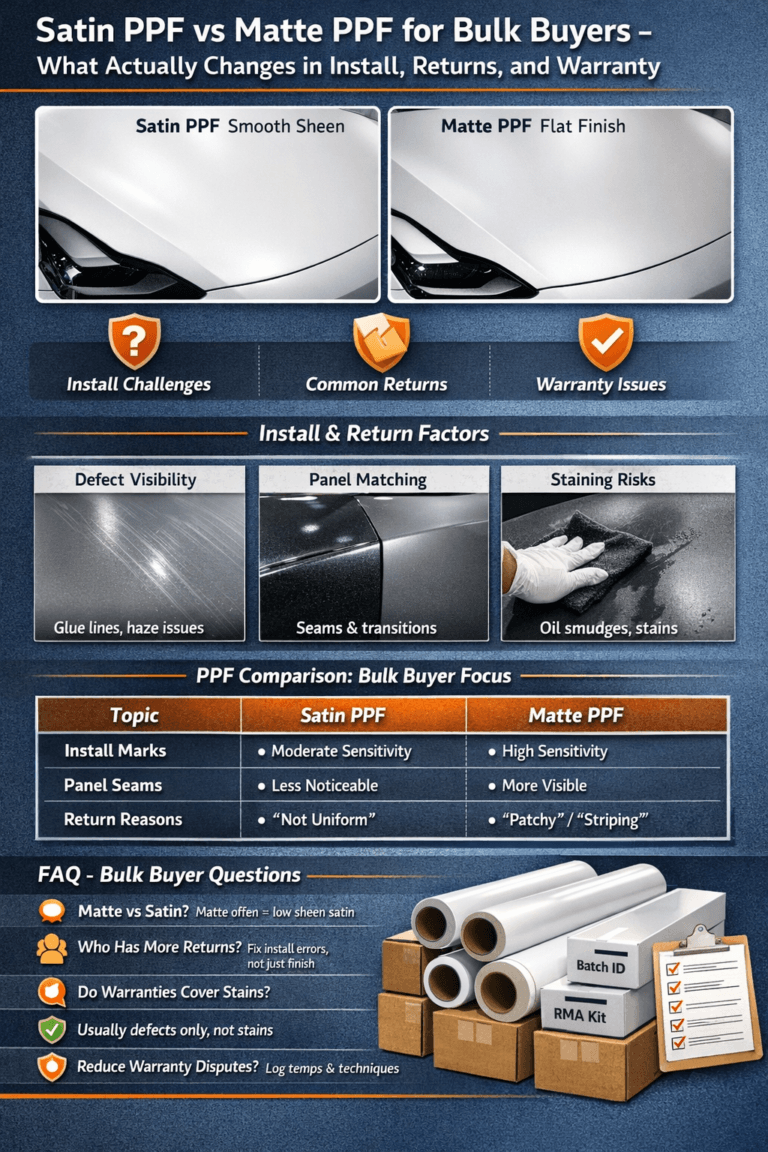
If your leads are asking “matte vs satin ppf,” that means they’re already sold on non-gloss and are choosing the safer finish (satin often looks less flat and is easier to live with). This comparison content is now common in the market.
4) Fitment-driven demand: partial panels and accents
Satin PPF is often applied to hoods, roofs, pillars, mirrors, and accents. That changes your roll consumption pattern: more short runs, more mixed widths, more “small but frequent” orders.
5) “Brushed / special finishes” protection needs
Some OEM finishes don’t look right under standard PPF gloss. XPEL’s own category guidance notes satin film use for brushed finishes because typical PPF can add gloss.
Why Satin PPF Often Holds Better Margin
Satin PPF can be a margin category because it is easier to position as a “finish upgrade” rather than a commodity shield.
The distributor profit stack for satin
A practical way to think about satin economics:
- Core film margin (rolls): Satin is less directly price-compared than gloss, so discount pressure is often lower (especially if you brand it as “STEALTH/satin finish class”).
- Service pull-through margin: Installers buying satin usually also buy more tools, plotter patterns, and aftercare because the finish is “appearance-first.”
- Lower “race-to-bottom” competition: Gloss PPF is easier to commoditize; satin is more style-driven and brand-coded.
- Warranty narrative supports pricing: Self-healing and durability claims are mainstream for premium PPF (3M highlights self-healing on its Pro Series pages), reinforcing premium positioning across the category.
Margin risk to watch
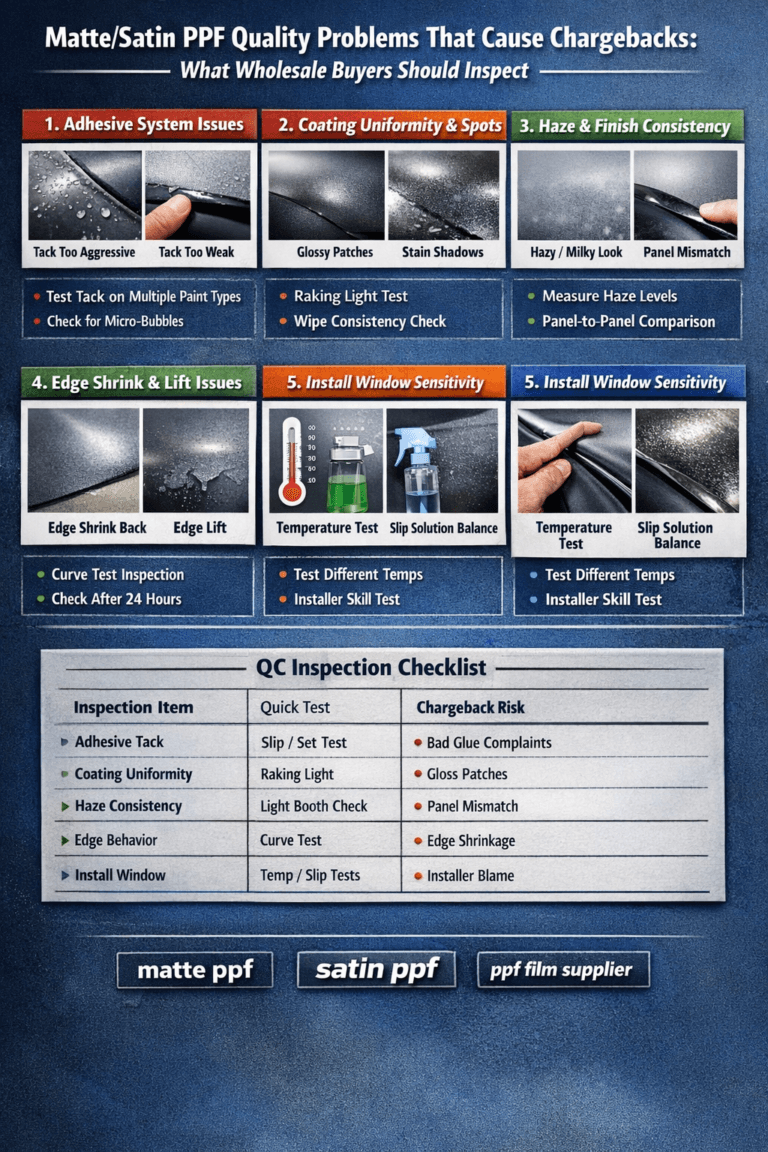
- Install sensitivity: Satin shows handling marks differently than gloss. Train installers on slip/tack balance and post-install cleaning expectations.
- Customer expectation mismatch: Some buyers say “matte” but actually want “satin sheen.” Your sales scripts must qualify the look.
Stocking Strategy: How Distributors Avoid Dead Satin Inventory
Satin PPF wins when stocked like a system, not like “one more SKU.”
Step 1: Define your “Satin Core Set” (the 80/20)
For most distributor ppf programs, start with a tight set:
- 60″ width (primary)
- 48″ width (secondary)
- 30″/36″ (for accents/partial panels and smaller vehicles)
Then expand only after you see repeat purchase cadence.
Step 2: Treat satin as a “finish layer,” not a separate universe
Don’t multiply every thickness, adhesive feel, and liner type at once. Keep the offer simple:
- One mainstream satin line (your hero SKU)
- Optional “premium satin” if you have proof of a high-end installer segment
- Keep gloss/matte as separate lanes, but share accessories and support
Step 3: Use sampling that predicts roll velocity
Sampling works best when it matches how installers sell:
- A4/A3 swatches for in-shop comparison
- Mirror/hood demo kits (small panels sell the finish fast)
- Before/after photos and a 30-second “finish difference” script
Step 4: Reorder rules that protect cash flow
For satin, avoid over-stocking by setting reorder based on weeks of cover (WOC):
- Fast movers: 4-6 WOC
- Medium movers: 2-4 WOC
- Long tail widths: 1-2 WOC (or special order)
Step 5: Make lead time a feature (not an excuse)
If your ppf supplier can ship same/next business day for certain SKUs (XPEL highlights fast ship timing on some shop listings), you can hold less inventory and still look “in stock.”
Table: Satin vs Matte vs Gloss PPF for Distributor Decisions
| Finish | Typical buyer trigger | Pricing power | Inventory risk | Best distributor move |
|---|---|---|---|---|
| Gloss PPF | “Protect my paint” | Medium | Medium-High (commoditized) | Compete on consistency, clarity, availability |
| Matte PPF | “Full stealth / flat look” | Medium | Medium | Stock selectively, align to local style demand |
| Satin PPF | “Stealth look but premium sheen” | High | Low-Medium (if core-set only) | Lead with demos, keep SKU count tight, push bundles |
(“Stealth/satin finish” positioning is commonly used by major brands, reinforcing how buyers perceive the category.)
How a PPF Supplier Can Support Distributor Sell-Through
If you’re pitching satin as a ppf supplier, the distributor will care about three support items more than extra specs:
- Consistency: finish uniformity roll-to-roll (reduces callbacks)
- Installer enablement: quick guides + handling tips (reduces install loss)
- Availability: predictable replenishment (reduces distributor cash tied up)
Also: product FAQs that address install time and repositioning reduce friction (3M discusses adhesive changes and working time in its PPF FAQ document – this kind of technical clarity helps distribution channels).
FAQ
What is satin ppf, and why do customers ask for it instead of matte?
Satin PPF sits between gloss and matte: it lowers shine but keeps more depth than a flat matte look. Many buyers want a “stealth” style without making the car look chalky or too flat.
Is satin ppf harder to install than gloss?
It can be more sensitive to handling marks and finish uniformity perception. Good installer process and aftercare guidance usually eliminates most issues.
How should a distributor ppf business stock satin without overcommitting cash?
Start with a core width set (60″ + 48″ + one mid width), cap weeks-of-cover, and use demo kits to predict which widths move.
Do big brands actually market satin/stealth as a distinct category?
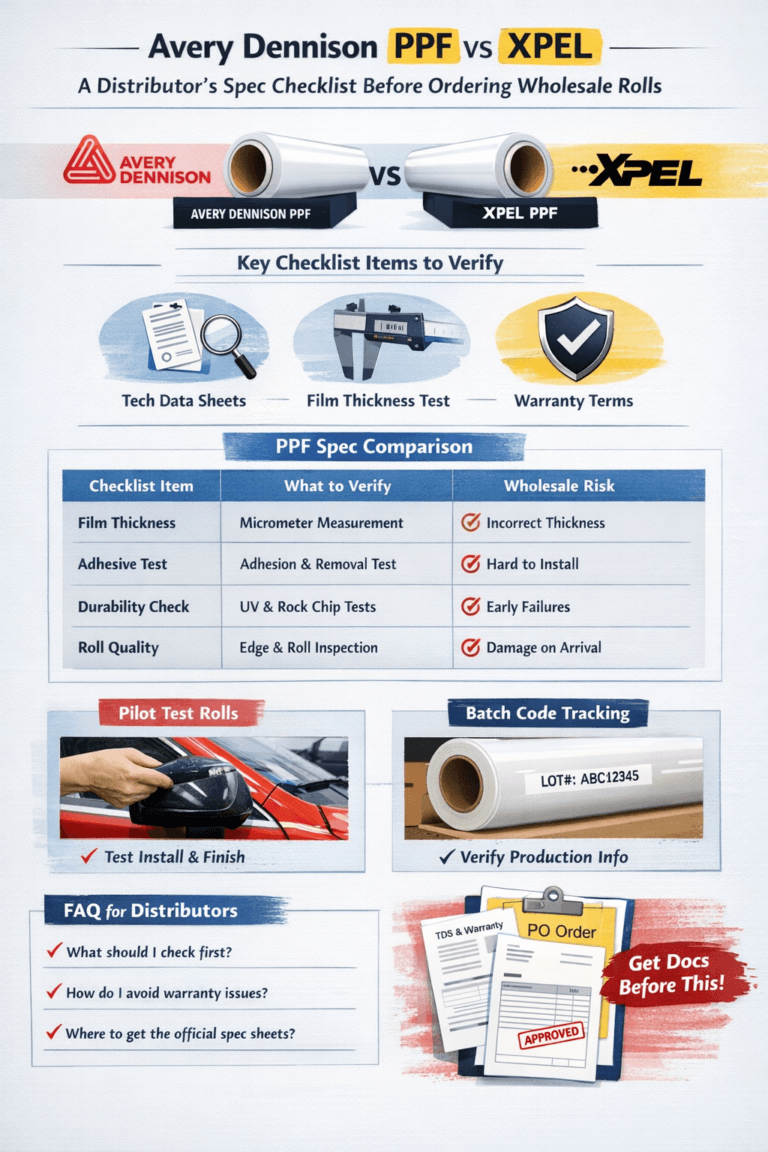
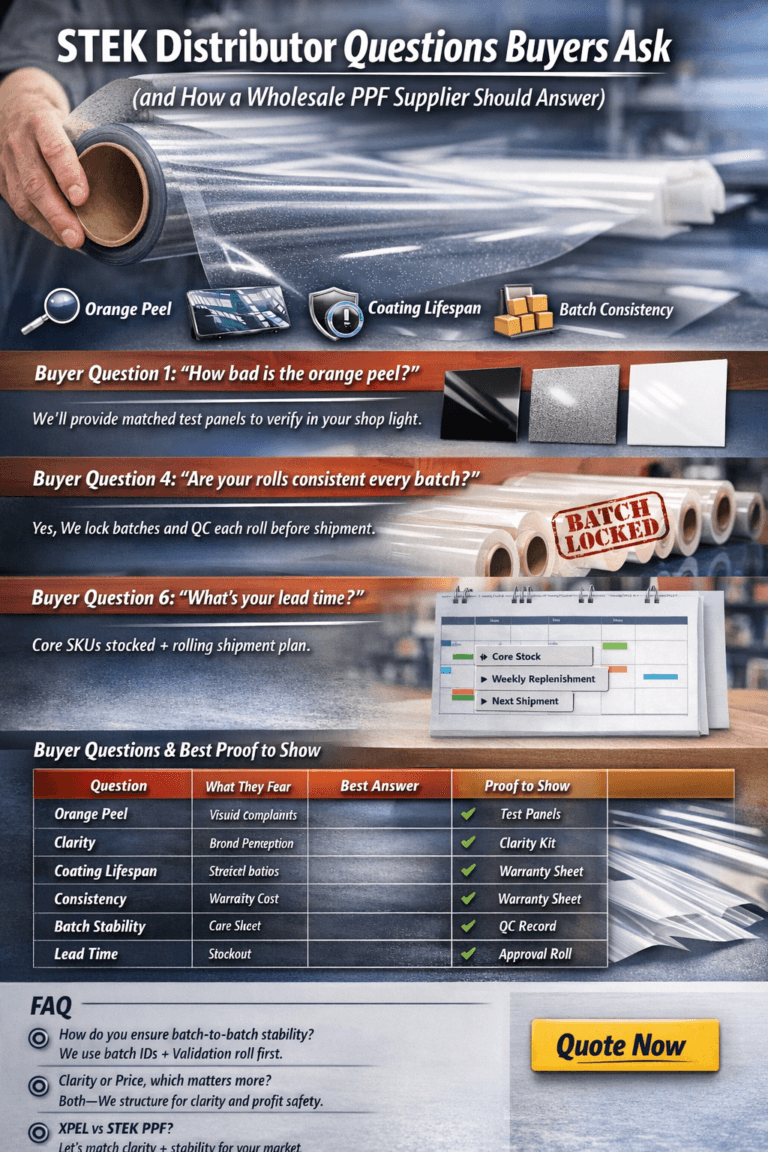
Yes. XPEL markets STEALTH for a satin finish look, and STEK markets DYNOmatte for matte-to-satin style positioning, which reflects established demand language in the market.
Does satin ppf change how customers maintain the car?
Usually the same wash rules apply (pH-neutral soaps, microfiber), but avoid products that add high gloss if the customer wants to preserve the satin look.
References
[1] STEALTH Paint Protection Film – XPEL (https://www.xpel.com/products/stealth)
[2] STEALTH Custom Length – XPEL Shop (https://www.xpel.com/shop/stealth-custom-length)
[3] Paint Protection Film Category FAQ – XPEL (https://www.xpel.com/products/category/paint-protection-film)
[4] DYNOmatte Paint Protection Film – STEK USA (https://www.stek-usa.com/paint-protection-film/dynomatte/)
[5] DYNOmatte – STEK Automotive (https://www.stekautomotive.com/brands/dyno/clear/dynomatte)
[6] Scotchgard Paint Protection Film Pro Series – 3M (https://www.3m.com/3M/en_US/p/d/b40066706/)
[7] Scotchgard Paint Protection Film Pro Series 200 – 3M (https://www.3m.com/3M/en_US/p/d/b5005352002/)
[8] 3M Paint Protection Film FAQ PDF (https://multimedia.3m.com/mws/media/2237340O/faq-3m-paint-protection-film.pdf)
[9] Gloss vs Satin vs Matte PPF (https://www.uppf-usa.com/blogs/post/gloss-vs-satin-vs-matte-ppf)
[10] Satin vs Matte PPF (https://rgbgfilms.com/satin-vs-matte-ppf/)