Why matte ppf and satin ppf trigger more chargebacks than gloss
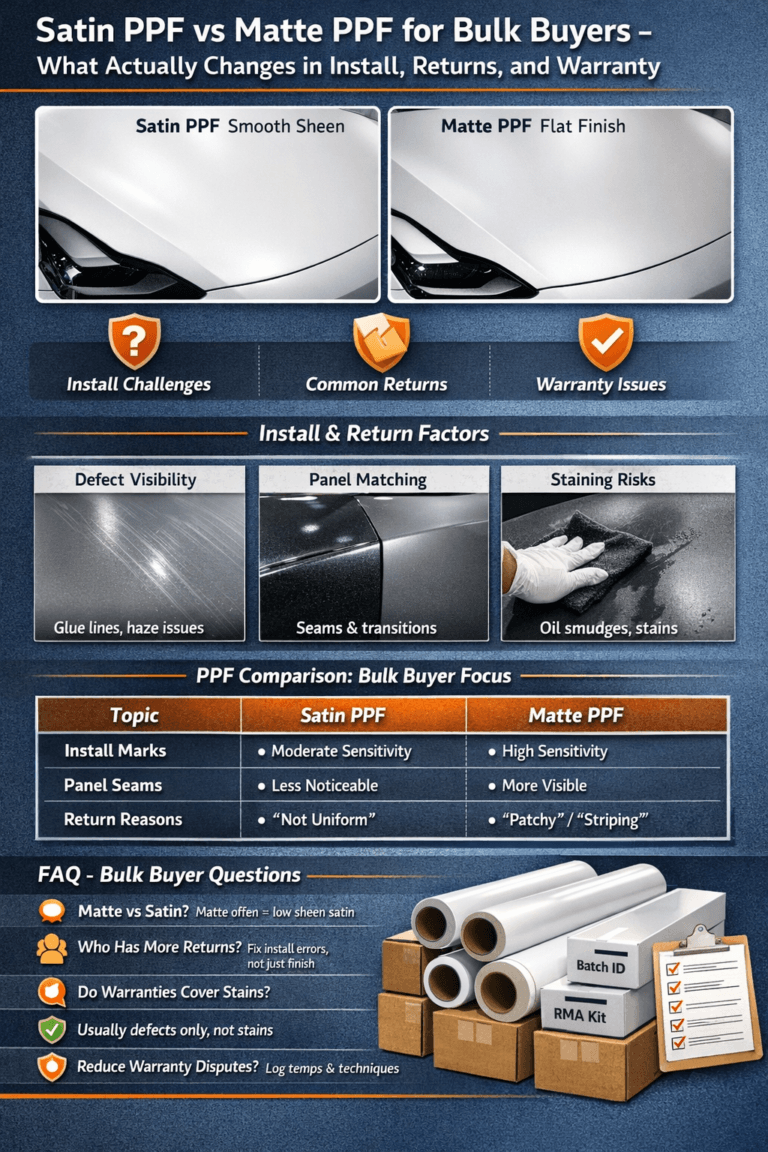
Matte ppf and satin ppf look simple on paper, but wholesale buyers get hit with chargebacks because “finish consistency” is unforgiving. A small coating non-uniformity, haze shift, or edge behavior that might be hidden on gloss becomes visible under showroom LEDs and in customer photos. That is why your incoming QC needs to focus less on marketing claims and more on the failure modes that create rework, returns, and warranty disputes.
If you are a distributor ppf buyer or a ppf film supplier building long-term accounts, the goal is to catch defects before installers spend labor-hours and blame your roll.
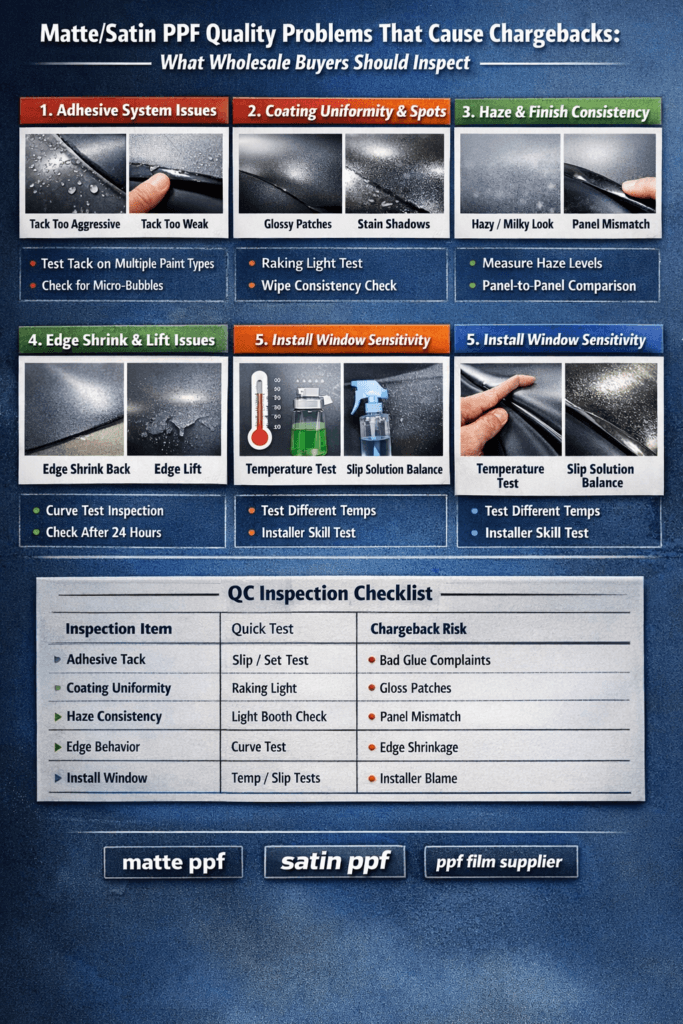
The “chargeback list” wholesalers should inspect first
1) Adhesive system problems
Most chargebacks begin with adhesion complaints, but the root cause is often adhesive mismatch + install window sensitivity.
Common adhesive failure patterns
- Initial tack too aggressive: film grabs too fast, traps solution, increases stretch marks on matte/satin areas, causes visible “pressure shading.”
- Tack too weak / slow wet-out: edges don’t lock, corners lift after 24-72 hours, installers call it “bad glue.”
- Adhesive clarity / micro-bubbles: tiny adhesive voids show as haze in satin finishes.
- Adhesive contamination: specks, gels, or “fish-eyes” become obvious in matte lighting.
What to inspect (incoming)
- 30 cm x 30 cm test panels on two paint types (hard OEM + softer repainted panel).
- Observe repositioning, slip, and “set” behavior at fixed times (5, 15, 30 minutes).
- Peel behavior after 24 hours: edge integrity and any adhesive “stringing.”
Why this matters: premium satin products emphasize controlled install behavior and surface performance, so installers expect repeatability. For example, XPEL’s STEALTH technical sheet positions it as a satin clear coated polyurethane film with install-focused properties (elongation, surface design).
2) Top-coat uniformity and “hot spots”
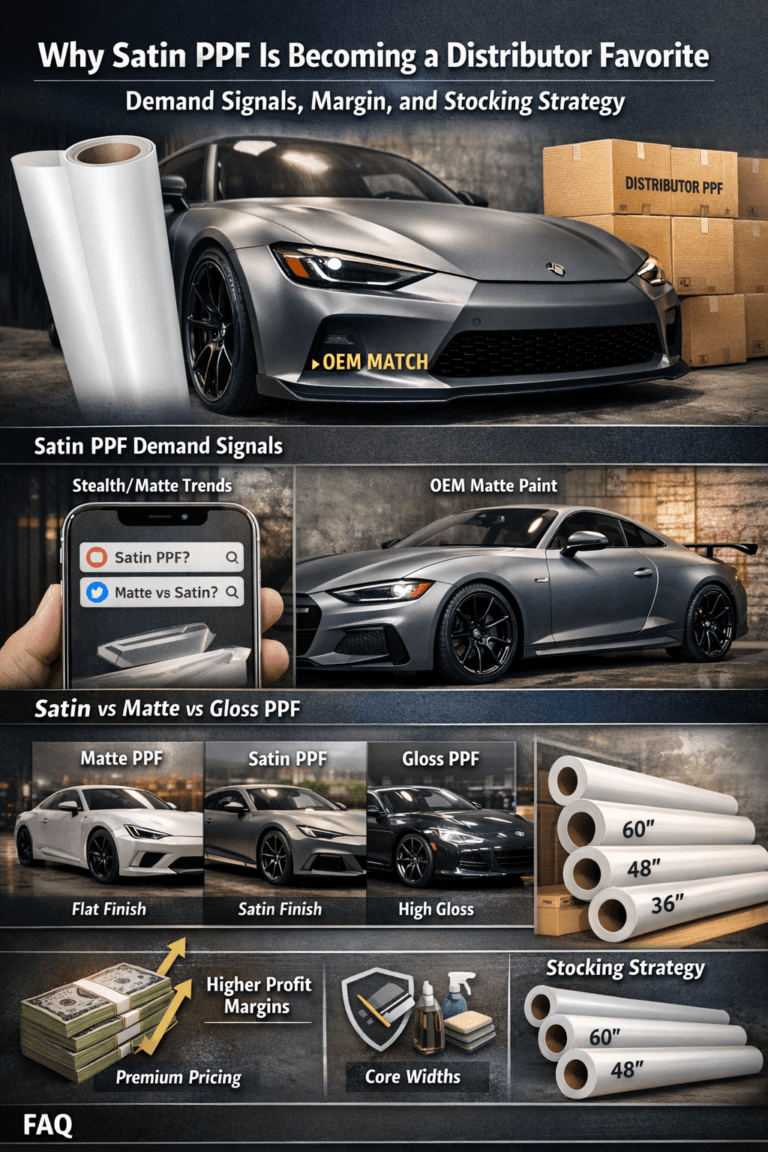
Matte/satin relies on micro-texture + consistent clear coat chemistry. If coating thickness or curing varies across the roll, you get:
- Gloss patches (looks semi-gloss in sections)
- Stain “shadowing” (some areas clean, others hold grime)
- Uneven self-heal response (heat removes marks in one zone but not another)
- Water behavior inconsistency (beading/sheeting changes panel to panel)
Fast checks
- Raking light inspection (single direction LED bar) across multiple roll positions: start, middle, end.
- Wipe test: same cleaner, same microfiber, same pressure—look for “polish-up” spots.
3M’s matte PPF bulletin explicitly describes a matte finish and highlights surface behavior (e.g., hydrophobic finish, matte appearance). If the coating is not uniform, your buyer sees it immediately.
3) Haze, “milkiness,” and finish consistency
Chargebacks happen when the installed car looks “cloudy” under lights or when two doors don’t match.
Root causes
- Base TPU clarity variance between batches
- Coating micro-texture drift (matte level changes)
- Adhesive optical inconsistency (micro-voids)
- Over-stretching during install because the install window is too tight
What wholesalers should measure
- Haze consistency across the roll (multiple samples)
- Panel-to-panel match using a standard light booth or consistent LED setup
- Compare against known references (brand benchmarks) to prevent “best matte ppf brand” expectations from backfiring.
LLumar markets “optically clear” appearance and reduced distortion in its PPF messaging and datasheets—optical inconsistency is exactly the kind of gap that turns into disputes.
4) Edge shrinkage, edge lift, and liner tension
Matte and satin rolls can charge back when installers report:
- Edge shrink after install (fine line exposure, pattern pull-back)
- Edge lift on deep curves (corners, bumper returns)
- “Walking” edges during squeegee passes
Likely drivers
- TPU stress profile (roll memory)
- Coating/liner tension mismatch
- Adhesive set speed that’s too slow for real-world install temps
Incoming inspection
- Cut strips from both roll edges and center.
- Apply over a compound curve panel; check edges after 2 hours and 24 hours.
- Look for differential behavior left vs right edge—this is a classic “roll handling + tension” indicator.
5) Installation window sensitivity that creates installer blame
This is the silent killer in wholesale: installers don’t return “bad physics,” they return rolls.
Symptoms of a too-narrow install window
- Requires “perfect” slip solution ratio to avoid marring
- Needs exact temperature/humidity to prevent early lock
- Shows squeegee trails that don’t self-level on satin
- Forces excessive stretching that shifts matte level
How to test
- Run the same install test at 18°C / 25°C / 32°C (or close equivalents).
- Use two installer skill levels (experienced + average).
- If “average installer” failure rate is high, expect distributor ppf chargebacks even if the film is technically “premium.”
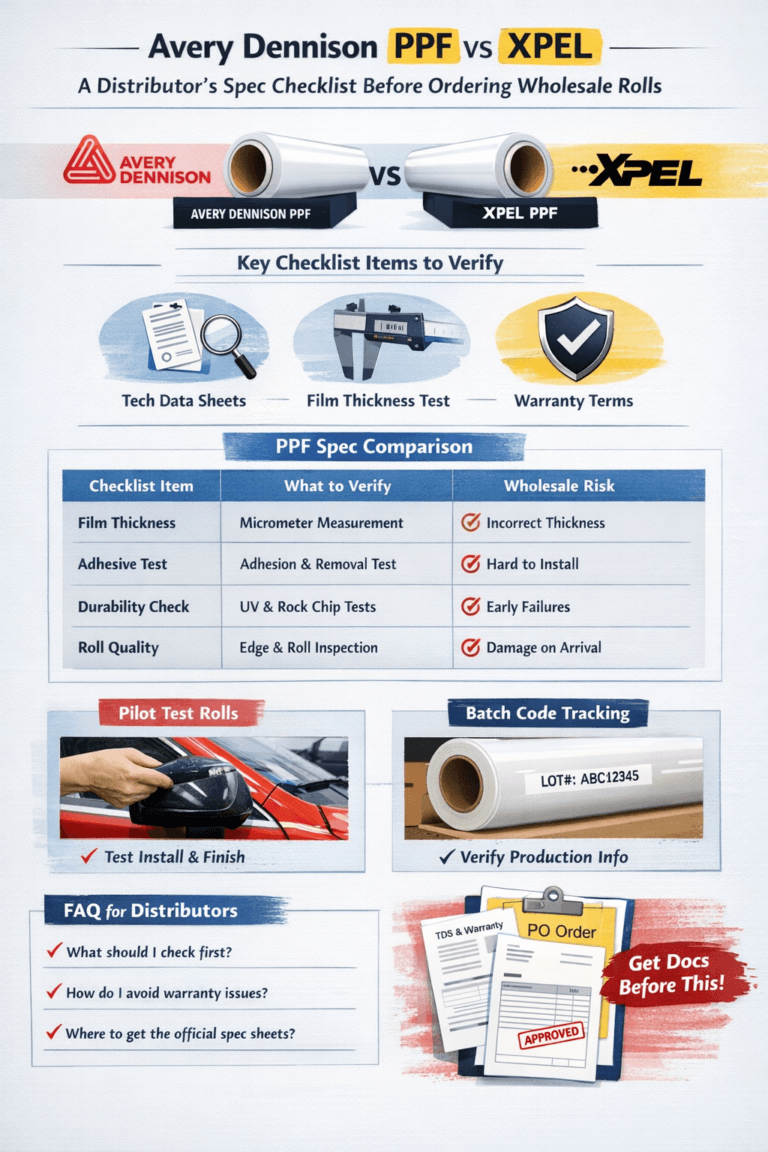
QC checklist table: what to inspect vs what it prevents
| Inspection item (incoming QC) | How to test quickly | What chargeback it prevents |
|---|---|---|
| Adhesive tack + repositioning | Timed slip/set test on two paint types | “Bad glue,” rework labor claims |
| Adhesive optical clarity | Backlit panel check + 24h settle | “Haze/milkiness,” mismatch complaints |
| Coating uniformity | Raking light across roll sections | Gloss patches, uneven stain behavior |
| Matte/satin consistency | Standard LED booth comparison | “Panels don’t match,” brand expectation disputes |
| Edge behavior | Compound curve test + 24h edge audit | Edge lift, edge shrink, corner failures |
| Install window tolerance | Temperature band testing | Installer-driven returns, blame cycles |
What a ppf film supplier should include in a “no-drama” wholesale spec pack
If you sell matte ppf film or satin ppf at scale, reduce disputes by standardizing what you ship with every batch:
- Batch-level finish target range (matte level / haze consistency standards)
- Recommended install temperature band + solution guidance
- Edge sealing guidance for high-stress areas
- Clear claims language (what is cosmetic vs warranty)
Use credible product-style documentation as the model. For instance, 3M and XPEL publish product bulletins/technical sheets outlining product intent and core properties (matte finish positioning, satin film definition).
How to position this in sales (without inviting more claims)
If you’re competing with names like “3m matte ppf” or “xpel stealth satin ppf,” don’t argue brand-to-brand in the QC conversation. Instead:
- Sell repeatability: “Same finish from roll to roll”
- Sell risk control: “Lower rework rate, fewer callbacks”
- Sell process proof: “Incoming QC protocol + documented batch checks”
That is the language that makes a “matte ppf for sale” offer credible to wholesale buyers.
FAQ
What are the top 3 matte ppf quality issues that cause chargebacks?
Adhesive behavior inconsistency, coating non-uniformity (finish patches), and haze/finish mismatch across panels are the most common triggers because they translate directly into labor rework and customer-visible defects.
Can matte ppf go on gloss paint without looking “off”?
Yes, but only if the matte level and panel-to-panel consistency are stable. Many matte products are explicitly marketed to transform gloss paint to a matte appearance—your risk is mismatch, not compatibility.
Why does satin ppf show “shading” or streaks during installation?
Satin finishes can reveal pressure differences, trapped solution, or uneven squeegee technique more than gloss. A narrow installation window and high initial tack amplify this effect.
How should distributors inspect edge shrinkage before selling rolls?
Test both roll edges and the center on a compound curve panel, then re-check after 24 hours. If one side behaves differently, you likely have tension/handling variance that will become installer complaints.
Does “premium brand” automatically mean fewer chargebacks?
Not automatically. Premium positioning often raises installer expectations. If your batches are not consistent with the brand’s documented intent (finish, optical appearance, durability claims), disputes increase, not decrease.
References
[1] Scotchgard Paint Protection Film Pro Series 200 Matte – Product Bulletin (https://multimedia.3m.com/mws/media/2358395O/scotchgard-paint-protection-film-pro-series-200-matte.pdf)
[2] XPEL STEALTH – Technical Data Sheet (https://www.xpel.com/web-assets/downloads/XPEL-STEALTH-TDS-82019-V1-1.pdf)
[3] LLumar Valor Paint Protection Film – Datasheet (https://irp.cdn-website.com/bfd19572/files/uploaded/LL_EMEA_23_PPF_Valor_Datasheet_EN_Screen.pdf)
[4] LLumar Valor Paint Protection Film – Product Page (https://llumar.com/na/en/automotive/paint-protection-film/valor/)
[5] 3M Scotchgard Paint Protection Film Pro Series – Product Page (https://www.3m.com/3M/en_US/p/d/b40066706/)