Matte PPF Wholesale – Why Distributors Treat It Differently
Matte and satin paint protection film is not “just gloss PPF with a different look.” It behaves differently in the two places distributors care about most:
- Inventory risk: matte and satin demand is more trend-driven, and regional taste swings fast.
- Return and warranty risk: finish inconsistency, staining, and install marks show up more visibly on matte surfaces than on gloss.
Major brands market matte lines like 3M Scotchgard PPF Pro Series Matte, XPEL STEALTH, SunTek Ultra Matte, and Avery Dennison Supreme Defense Matte. These product pages all position matte PPF as a protective film that also delivers a satin/matte finish and targets high-exposure panels or full wraps.
For a distributor, that means you need a buying method that prioritizes sell-through and consistency over hype.
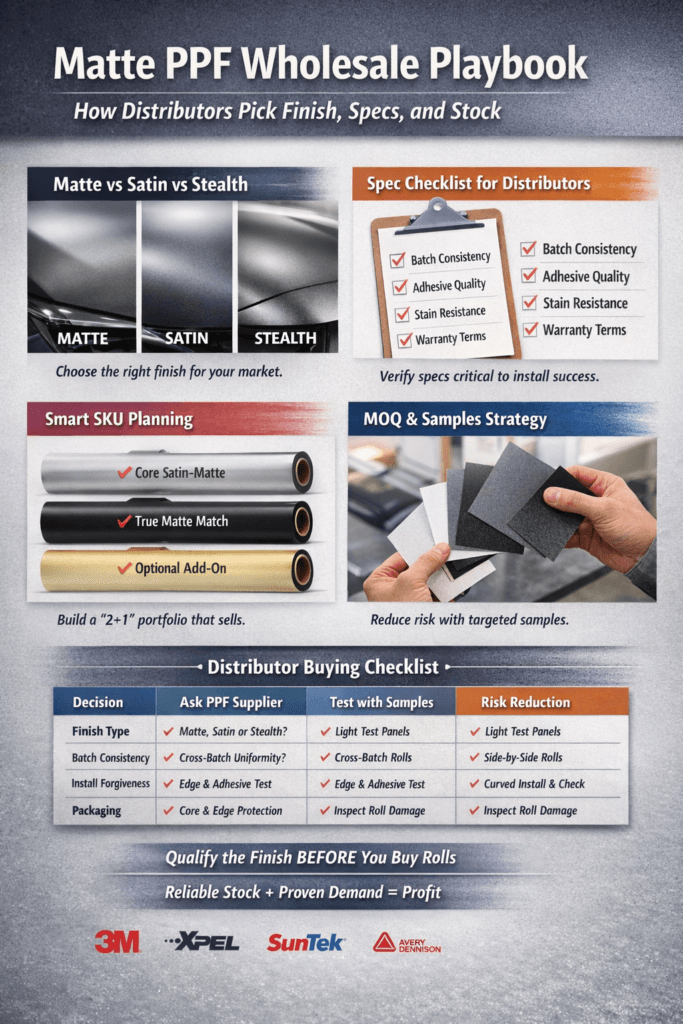
Step 1 – Define the Finish You’re Actually Buying (Matte vs Satin vs “Stealth”)
Distributors lose money when the market asks for one finish and they stock another. In the real world:
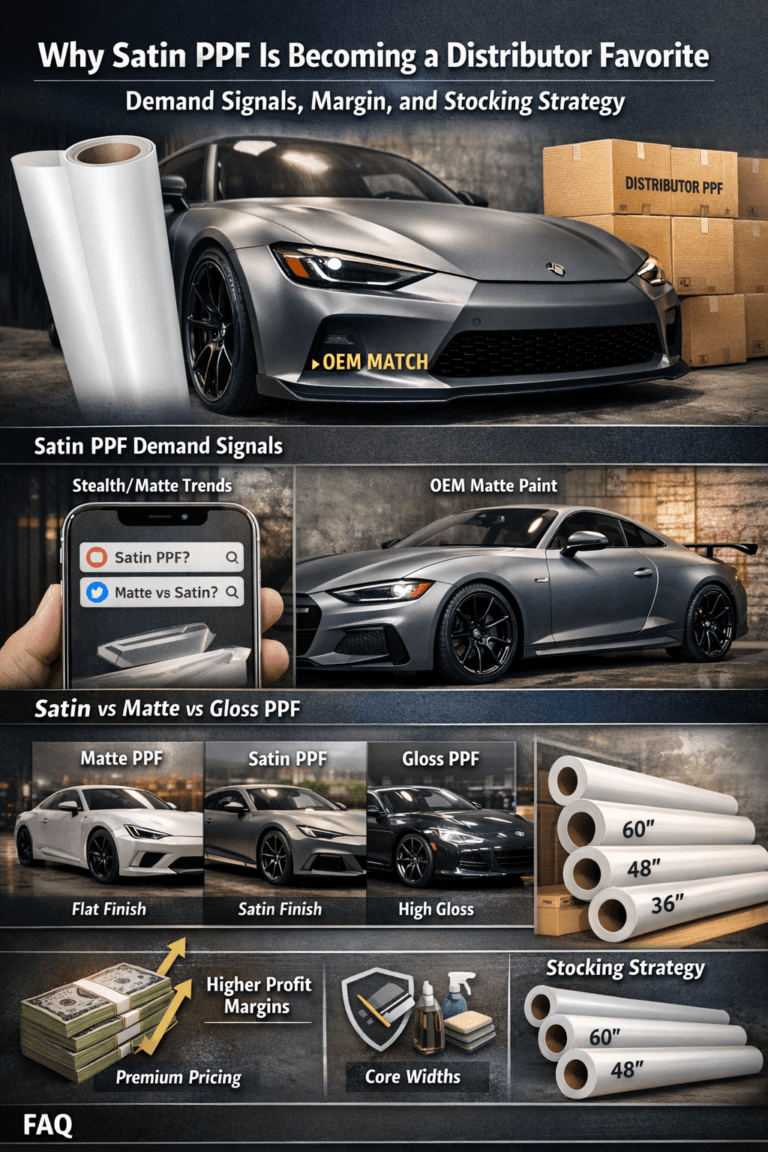
- Matte PPF is flatter, diffuses reflections more, and is often used to match factory matte paints.
- Satin PPF keeps a soft sheen, and is often chosen to convert gloss paint to a “stealth” look.
- “Stealth” is frequently used as a market term for satin-matte finishes (XPEL describes STEALTH as a satin finish).
Practical distributor rule
If your region’s customers mostly want the “luxury stealth” look, your core SKU is often satin-matte (not ultra-flat matte). If your customers are protecting factory matte paint, you need a true matte match and tighter batch controls.
Step 2 – Spec Checklist That Matters for Wholesale Buying
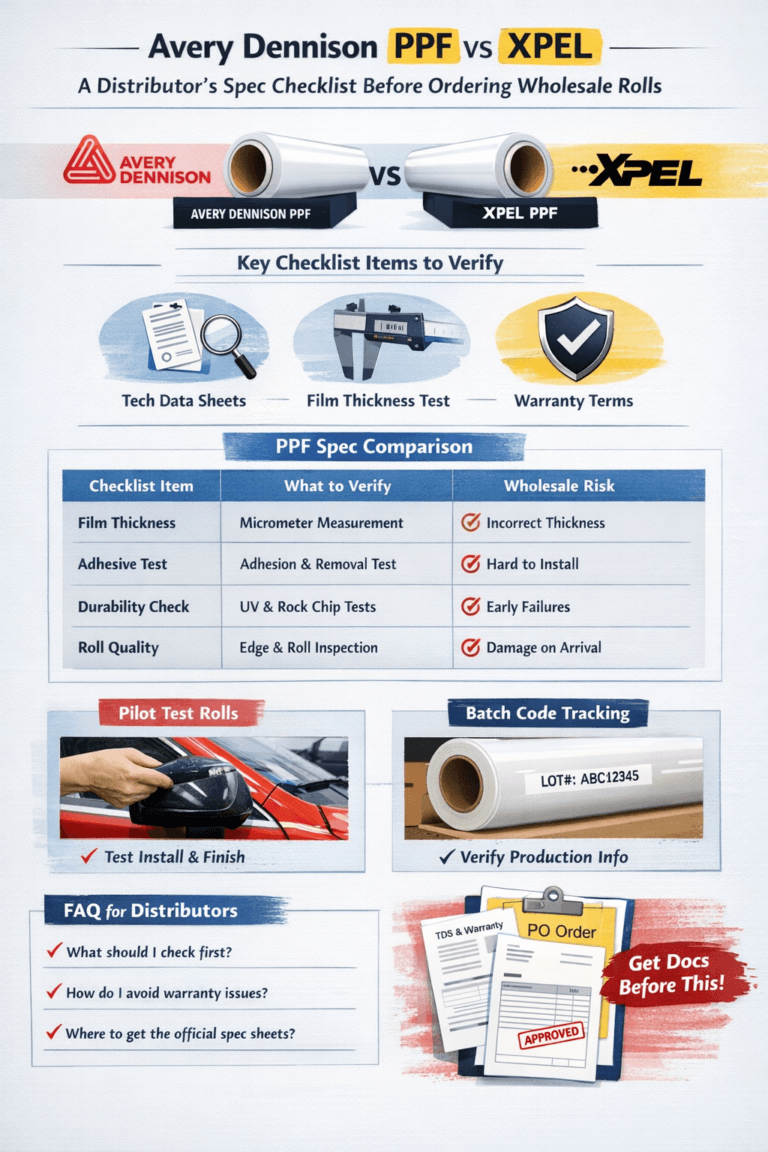
When you source from a ppf film supplier, distributors should evaluate specs in a way that predicts install outcomes and returns, not just lab numbers.
What to confirm before you commit MOQ
- Top coat behavior: self-healing positioning exists across matte lines (SunTek Ultra Matte highlights a self-healing top coat).
- Heat and moisture resistance: relevant to shipping, storage, and install variability (3M highlights heat and moisture resistance on its matte film page).
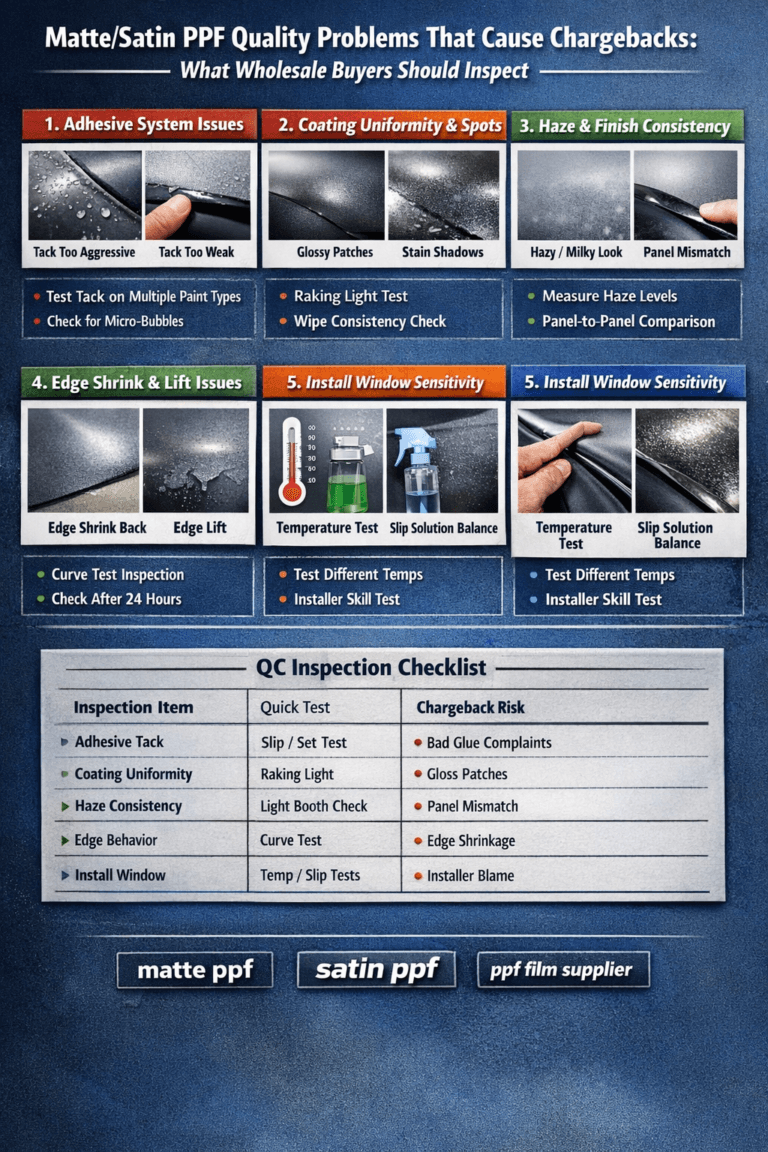
- Finish uniformity: how stable the matte level is across roll, across batch, and across lots.
- Adhesive handling: repositioning window, glue lines, edge lift sensitivity (critical for installer satisfaction).
- Stain resistance and maintenance: matte finishes make contamination and uneven cleaning more visible.
- Warranty logic: what is covered (yellowing, cracking, lifting) and what is excluded (installer errors).
Buying table – distributor-ready checklist
| Distributor decision | What to ask the PPF supplier | What to verify with samples | Why it reduces risk |
|---|---|---|---|
| Finish target | Is it true matte, satin, or satin-matte “stealth”? | Compare under direct light and shade on the same panel | Prevents “wrong look” returns |
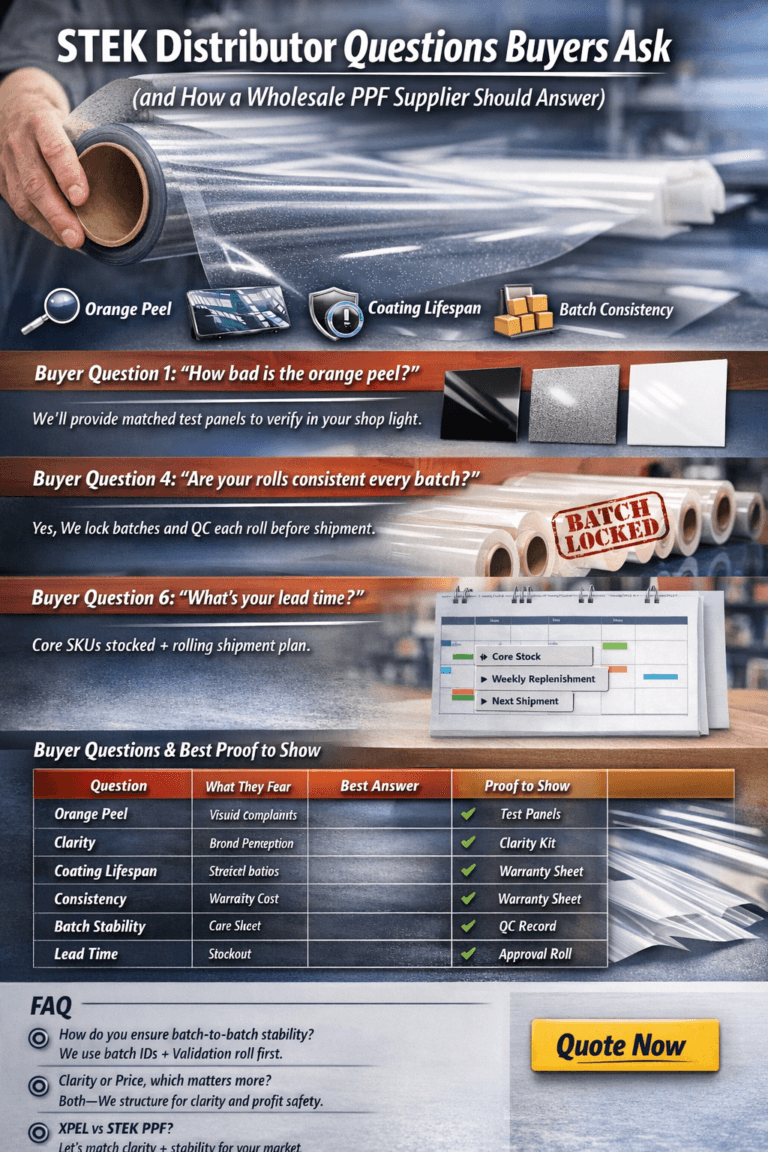
| Batch consistency | What tolerances exist for haze/finish uniformity? | Cross-batch panel test (two lots side-by-side) | Prevents mixed inventory complaints |
| Install forgiveness | Repositioning window, stretch behavior, edge stability | Install on curved bumper corner and door edge | Predicts installer rejection |
| Mark resistance | How does it handle squeegee trails and install marks? | Install with standard solution and check 24h later | Matte shows marks more easily |
| Care compatibility | Which cleaners and coatings are recommended? | Test wash, drying towel marks, bug remover spot | Reduces post-install complaints |
| Packaging | Core protection, end caps, roll crush resistance | Receive 1-2 rolls and inspect edge damage | Packaging drives hidden waste |
Step 3 – SKU Sets- How Distributors Build a Matte Line Without Dead Stock
The fastest way to get stuck with slow inventory is to over-SKU early. A simple, scalable approach:
The “2+1” matte portfolio
- SKU A – Core satin-matte (highest sell-through in many markets)
- SKU B – True matte match (for factory matte paint protection)
- SKU C – Optional add-on: a compatible maintenance product or a coating designed for matte PPF applications (some installers ask about ceramic coating for matte PPF, so you can bundle education and approved products rather than letting customers experiment)
Width-first strategy
For rolls, distributors generally win by standardizing on the widths that installers use most, then expanding only when demand proves it.
- Start with the dominant width used in your region for full-body and partial panels.
- Add a second width only after you see consistent re-orders.
- Offer “custom length” cutting as a service only when your warehouse process can do it without edge damage or contamination.
(Brands also sell custom-length options, which is a useful signal that mixed lengths and widths are common buyer needs.)
Step 4 – MOQ Design That Matches Demand Reality
MOQ should protect your cash flow and protect the relationship with your installers.
MOQ frameworks distributors actually use
- Test MOQ: small first order that proves finish acceptance and install behavior.
- Launch MOQ: enough inventory to support marketing and avoid stockouts.
- Scale MOQ: only after you confirm re-order cycles and complaint rate.
A practical MOQ rule for matte
If you cannot sell through the first batch within a predictable cycle, don’t widen SKUs. Expand by turnover, not by excitement.
Step 5 – Sample Strategy That Qualifies Demand Before You Buy Rolls
This is where most distributor ppf buyers can out-execute competitors.
Your sample kit should include
- 2 finishes: satin-matte and true matte
- 2 thickness options if available (only if it changes your positioning)
- A curved test panel piece (for stretch and edge behavior)
- A care test card (approved cleaners, what not to use)
Sample workflow that drives purchase decisions
- Pre-qualify the buyer: finish goal (factory matte match vs stealth conversion)
- Installer test: one bumper corner + one door edge
- 24-48 hour check: marks, haze, edge stability
- Commit: only then place the MOQ
This workflow reduces “I loved it in photos” mistakes that kill margin on matte products.
Step 6 – Competing With Brand Searches Without Selling Only Brands
Many buyers search brand combos like 3m matte ppf, xpel matte ppf, xpel stealth matte ppf, suntek matte ppf, or avery dennison matte ppf. The winning distributor approach is:
- Use comparison content to capture clicks (brand vs brand, stealth vs matte)
- Use a spec checklist to keep the discussion objective
- Offer a supply path that emphasizes consistency, lead time, and business terms
XPEL positions STEALTH around a satin finish and protection benefits, and SunTek markets Ultra Matte as combining protective performance with a smooth matte finish and a self-healing top coat. Those are exactly the talking points distributors should translate into measurable criteria and supply commitments.
FAQ
1) What is the difference between matte PPF and satin PPF for wholesale buyers?
Matte is flatter and aims to match factory matte paint. Satin keeps a soft sheen and is often used to convert gloss paint to a stealth look. Many markets use “stealth” to mean satin-matte.
2) Is PPF for matte paint different from matte PPF used as a style wrap?
Yes. Protecting factory matte paint is less forgiving – finish match and batch consistency matter more. Style conversions can tolerate slightly more variation if the look is consistent across panels.
3) Can you apply ceramic coating for matte PPF?
Some installers do, but the bigger wholesale move is to provide an approved care path and prevent random chemistry experiments. If you support coating, document what is compatible with your matte top coat and include aftercare instructions.
4) What specs should a distributor ask a PPF supplier for before buying MOQ?
Ask about finish definition (matte vs satin), batch consistency controls, top coat behavior, adhesive handling, stain resistance, packaging protection, and warranty scope.
5) How do I avoid slow stock when selling matte PPF for sale?
Start with a “2+1” portfolio, standardize widths, run a sample-driven qualification process, and scale MOQ only after re-order cycles are proven.
References
[1] Scotchgard Paint Protection Film Pro Series Matte (https://www.3m.com/3M/en_LB/p/d/b5005067101/)
[2] Stealth PPF – XPEL (https://www.xpel.com/products/stealth)
[3] Paint Protection Film Ultra Matte – SunTek (https://suntekfilms.com/na/en/paint-protection-film/ultra-matte/)
[4] Supreme Defense Matte Paint Protection Film – Avery Dennison (https://graphics.averydennison.com/en/home/graphics-products/paint-protection-film/supreme-defense-matte-film.html)
[5] Suntek Ultra Matte PPF vs Xpel Stealth for Model Y (https://www.reddit.com/r/AutoDetailing/comments/1lcecrx/suntek_ultra_matte_ppf_vs_xpel_stealth_for_model_y/)