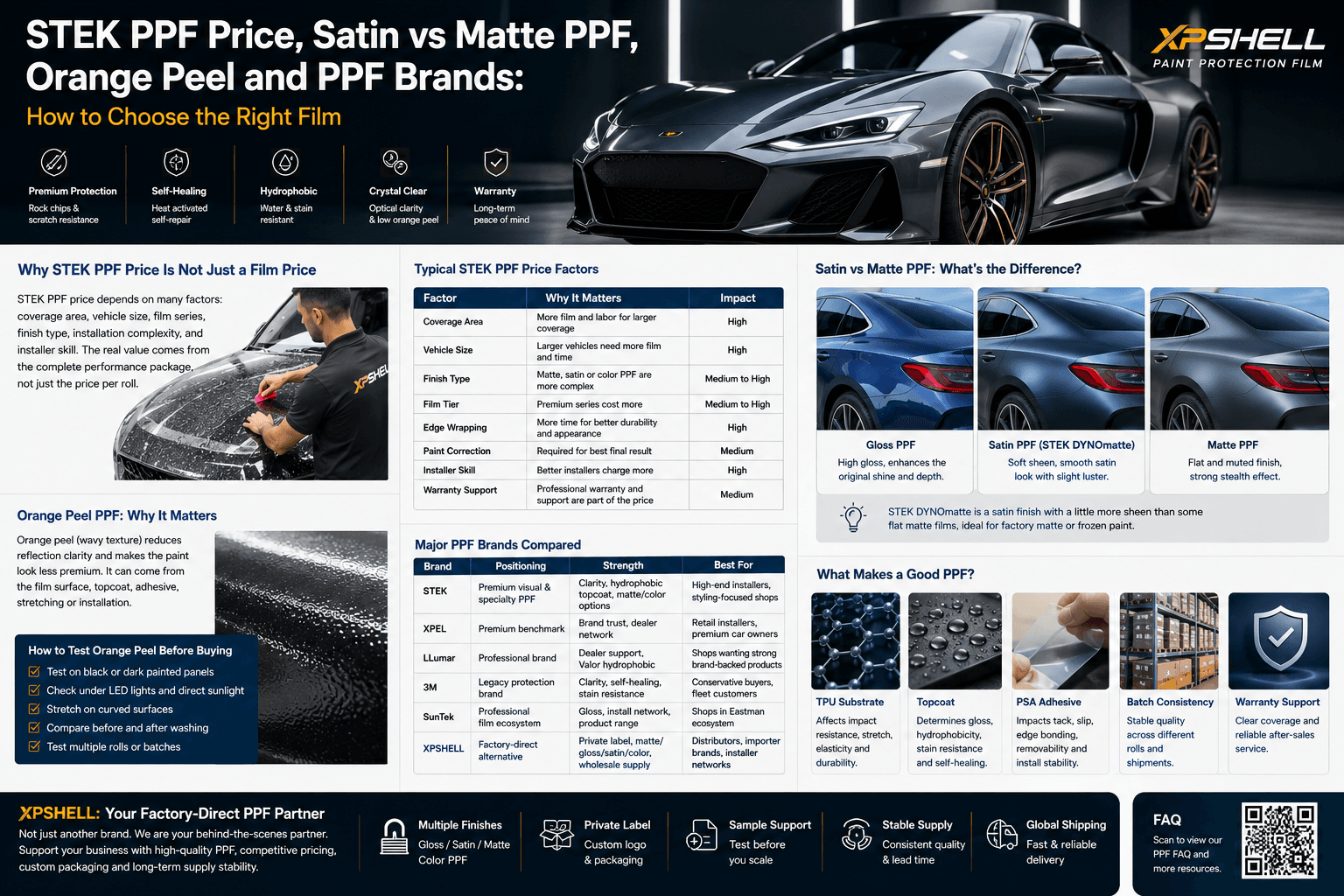
This guide explains STEK PPF price factors, the difference between satin vs matte PPF, why orange peel matters, and how professional buyers should evaluate PPF brands by film structure, topcoat behavior, adhesive stability, installation feedback and business margin.
Why STEK PPF Price Is Not Just a Film Price
Searches like “STEK PPF price” usually come from two different buyers.
Car owners want to know how much it costs to install STEK PPF on a car. Installers and distributors want to know whether STEK-style premium PPF can support enough margin, repeat sales and customer trust.
Those are different questions.
For retail installation, STEK PPF price depends on the vehicle, coverage area, local labor cost, film series, edge wrapping method, pattern cutting, paint preparation and warranty handling. A bumper-only job, full front package, full-body clear PPF and full-body matte or color PPF installation are not comparable jobs.
For distributors, the bigger question is not one installed price. The bigger question is whether the film can be sold, installed, reordered and supported profitably.
Typical STEK PPF Price Factors
The final installed price of STEK PPF is usually driven by these factors:
Price Factor | Why It Matters | Impact on Price |
|---|---|---|
Coverage area | Full front, track package and full body use very different amounts of film and labor | High |
Vehicle size | Large SUVs, trucks and supercars need more film and more installation time | High |
Finish type | Clear gloss is usually simpler than matte, satin or color PPF | Medium to high |
Film tier | Premium films usually cost more than entry-level films | Medium to high |
Edge wrapping | Wrapped edges take more time but look cleaner and may reduce edge lift risk | High |
Paint correction | Swirls and defects should be corrected before installation | Medium |
Installer skill | Better installers charge more because the job is labor-intensive | High |
Warranty support | A professional warranty process is part of the price | Medium |
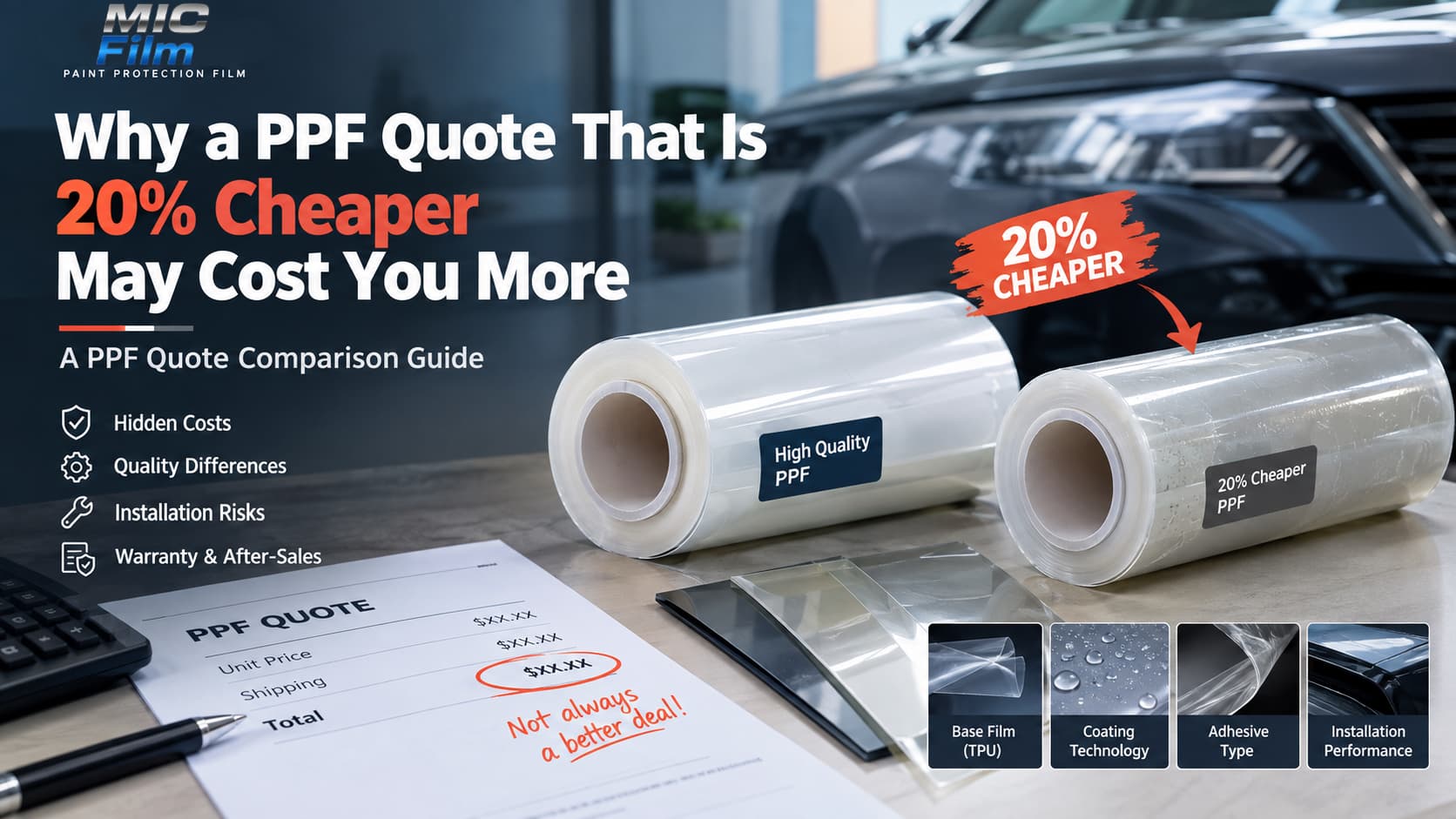
The mistake is to compare PPF by roll price only. A cheap roll can become expensive if it stretches poorly, leaves glue marks, lifts at edges, creates haze, or causes rework. For professional buyers, installation stability is part of real cost.
STEK DYNOshield: Why It Became a Premium Reference
STEK DYNOshield is one of the most discussed clear PPF products because it positions itself around premium optical clarity, hydrophobic behavior and self-healing performance. STEK describes DYNOshield as a premium top-coated PPF designed to stop rock chips and scratches while staying virtually invisible over factory gloss paint. Its official product information lists a glossy finish, 8 mil thickness, hydrophobic properties, anti-contamination performance, stain resistance and self-healing by heat or hot water [3].
The important point is not only the word “premium.” It is the full performance package:
- Clear gloss appearance
- 8 mil construction
- Hydrophobic topcoat
- Stain resistance
- Anti-contamination behavior
- Heat-assisted self-healing
- Warranty protection against defects such as delamination, yellowing, bubbling and cracking
That is why STEK often appears in comparisons with XPEL, LLumar and 3M. It is not only selling protection. It is selling a high-end visual result.
Satin vs Matte PPF: Are They the Same?
Many buyers search “satin vs matte PPF” because the words are often used loosely. In real sales language, matte, satin and stealth are related but not always identical.
Matte PPF usually means a flatter, lower-reflection finish. Satin PPF usually means a softer, silkier finish with a little more sheen. Stealth PPF is often used as a marketing term for matte or satin paint protection film that changes gloss paint into a muted finish.
STEK DYNOmatte is a useful example. Although the product name uses “matte,” STEK lists DYNOmatte with a satin finish and explains that it has slightly more sheen than some flatter matte alternatives [4]. This matters because many customers do not actually want a completely flat look. They want a premium satin surface that reduces gloss but still keeps visual depth.
Satin vs Matte PPF Comparison
Finish Type | Visual Look | Best For | Buyer Concern |
|---|---|---|---|
Gloss PPF | Preserves original shiny paint | Most daily drivers, luxury cars, resale-focused buyers | Must be clear with low haze |
Satin PPF | Soft sheen, less reflective than gloss | Factory-style stealth look, premium SUVs, Tesla, performance cars | Must look even across panels |
Matte PPF | Flatter and more muted | Matte paint protection, stronger restyling effect | Dirt, stains and uneven finish are more visible |
Color PPF | Changes color while protecting paint | Restyling buyers, shops wanting premium upsells | Color consistency and sample validation |
The best way to explain it to customers is simple: satin and matte PPF are not chosen mainly for protection difference. They are chosen for appearance. The protection logic is still based on TPU quality, topcoat, adhesive and installation.
Why Orange Peel PPF Matters
Orange peel in PPF refers to a textured or wavy surface appearance that reduces reflection quality. It can come from the original paint, the film surface, the topcoat, the adhesive layer, stretching, or installation technique.
This is why “orange peel PPF” is such an important search. Buyers are not only asking whether a film protects paint. They are asking whether the car still looks premium after protection.
Dark paint makes the problem more obvious. Black, dark blue, deep red and metallic finishes expose haze, waves and film texture faster than white or silver paint. A film may look acceptable on a small sample but show more distortion on a full hood under LED lighting.
XPSHELL’s STEK vs XPEL comparison makes a useful point: clarity should be tested under direct sunlight, LED shop lights, dark paint, curved panels and after washing [1]. This is exactly how installers and distributors should evaluate films before making purchasing decisions.
How to Test PPF Orange Peel Before Buying Rolls
A professional buyer should not rely only on catalog claims. Test the film in real installation conditions:
- Install samples on black or dark painted panels.
- Check reflection under LED lights.
- Inspect the panel under direct sunlight.
- Stretch the film on a curved surface.
- Compare gloss and texture before and after washing.
- Let the film cure and check whether adhesive marks, lift lines or haze appear.
- Compare multiple rolls or batches before scaling orders.
Low orange peel is especially important for high-end customers. A luxury car owner does not want protected paint that looks less refined than before.
PPF Brands: Why the Best Brand Depends on the Buyer
There is no single best PPF brand for every market. XPEL, STEK, LLumar, SunTek and 3M are all strong reference brands, but they solve different problems.
XPEL is often used as a premium benchmark because of brand recognition, installer network and clear paint protection positioning. STEK is known for optical clarity, hydrophobic topcoat and specialty finishes. LLumar and SunTek have strong professional dealer networks and product systems. 3M has deep material science credibility and a long history in automotive surface protection. XPSHELL is positioned differently: not as a retail-famous legacy brand, but as a factory-direct alternative for distributors, OEM buyers, private label programs and installer networks that want more control over margin, product tiers and supply [2].
Major PPF Brands Compared
Brand | Common Market Position | Strength | Best Buyer Type |
|---|---|---|---|
STEK | Premium visual and specialty PPF brand | Clarity, hydrophobic topcoat, matte/color/effect films | High-end installers, styling-focused shops |
XPEL | Premium clear bra benchmark | Brand trust, dealer network, consumer awareness | Retail installers, premium car owners |
LLumar | Established professional film brand | Dealer support, Valor hydrophobic positioning | Shops that want strong brand-backed products |
3M | Material science and legacy protection brand | Clarity, self-healing, stain and abrasion resistance | Conservative buyers, fleet or warranty-focused customers |
SunTek | Professional PPF and window film ecosystem | Gloss, install network, product range | Shops already selling Eastman film lines |
XPSHELL | Factory-direct alternative | Private label, sample testing, matte/gloss/satin/color PPF, wholesale supply | Distributors, OEM buyers, importer brands, installer networks |
How XPSHELL Fits Into the PPF Brand Conversation
XPSHELL should not be presented as “the same as STEK” or “better than every premium brand.” That is not the strongest position.
The stronger position is this:
XPSHELL is a factory-direct PPF and color PPF supplier for professional buyers who want to test film performance, build local product lines, control their supply chain and improve margin structure.
For a distributor, a premium brand like STEK creates customer trust. A factory-direct alternative like XPSHELL creates business flexibility. These are different advantages.
XPSHELL’s own brand comparison logic focuses on evidence instead of slogans: TPU substrate, topcoat, PSA adhesive, installation workability, batch consistency, warranty logic, dealer support and private label potential [2]. That is the right framework for professional buyers.
What Actually Makes a Good PPF?
A good paint protection film should be judged as a complete system.
1. TPU Substrate
The TPU substrate is the physical foundation of the film. It affects impact resistance, stretch behavior, elasticity, aging resistance and long-term appearance.
2. Topcoat
The topcoat decides the daily user experience. It affects gloss, smoothness, hydrophobic behavior, stain resistance, wash swirl visibility and self-healing performance.
LLumar Valor, for example, positions itself around self-healing protection and hydrophobic behavior against rocks, road debris, winter salt and sand [5]. 3M Scotchgard Pro Series also emphasizes self-healing technology, scratch and stain resistance, clarity and durability [6]. These examples show why premium brands talk so much about surface technology.
3. PSA Adhesive
The adhesive is less visible to consumers but extremely important to installers. It affects initial tack, slip, repositioning, water evacuation, edge bonding, glue marks, lift lines and removal risk.
For shops and distributors, adhesive behavior directly affects profit. A film that looks glossy but installs poorly can destroy margin through extra labor, rework and complaints.
4. Batch Consistency
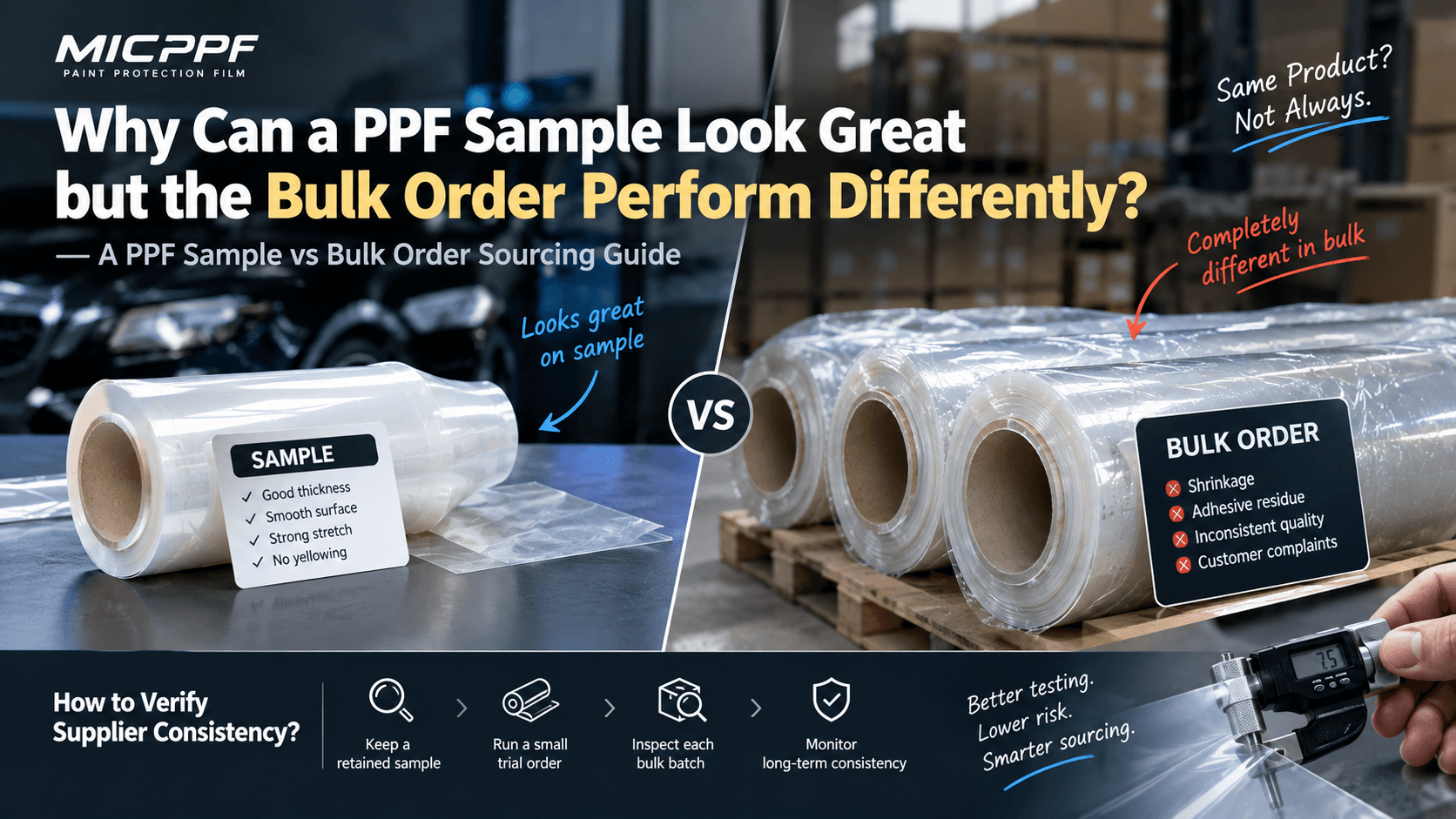
A supplier is not proven by one good sample. A supplier is proven by repeatable rolls. Distributors should test more than one batch before committing to a full product line.
5. Warranty Logic
A good warranty should be clear about what is covered and what is not. Yellowing, bubbling, cracking and delamination are different from rock impact damage, improper installation or chemical abuse. Professional buyers need clear after-sales rules before selling at scale.
STEK PPF Price vs Factory-Direct Alternatives
Premium brands usually help installers sell trust. Factory-direct suppliers help distributors build margin. The best choice depends on the business model.
A high-end detailing studio may prefer STEK or XPEL because brand trust helps close premium retail customers. A distributor or importer may prefer a factory-direct PPF supplier because the goal is to build local dealer margin, flexible product tiers and private label packaging.
This is where XPSHELL can be positioned as a business alternative, not a cheap substitute.
The buyer should ask:
- Can the supplier provide clear gloss, satin, matte and color PPF options?
- Can sample books be made for local dealers?
- Can the film be tested under heat, humidity, washing and stretch conditions?
- Is the adhesive stable enough for local installers?
- Are batches consistent enough for repeat orders?
- Can the packaging support private label or distributor branding?
- Can the supplier explain warranty boundaries clearly?
If the answer is yes, the buyer is not simply buying cheaper film. The buyer is building a product system.
Which PPF Should You Choose?
For Car Owners
Choose the installer first, then the film. A premium film installed badly is still a bad result. Ask to see finished cars, especially dark paint. Check edge wrapping, corners, mirrors, bumpers and lighting reflections.
For Installers
Choose film that fits your customer type. If your customers ask for the most recognized brand, a premium brand may help you close jobs. If your customers care about value, finish options and customization, testing factory-direct alternatives may improve your product range.
For Distributors
Do not choose by brand name alone. Build a test matrix around clarity, orange peel, hydrophobicity, adhesive behavior, stretch, removability, batch consistency and warranty support.
For Private Label Buyers
The best supplier is not necessarily the cheapest. It is the supplier that can help you build a stable product ladder: clear gloss, satin, matte, color PPF, premium series, entry series, sample books, packaging and dealer education.
Final Recommendation
STEK PPF price is high because STEK is not selling only a protective film. It is selling a premium finish, brand confidence, hydrophobic surface behavior, optical clarity and specialty options such as satin, matte and color PPF.
But the best PPF decision depends on the buyer.
If you are a car owner, compare installers and finished results. If you are a shop, compare film performance and customer demand. If you are a distributor, compare product systems, supply control and margin. If you are building a private label program, compare the full evidence chain: TPU substrate, topcoat, adhesive, installation feedback, batch stability and after-sales logic.
The best PPF is not just the one with the loudest brand name. It is the one that can be installed cleanly, sold confidently, reordered consistently and supported profitably.
FAQ
How much does STEK PPF cost?
STEK PPF cost depends on coverage area, vehicle size, local labor, film type, installer skill and finish. Full-front PPF is much cheaper than full-body matte or color PPF. For accurate pricing, buyers should request quotes based on vehicle model, coverage and finish.
Is STEK PPF worth the price?
STEK PPF can be worth the price for buyers who value optical clarity, hydrophobic behavior, premium finish options and strong visual results. However, installation quality is just as important as film choice.
What is the difference between satin and matte PPF?
Satin PPF usually has a soft sheen, while matte PPF looks flatter and less reflective. In practice, many brands use terms such as matte, satin and stealth together. Always check real samples on the vehicle color before deciding.
Does matte PPF protect as well as gloss PPF?
Protection depends more on TPU quality, topcoat, adhesive and film construction than on whether the finish is gloss or matte. The finish mainly changes appearance.
What is orange peel in PPF?
Orange peel is a wavy or textured surface appearance that reduces reflection clarity. It may come from original paint, film texture, topcoat, adhesive, stretching or installation technique.
Which PPF brand has the least orange peel?
There is no universal answer. STEK promotes DYNOshield as having optical clarity and an orange peel-free finish, but real-world comparison should be done on the same panel, under the same lighting and with the same installer.
Is XPSHELL a STEK alternative?
XPSHELL can be positioned as a factory-direct alternative for distributors, OEM buyers, private label programs and installer networks. It should not be described as identical to STEK. Its value is in sample testing, wholesale supply, private label support, matte/gloss/satin/color PPF options and supply-chain flexibility.
What should distributors test before buying PPF rolls?
Distributors should test clarity, orange peel, hydrophobicity, self-healing, adhesive behavior, edge bonding, stretch, removability, batch consistency, packaging and warranty rules before scaling orders.
References
- STEK PPF vs XPEL: Clarity, Orange Peel, Hydrophobicity, Price and Distributor Options
- Best Paint Protection Film Brands and Technology in 2026: XPEL, STEK and LLumar Alternatives
- DYNOshield Hydrophobic Paint Protection Film – STEK USA
- DYNOmatte Paint Protection Film – STEK USA
- Valor Paint Protection Film – LLumar
- Scotchgard Paint Protection Film Pro Series – 3M
- How Much Should I Pay for Paint Protection Film? – Detailed Image Ask a Pro
- Wholesale Color PPF – XPEL, STEK and 3M Alternative Film – XPSHELL