A paint protection film roll is the bulk, installer-grade format of PPF—a clear urethane film engineered to protect painted surfaces from chips, scuffs, stains, and everyday abrasion. Major manufacturers describe PPF as a durable barrier against scratches, chips, and weathering, and they also highlight heat-activated self-healing for minor surface marks.[1][2][3]
Buying a ppf roll is different from buying an installation service. With a roll purchase, you are responsible for the material spec, the consistency of future batches, the storage and shipping conditions, and the warranty boundaries you can defend.
Paint Protection Film Roll / PPF Roll Basics: Construction and What “Roll Quality” Means
A paint protection film roll (often listed as a ppf roll) is a system, not a single layer. In simplified terms it includes:
A urethane film body (the impact-absorbing layer)
A surface topcoat (clarity, stain resistance, and often self-healing behavior)
A pressure-sensitive adhesive (bonding strength and clean removability)
A release liner (handling and cutting stability)
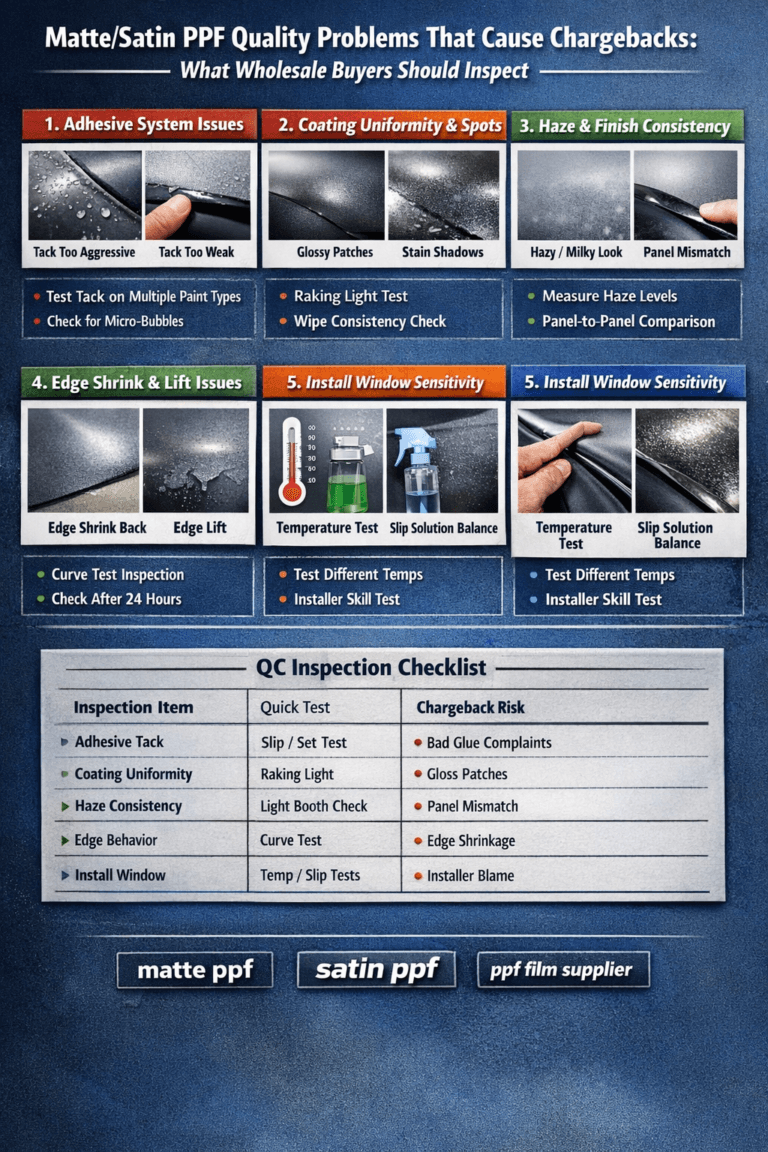
If any one layer is inconsistent, the whole roll becomes risky—edge lift, hazing, or adhesive residue can turn a cheap roll into expensive rework.
PPF Film Roll Specifications: Thickness, Urethane Body, Adhesive, and Topcoat
When comparing a ppf film roll, focus on measurable outcomes: optical clarity, resistance to staining, edge stability after wash/heat cycles, and predictable install behavior.
Thickness. Many premium lines are marketed around an “8 mil” class and position that thickness as robust protection against chips and light abrasion.[2][4] Thickness should be evaluated together with stretch and conformability—especially for bumpers, mirrors, and deep contours.
Topcoat and self-healing. Brand claims matter here because they set customer expectations. 3M’s Pro Series describes a self-healing formula where minor scratches can disappear, and a Pro Series 200 listing describes heat-applied self-healing for minor marks.[1][3] XPEL’s ULTIMATE PLUS describes advanced self-healing for minor scratches and swirl marks.[2][4]
Adhesive behavior. Adhesive is the “silent failure” variable. A roll that looks perfect out of the box can still cause silvering, edge lift, or difficult removal if the adhesive system is unstable or if the roll experienced poor storage.
Self Healing PPF vs Self Healing Paint: Healing Paint, Self Healing Auto Paint, and What Actually Heals
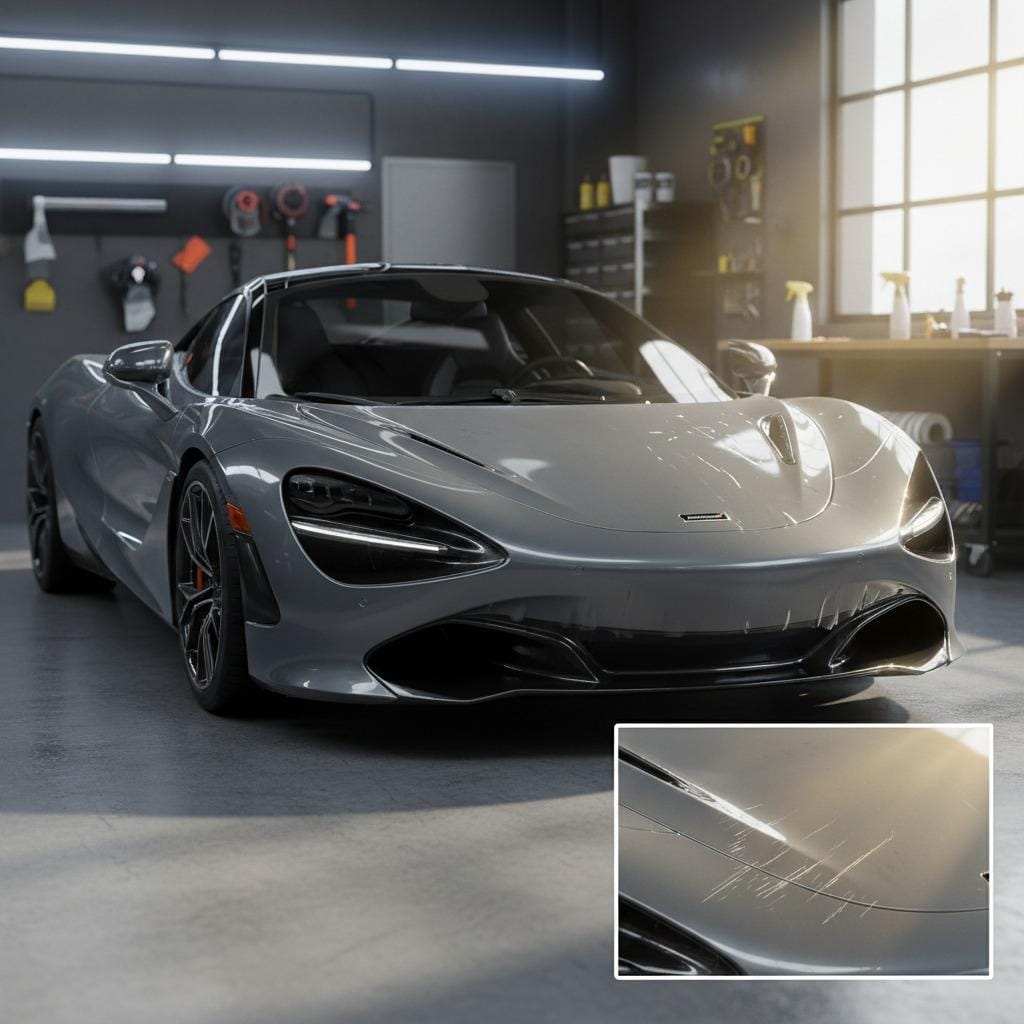
Self healing ppf is a commercial product feature: the film’s surface layer is designed to recover from light swirl marks and minor scratches when warmed. That recovery is consistently described as addressing minor surface defects—not deep cuts or punctures.[1][2][3]
By contrast, self healing paint, healing paint, and self healing auto paint are commonly used to describe self-healing coatings or paint-like polymer systems discussed in materials research. Reviews distinguish:
Intrinsic self-healing (reversible bonds/interactions inside the material)
Extrinsic self-healing (embedded healing agents such as microcapsules)[5][6]
Microcapsule-based protective coatings have been demonstrated to self-heal cracks and maintain protective performance in controlled studies.[7] This is a different approach from self healing paint protection film, which is designed as a removable, sacrificial barrier with a self-healing top surface for daily marring.
Self Healing Paint Protection Film: Performance Boundaries You Can Explain and Defend
Use self healing paint protection film to describe what the product reliably does:
Reduces visible micro-marring from routine washing and handling
Helps maintain gloss and visual clarity when minor swirls appear
Adds a physical barrier that can be replaced section-by-section if damaged
Use it to describe what it does not do:
It does not “erase” rock chips that cut through the film
It does not reverse deep gouges
It cannot prevent damage from severe impacts
Those boundaries align with how major brands describe self-healing as “minor” mark recovery, often activated by heat.[1][3]
Coating on a PPF Film Roll Installation: How Coating Changes Cleaning, Not Impact Protection
A coating applied on top of a PPF installation is typically used for easier cleaning, better water behavior, and resistance to certain contaminants. XPEL positions FUSION PLUS as a coating designed to repel dirt and liquids and reduce cleaning effort over time.[8]
A coating does not replace the impact-absorbing role of paint protection film. If you sell a ppf film roll, treat coating as an optional maintenance enhancer—not the core protection mechanism.
PPF Film for Sale / PPF for Sale: Vetting Sellers, Batches, and Warranty Positioning
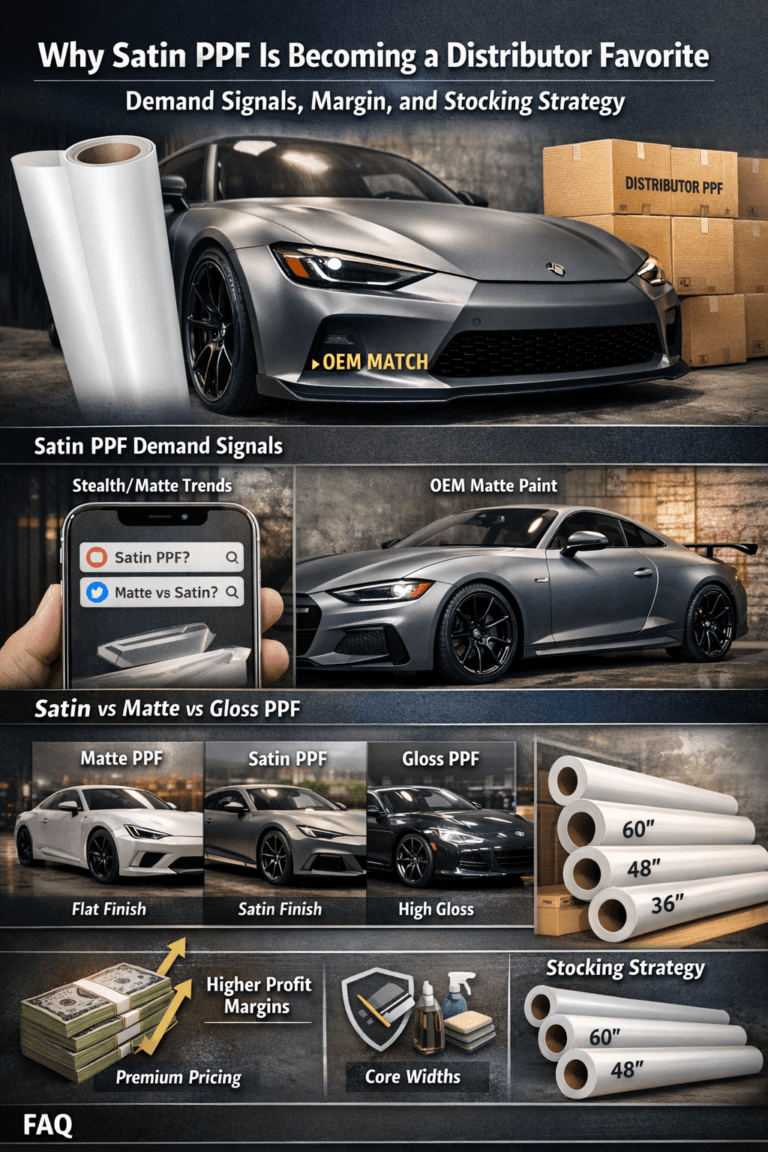
When evaluating ppf film for sale listings (or ppf for sale offers), prioritize what reduces downstream complaints:
Traceability: batch/lot ID for each ppf roll
Repeatability: consistent clarity and topcoat feel across shipments
Packaging & transport control: edge compression and heat exposure can damage rolls
Published claims: self-healing and durability statements you can reference publicly[1][2]
If a supplier cannot document what film line you are buying—or cannot keep batch consistency—switch suppliers before you scale orders.
Where to Buy PPF Film / Buy PPF Film Online: A Roll Procurement Checklist
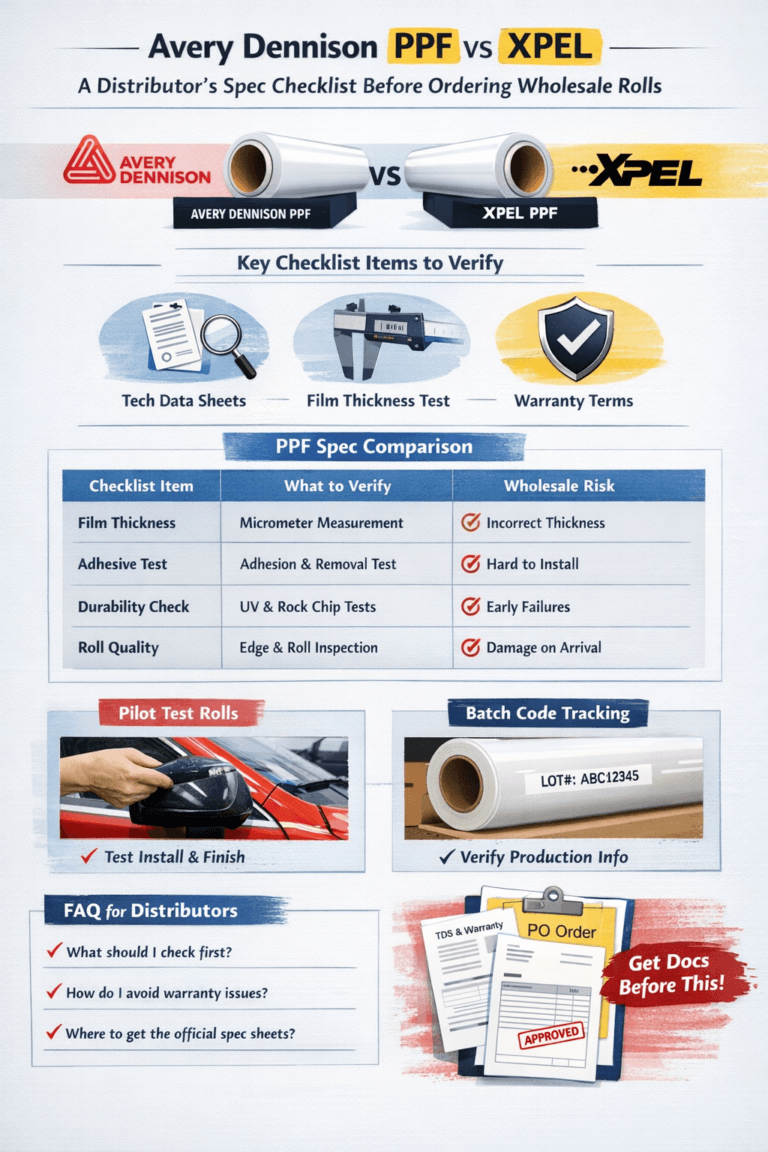
If your question is where to buy ppf film, the safest answer is: buy from a supplier who can prove exactly what you are receiving and can support repeat orders with the same spec. If you buy ppf film online, add verification steps:
Request the exact datasheet and product line name for the ppf film roll.
Confirm warranty and claim language (self-healing scope, exclusions, registration requirements).[1][2]
Test a sample cut from the same batch you will receive.
Validate shipping conditions for a paint protection film roll (heat, compression, and moisture control).
Run a controlled install test: clarity, edge behavior, and self healing ppf response to gentle heat on light marring.
FAQ: Paint Protection Film Roll, PPF Film Roll for Sale, and Self Healing Paint Protection Film
Q1: Is a paint protection film roll the same as a ppf roll?
Yes—“paint protection film roll” and “ppf roll” typically describe the same roll-format material.
Q2: What is a ppf film roll used for?
A ppf film roll is used to plot-cut patterns or hand-cut sections for vehicles and other painted surfaces.
Q3: Does self healing ppf fix rock chips?
No. Brand descriptions consistently frame self-healing as minor scratch/swirls recovery, often with heat, not chip repair.[1][2][3]
Q4: Is self healing paint the same as self healing paint protection film?
No. Self healing paint (and healing paint / self healing auto paint) usually refers to self-healing coating concepts studied in materials science. Self healing paint protection film refers to PPF with a self-healing top surface designed for minor marring recovery.[5][7]
Q5: Should I apply a coating on top of PPF?
A coating can improve cleaning and water behavior, but it does not replace film thickness and impact protection.[8]
Q6: Where to buy ppf film for commercial resale?
Choose suppliers that provide batch IDs, consistent specs, and published product claims you can cite when resolving disputes.[1][2]
References
[1] Scotchgard™ Paint Protection Film Pro Series (3M) — https://www.3m.com/3M/en_US/p/d/b40066706/ 3M
[2] ULTIMATE PLUS™ Paint Protection Film (XPEL) — https://www.xpel.com/products/ultimate-plus XPEL
[3] Scotchgard™ Paint Protection Film Pro Series 200 (3M) — https://www.3m.com/3M/en_US/p/d/b5005352002/ 3M
[4] ULTIMATE PLUS Custom Length (XPEL) — https://www.xpel.com/shop/ultimate-plus-custom-length XPEL
[5] Self-Healing Polymer — an overview (ScienceDirect Topics) — https://www.sciencedirect.com/topics/materials-science/self-healing-polymer ScienceDirect
[6] Properties and Applications of Self-Healing Polymeric Materials (PMC) — https://pmc.ncbi.nlm.nih.gov/articles/PMC10674826/ PMC
[7] Microcapsule-Type Self-Healing Protective Coating That… (PMC) — https://pmc.ncbi.nlm.nih.gov/articles/PMC8539965/ PMC
[8] Automotive Ceramic Coating – XPEL FUSION PLUS (XPEL) — https://www.xpel.com/products/automotive-ceramic-coating