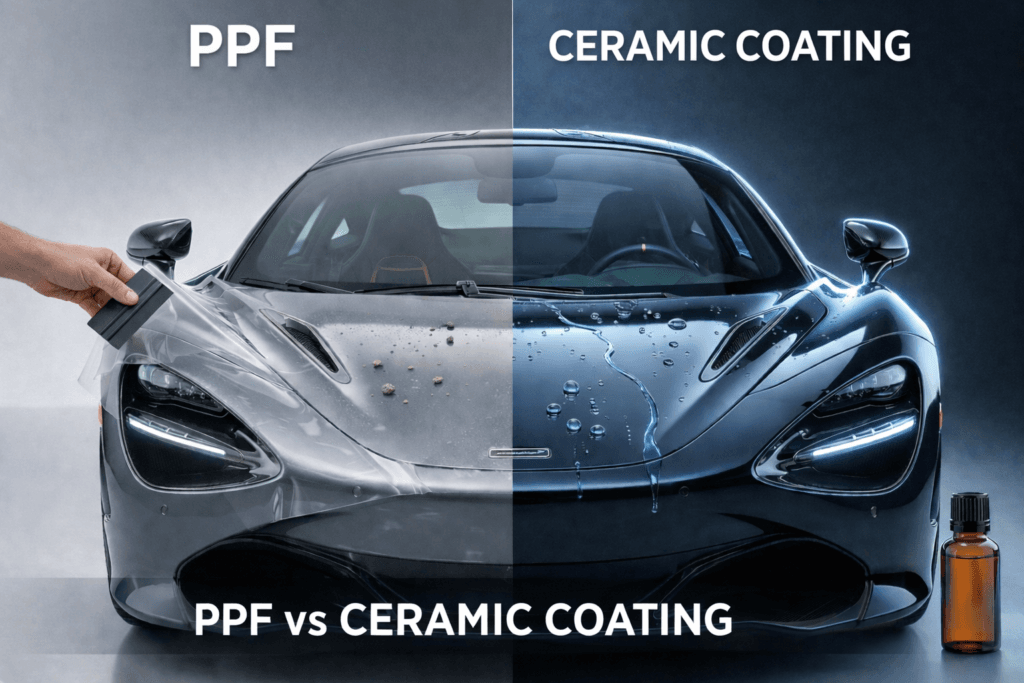
If you’re comparing ppf and ceramic coating, you’re usually trying to solve two different problems:
Physical damage (rock chips, scratches, road debris)
Chemical/maintenance stress (UV, water spots, bird droppings, road salt, grime)
This guide answers the exact search intent behind: ceramic vs ppf, ppf vs ceramic coating cost/price, and can you ceramic coat paint protection film—plus the best “PPF + ceramic” combo strategy.
PPF vs Ceramic Coating: What’s the Difference?
What is PPF?
Paint Protection Film (PPF) is a clear polyurethane film applied on top of paint to absorb impact and reduce physical wear (chips/scuffs/swirls). It’s widely described as the “physical barrier” option for real-world road hazards.[1]
What is ceramic coating?
Ceramic coating is a liquid polymer coating that bonds to the surface and improves hydrophobic behavior, chemical resistance, gloss, and ease of cleaning. It does not provide meaningful impact protection like PPF.[2]
Ceramic vs PPF: Which Protects Better?
Choose based on damage type
Impact / chips / scratches: PPF wins (it’s thickness + elasticity doing the work).[1]
UV / chemical / staining / easier washing: Ceramic coating wins.[2]
Durability expectations (realistic view)
High-quality PPF is often discussed as a long-term solution when properly maintained; some sources describe multi-year (even decade+) lifespans.[1]
Ceramic coatings are typically positioned as multi-year protection depending on product and maintenance.[2]
PPF and Ceramic Coating Comparison Table
| Category | PPF (Paint Protection Film) | Ceramic Coating |
|---|---|---|
| Main purpose | Physical protection (chips, scratches, scuffs) | Chemical resistance + hydrophobic + gloss |
| Best at | Rock chips, swirl reduction, sacrificial barrier | Easier cleaning, water beading, UV/contaminant resistance |
| Weakness | Higher cost; edges/installation quality matter | Doesn’t stop rock chips; prep quality determines results |
| Appearance | Depends on film quality + installer technique | Enhances gloss; doesn’t hide defects |
| Maintenance | Wash-safe; avoid harsh abrasives | Wash-safe; avoid harsh abrasives |
| Ideal user | Highway driving, new cars, luxury/performance | Daily drivers wanting easy maintenance + shine |
PPF vs Ceramic Coating Cost and Price: What to Expect
People search ppf vs ceramic coating cost and ppf vs ceramic coating price because they want to know what they really pay for.
Why PPF costs more
PPF is material-heavy and labor-heavy (alignment, stretching, squeegee work, edge finishing). Many consumer guides note that full coverage can become expensive depending on vehicle and coverage area.[1]
Why ceramic coating pricing varies a lot
Ceramic coating cost is heavily influenced by prep work: decontamination, paint correction, panel wipe, and curing discipline. Many brands frame ceramic coating as a “prep-dependent” system.[2]
“Value” mindset (what matters more than sticker price)
If you do frequent highway miles: PPF can save you from repaint/touch-up cycles and preserve the finish longer.
If you want the car to stay cleaner and glossy with less effort: ceramic coating is the highest ROI upgrade.
Can You Ceramic Coat Paint Protection Film?
Can you ceramic coat paint protection film?
Yes. Many installers and brands treat ceramic-over-PPF as a common best practice to improve hydrophobicity and make the film easier to clean.[2]
Can you ceramic coat PPF?
Yes, as long as the film is properly installed, cured (per installer guidance), and prepped. Some ceramic brands explicitly discuss applying certain coatings over PPF, and some even sell PPF-specific coating products.[5]
Ceramic PPF: Should You Combine Both?
If you want maximum “real life” protection, ceramic ppf is often the sweet spot:
PPF handles impact
Ceramic coating adds slickness + hydrophobicity + easier maintenance
Best order: PPF first, ceramic second
Do PPF first, then coat the film. Doing ceramic first can interfere with film adhesion and is generally discouraged by installers.[1][2]
Which One Should You Choose?
Choose PPF if…
You do lots of highway driving / road debris exposure
You’re protecting a new car or high-value paint
You care about physical damage prevention more than shine
Choose ceramic coating if…
You want easier washing + gloss improvement
You park outside and want better contaminant resistance
You want a lower upfront option vs full-film coverage
Choose both (ceramic ppf) if…
You want long-term physical protection and easy maintenance
You want the car to stay “new-looking” with less effort
You’re protecting a luxury/performance car or a vehicle you’ll keep long-term[1][2]
FAQ
1) PPF vs ceramic coating: which is better?
If you mean chip protection, PPF is better.[1] If you mean easy cleaning and gloss, ceramic coating is better.[2]
2) Can you ceramic coat paint protection film?
Yes—common practice, often recommended for easier maintenance.[2]
3) Can you ceramic coat PPF with a factory topcoat?
Usually yes, but follow installer/brand guidance and prep correctly; some brands explicitly address coating over PPF.[5]
4) Does ceramic coating prevent rock chips?
No—coatings mainly provide chemical resistance and hydrophobic behavior, not impact absorption.[2]
5) What’s the best “budget” approach?
Do partial PPF on high-impact areas (bumper/hood/mirrors) + ceramic coating for the rest.
Reference
[1] Edmunds — Paint Protection Film (PPF): What You Need to Know
https://www.edmunds.com/car-maintenance/paint-protection-film.html
[2] Gtechniq — Ceramic Coating vs PPF: Which is Better?
https://www.gtechniq.com/ceramic-coating-vs-ppf/
[3] 3M — 3M™ Paint Protection Film (Product page)
https://www.3m.com/3M/en_US/p/d/b5005353004/
[4] XPEL — FAQs
https://www.xpel.com/faqs
[5] Gtechniq — Crystal Serum Light (product page)
https://gtechniq.com/shop/auto/ceramic-coatings/crystal-serum-light/