“Self-healing” is one of the most searched claims in modern paint protection films for cars, but it’s also one of the most misunderstood. This guide breaks down the real paint protection film self healing mechanism, the boundary conditions that must be met, and the most common “it didn’t heal” failure points-so you can set correct expectations before you buy, install, or sell clear paint protection film for cars.
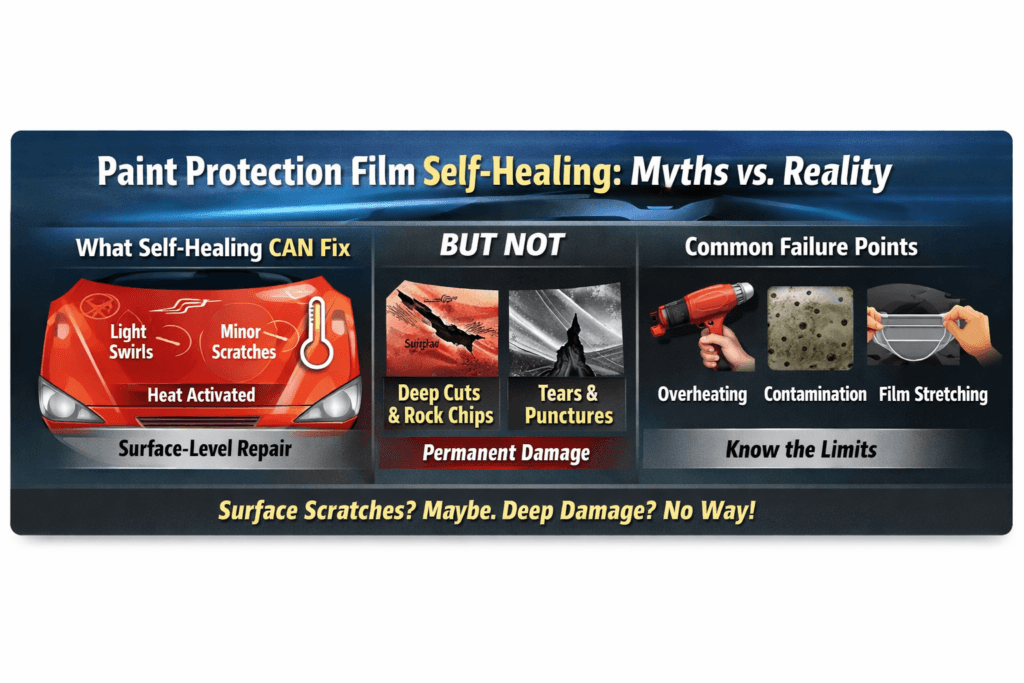
What “self-healing PPF” actually means
Most “self-healing” PPF is a TPU-based film with a self-healing topcoat (often described as an elastomeric clear coat). When the surface gets light swirls or micro-marring, heat allows the polymer chains in the top layer to relax and flow back toward a smoother surface, reducing the appearance of those fine defects. Many major brands explicitly describe this as minor scratches disappearing rather than deep damage being repaired.
The core idea in one sentence
Self-healing PPF can reduce surface-level marks in the topcoat under the right heat conditions-it does not “rebuild” missing material from a deep cut or rock chip.
What self-healing can fix vs what it cannot
Here’s the practical boundary most installers and manufacturers align on: light scratches and swirl marks can improve; deep cuts, tears, chips, and edge damage will not.
| Surface issue | Will it self-heal? | Why |
|---|---|---|
| Light wash swirls / micro-marring | Often yes | Topcoat can relax and level with heat |
| Soft scuffs (transfer on topcoat) | Sometimes | May “heal” if it’s shallow; otherwise needs cleaning/polish-safe methods |
| Moderate scratch you can feel with a fingernail | Usually no | Too deep into the coating/film to re-level fully |
| Rock chips / missing paint | No | PPF can absorb impact, but cannot replace removed material |
| Cuts, punctures, torn edges | No | Physical rupture of film needs repair or replacement |
| Yellowing/haze from contamination or aging | Not “healed” | This is chemistry/soiling, not a surface scratch |
Heat is the trigger-but the heat source matters
Self-healing is typically heat-activated: sunlight, warm water, or controlled heat can speed the recovery of fine defects. Some brands even state “by heat or hot water.”
Common heat sources (and the risks)
| Heat source | Typical use | Main risk / common mistake |
|---|---|---|
| Sunlight | Slow, gentle healing over time | Works best on light defects; inconsistent in cold seasons |
| Warm water rinse | Quick test for minor swirls | Too hot water can stress edges if film is freshly installed |
| Heat gun / steamer | Fast, controlled in trained hands | Overheating can distort film, lift edges, or damage surrounding materials |
Does thickness determine self-healing?
Not directly. Thickness is more about impact protection, conformability, and durability tradeoffs. Self-healing is primarily driven by the topcoat formulation and whether damage stays within that “heal-able” layer. That’s why two films of similar thickness can behave differently in real use.
Also note the marketing nuance: some products advertise “self-heal at ambient temperature,” while others emphasize heat activation. Always read the brand’s own claims and technical notes.
The real-world “flip points” that decide whether it heals
These are the conditions that most often decide success vs disappointment:
- Depth of damage: if the mark is deeper than the topcoat, healing will be partial at best.
- Temperature and time: colder conditions slow recovery dramatically.
- Film age and contamination: embedded grime, hard-water minerals, or chemical staining can mask healing.
- Installation stretch: aggressive stretching (complex curves, tight edges) can reduce uniformity and make defects look worse.
- Top-layer interference: some coatings or maintenance products can change surface behavior and make “healing” harder to observe (or cause spotting that looks like damage).
“Benefits of paint protection film” without the hype
Self-healing is only one of the benefits of paint protection film. Even when healing is limited, high-quality PPF is still widely chosen for:
- reducing paint damage from road debris
- protecting high-impact areas (bumper, hood, fenders, mirrors)
- reducing wash-induced swirls over time compared with bare clear coat
- preserving resale appearance when maintained correctly
Major manufacturers position PPF as protection against chips, scratches, and weathering, while describing self-healing as a benefit mainly for minor marks.
Common “self-healing” myths that cause failed expectations
- Myth 1: It heals rock chips. No. It can reduce the chance of chips, but it can’t restore missing paint.
- Myth 2: Any scratch will heal. Only shallow defects. If you can catch it with a fingernail, assume “no.”
- Myth 3: More heat is always better. Overheating is how edges lift and film distorts.
- Myth 4: All self-healing is equal. Brands vary in topcoat chemistry, hydrophobic behavior, and stated healing methods.
Buying rolls: what to ask suppliers if “self-healing” matters
If you’re comparing best car paint protection film, high quality ppf, or evaluating a car ppf roll for resale, don’t accept “self-healing” as a generic checkbox. Ask for:
- What kind of healing: heat-activated vs ambient
- What damage types: “minor scratches and swirls” language is more realistic than “scratches disappear”
- Warranty terms: yellowing, cracking, delamination coverage and length
- Topcoat properties: stain resistance, hydrophobic claims
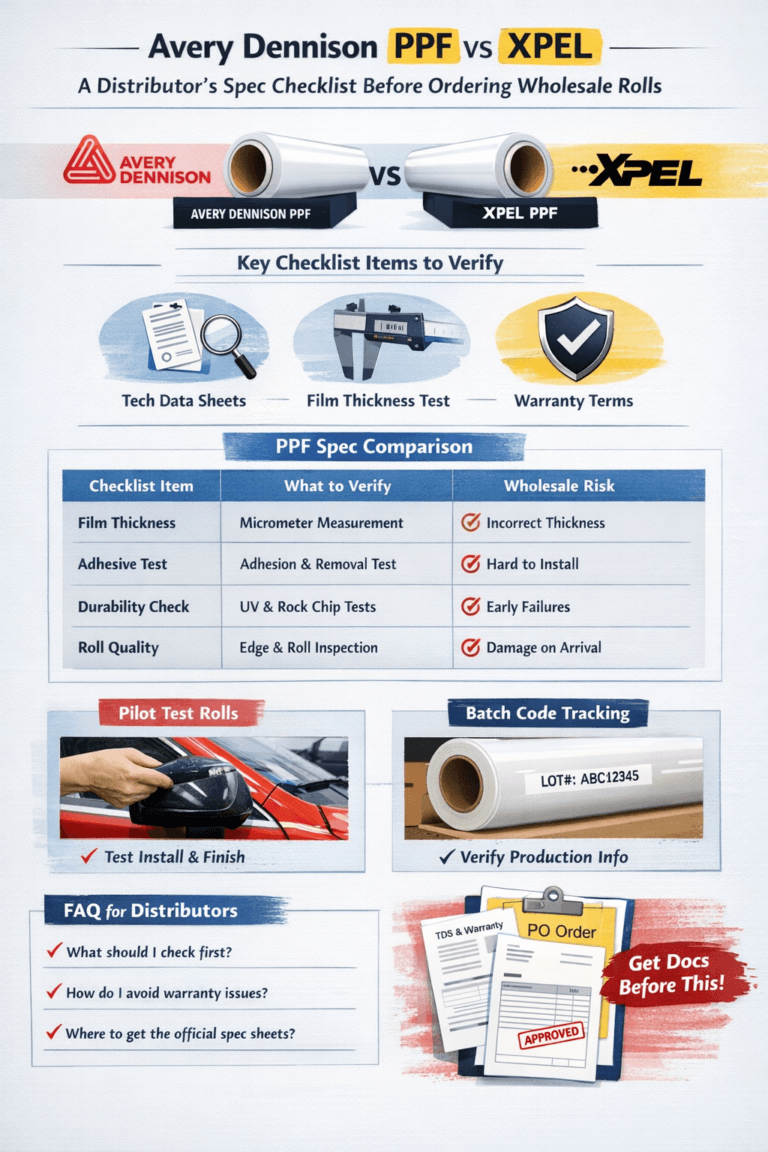
- Technical documentation: TDS, care guidelines, shelf life/storage
This is especially important when you’re sourcing from paint protection film suppliers or looking for ppf for sale / ppf film for sale, because product positioning can be looser outside official brand documentation.
FAQ: Paint Protection Film Self Healing
Does self-healing PPF work on deep scratches?
Usually not. Self-healing is mainly for light swirls and surface-level marks in the topcoat. Deep scratches that cut into the film will remain visible and may require replacement of that section.
How long does self-healing take?
It depends on temperature, defect depth, and film chemistry. Sunlight may take hours; warm water or controlled heat can make results visible faster for minor defects.
Can I use boiling water to “force” healing?
Not recommended. Excessive heat can stress edges and adhesives, especially soon after install. Use gentle warm water or follow the manufacturer’s care guidance.
Is matte PPF self-healing the same as gloss?
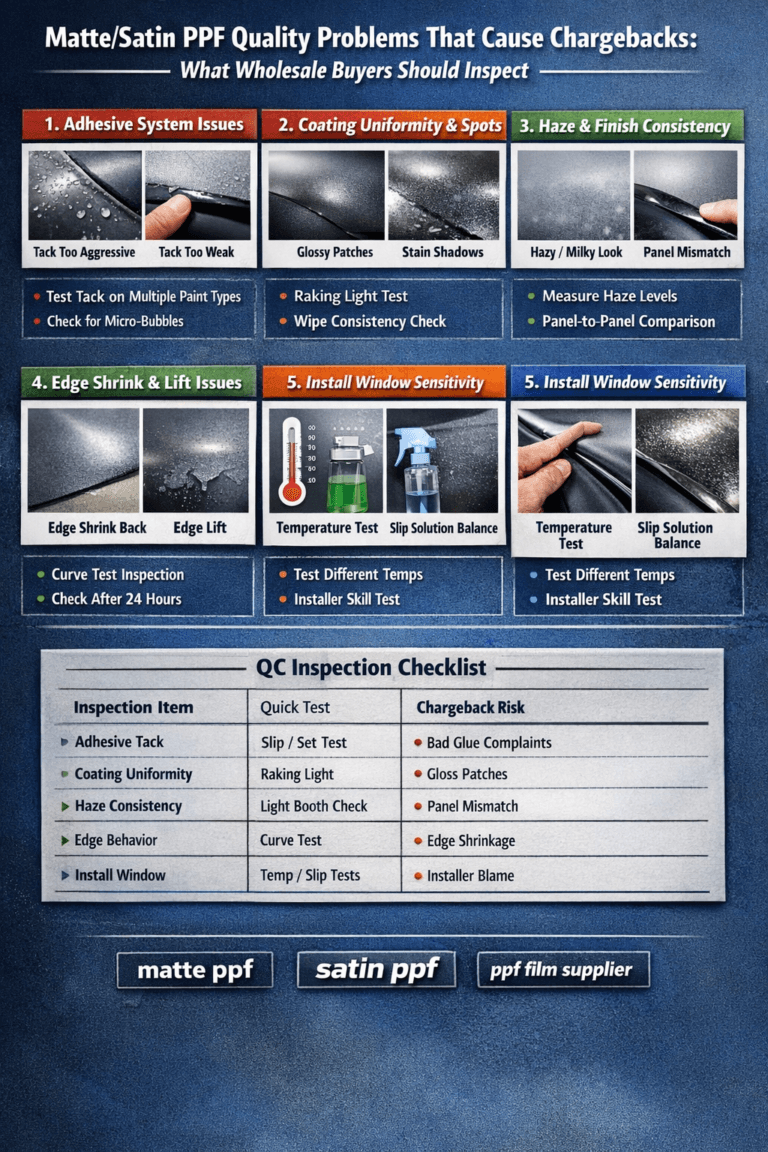
Some matte lines are self-healing, but visual results can be harder to judge because matte surfaces show “texture change” differently than gloss. Always check the product’s own claim for healing behavior.
Does ceramic coating replace self-healing PPF?
No. Some products combine PPF with hydrophobic or “ceramic-style” behavior, but coatings and films solve different problems. Coatings won’t absorb impacts like film, and film healing is about the film’s top layer.
Where to buy paint protection film if I need roll supply?
For roll supply, prioritize suppliers who can provide consistent documentation (TDS, warranty, storage/shelf life) and stable batch quality. Treat “self-healing” as a spec you verify, not a slogan.
References
[1] Scotchgard™ Paint Protection Film Pro Series (https://www.3m.com/3M/en_US/p/d/b40066706/)
[2] XPEL ULTIMATE PLUS Technical Data Sheet (PDF) (https://www.xpel.com/web-assets/downloads/XPEL-ULTIMATE-PLUS-TDS-82019-V1-1.pdf)
[3] XPEL – Discover Automotive Paint Protection Film (https://lp.xpel.com/discover-automotive-ppf)
[4] STEK DYNOshield Specifications (self-healing by heat or hot water) (https://www.stek-usa.com/paint-protection-film/dynoshield/)
[5] SunTek Reaction Paint Protection Film (https://suntekfilms.com/na/en/paint-protection-film/reaction/)
[6] LLumar Valor Paint Protection Film (https://llumar.com/na/en/automotive/paint-protection-film/valor/)
[7] Self-healing polymers for surface scratch regeneration (review, PMC) (https://pmc.ncbi.nlm.nih.gov/articles/PMC10690873/)
[8] Self-Healing Thermoplastic Polyurethane linked via host-guest interactions (PMC) (https://pmc.ncbi.nlm.nih.gov/articles/PMC7361818/)
[9] Development of Self-Healing Polyurethane and Composites (MDPI Polymers, 2025) (https://www.mdpi.com/2073-4360/17/17/2274)
[10] SunTek Paint Protection Film overview (mentions heat sources like engine/sun) (https://suntekfilms.com/na/en/paint-protection-film/)