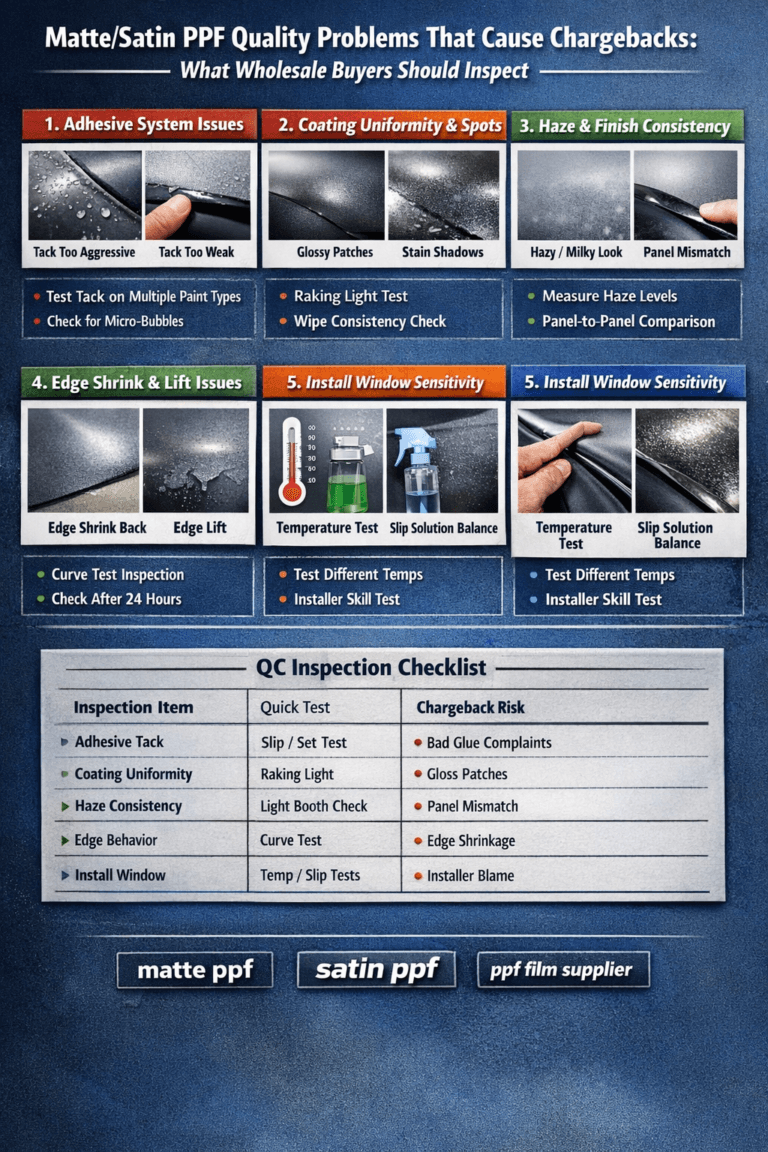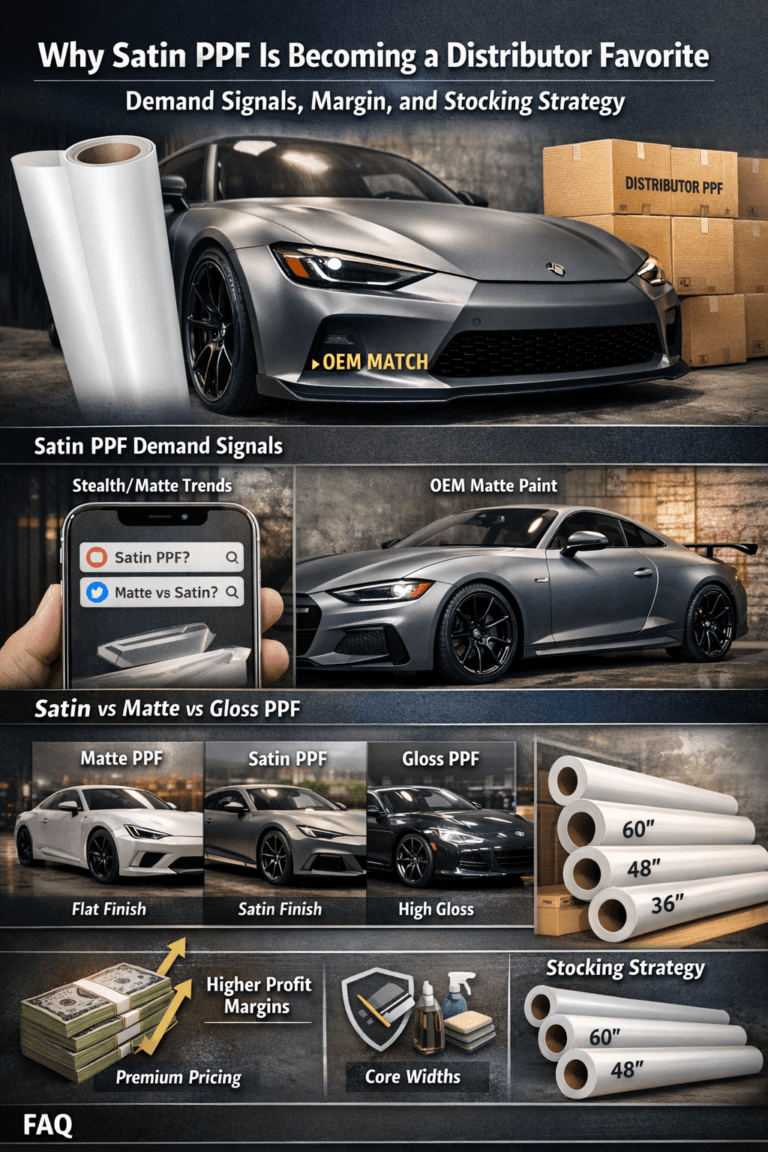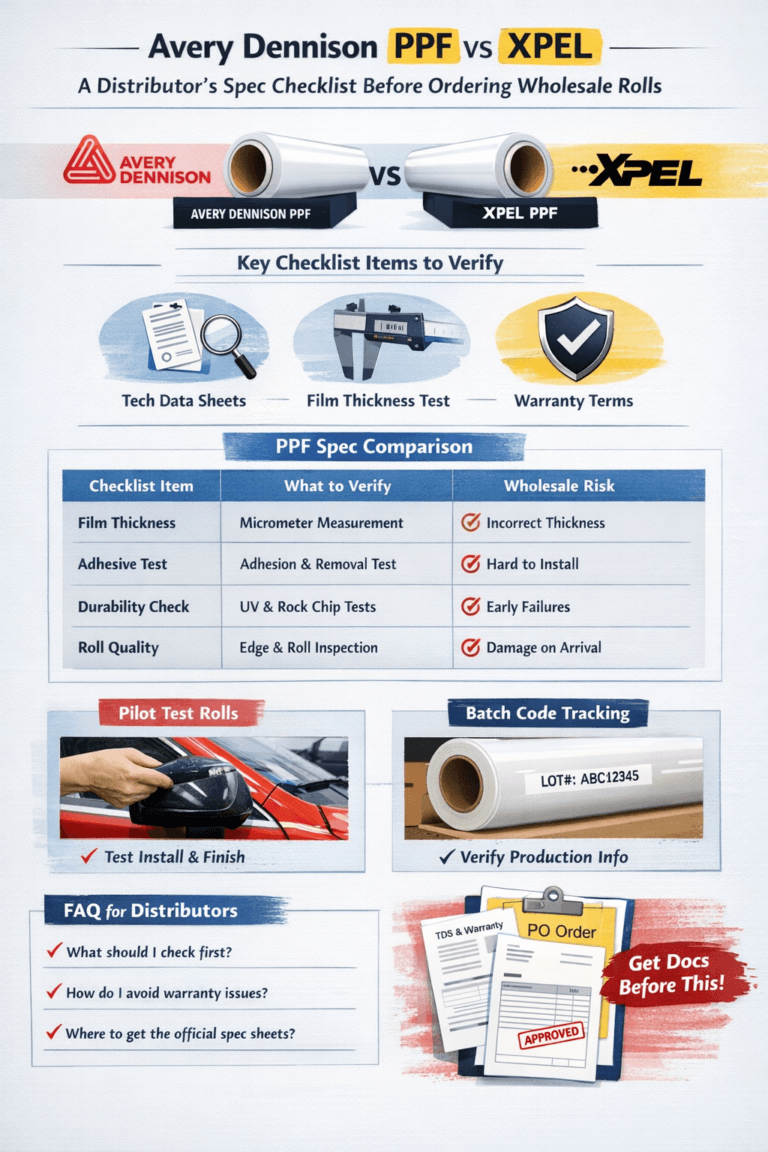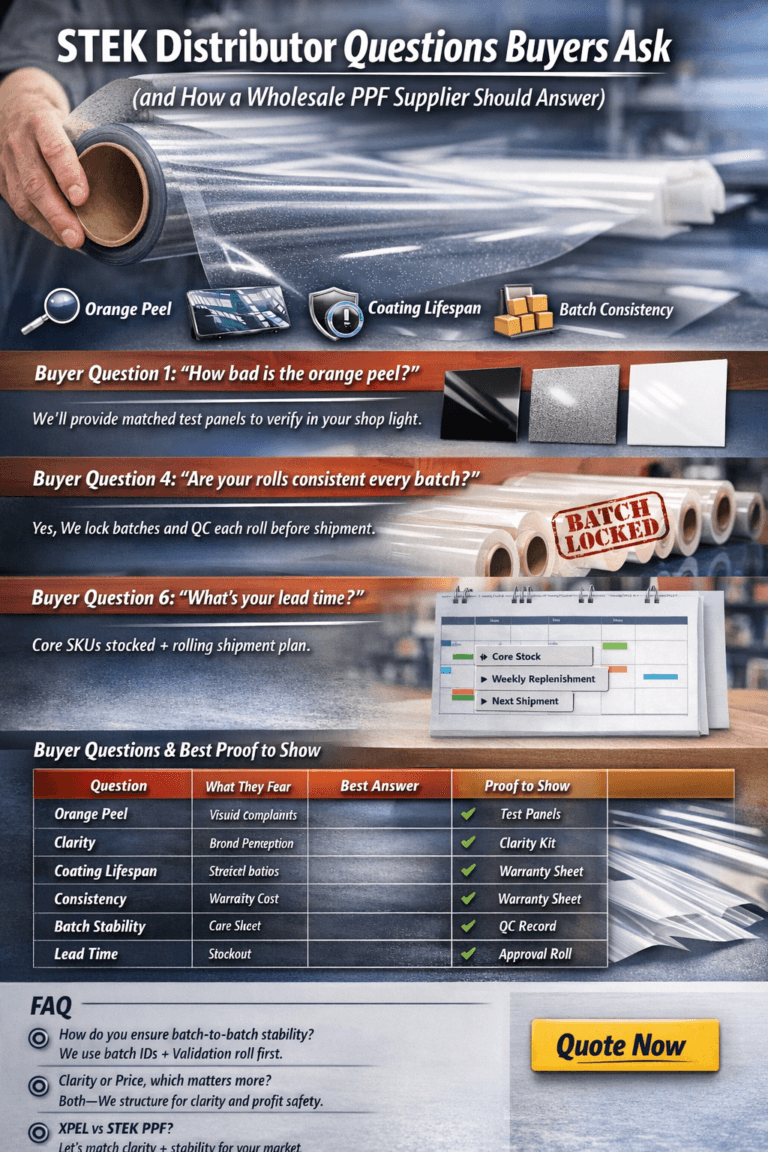
What the community complains about (and why distributors end up eating it)
You’ll see the same themes in installer discussions:
- “This roll installs like butter, the next one fights me.”
- “Edges lift on one batch, not on another.”
- “Looks perfect in the shade, but orange peel/texture pops under LEDs.”
- “Same SKU, different tack… did they change adhesive or storage conditions?”
Even when a brand advertises self-healing and hydrophobic performance, distributors still win or lose on the unglamorous stuff: roll-to-roll consistency and batch traceability. (For example, STEK’s DYNOshield lists core performance claims like hydrophobic and self-healing, but distributors still need inbound QC to ensure what arrives matches expectations.)
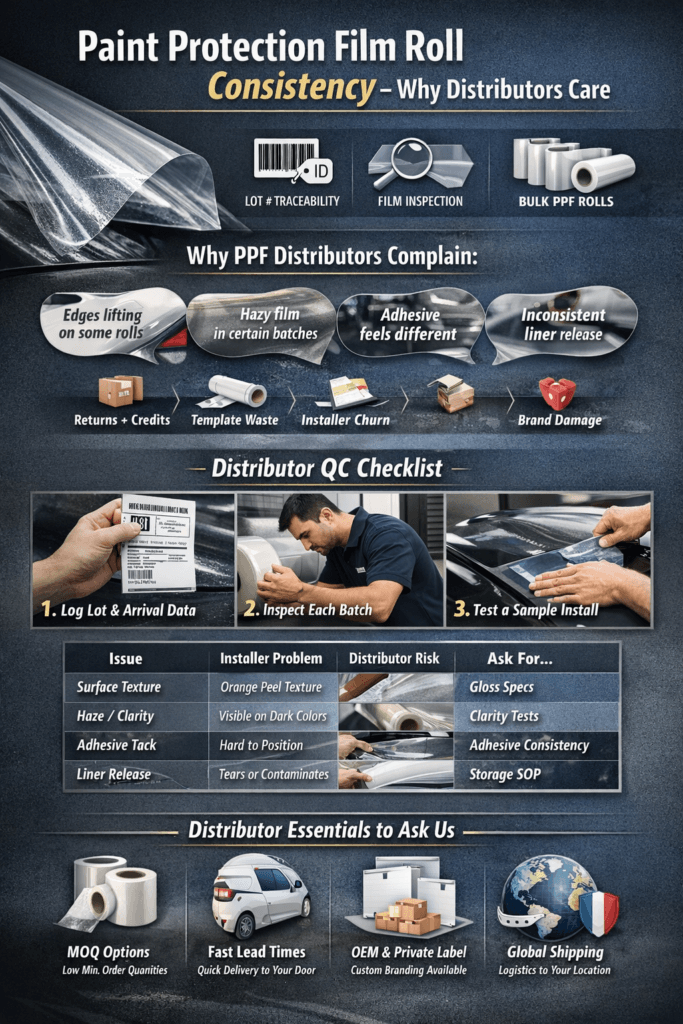
Why roll consistency matters more in B2B than in consumer installs
If you’re buying one kit for one car, a “slightly off” roll is annoying.
If you’re stocking warehouse inventory as a paint protection film supplier to shops, inconsistency becomes systemic:
- Returns + credits: you pay freight twice and lose margin.
- Installer churn: shops quietly switch brands after 1–2 bad experiences.
- Template + plotting waste: inconsistent liner release or stretch behavior burns material.
- Brand damage: distributors get blamed even when the factory caused the variation.
This is why top brands publish technical data sheets and product specs, and why distributors should tie every inbound roll to a lot/ID and storage window.
The “Distributor QC” checklist people wish existed
Here’s the practical checklist most community threads imply, but rarely spell out.
1) Traceability first (before you even unbox)
- Record lot/roll IDs and match them to invoice + packing list.
- Store photos of box labels and core labels.
- Log arrival date + warehouse conditions (heat swings matter).
Why: If something goes wrong, you need to isolate the batch fast—otherwise you’ll have “random problems” across customers.
2) Open one roll per lot (minimum)
Do a quick incoming inspection:
- Visual: haze, liner scuffs, edge damage, telescoping
- Hand feel: topcoat slickness consistency (basic sanity check)
- Release: liner separation should be predictable (no tearing / weird resistance)
3) Test a small install sample (15–30 minutes saves weeks)
On a standard panel or test board:
- Squeegee feel: does it grab or glide consistently?
- Tack level: too aggressive = reposition pain; too low = edge lift risk
- Stretch: does it elongate predictably or “snap back” weirdly?
(Brands often specify recommended storage and shelf life windows; if a roll is out-of-window or stored poorly, you can see odd behavior.)
Table: Distributor-facing roll consistency risks and what to ask your manufacturer
| What varies between rolls | What installers notice | Distributor risk | What to request from your PPF manufacturer / supplier |
|---|---|---|---|
| Surface texture / “orange peel” | Looks different under shop lights | Complaints + brand switching | Standardized gloss/texture specs + sample approval process |
| Optical clarity / haze | “Film is visible” on dark colors | Refunds + reputation hit | Clarity metrics, batch QC photos, controlled lighting inspection |
| Adhesive tack / repositioning | Hard to place, edge issues | Extra labor claims, slow adoption | Adhesive spec consistency + storage guidance |
| Liner release behavior | Pulls unevenly, tears, contamination | Material waste | Liner spec + roll handling SOP |
| Thickness tolerance | Cuts/edges behave differently | Pattern/plotter inefficiency | Thickness tolerance range; confirm (e.g., 8 mil class products) |
| Shelf life / storage sensitivity | “This batch feels off” | Hidden warehouse loss | Shelf-life statement + storage conditions in writing |
Where STEK-related buyers usually land (and what they ask next)
If someone searches stek wholesale or stek distributor, they usually care about two things:
“Is the film optically clean?”
Community posts frequently compare brands on visibility/texture. Some users specifically call out STEK for optical appearance and others point out brand-to-brand differences.
“Can I get steady supply in rolls?”
STEK DYNOshield and other premium films are commonly sold in roll formats by various distributors/retailers (different roll sizes exist in the channel).
Distributor takeaway: regardless of brand, your “trust layer” is: lot control + inbound QC + clear escalation path when a batch is off.
How to position your offer as a distributor (without sounding like marketing)
If you’re building a ppf distributor page meant to convert B2B leads, keep it simple and specific:
- “We stock consistent paint protection film roll inventory with batch tracking.”
- “Each lot is checked on arrival; issues are isolated fast.”
- “We support oem paint protection film orders: private label, cartons, pallet specs.”
- “We can supply clear paint protection film (PPF) rolls for installers + regional resellers.”
That language matches how real buyers think: risk reduction, not hype.
FAQ
What does “roll consistency” actually mean in paint protection film?
It means the same SKU performs the same across batches—similar clarity, texture, tack/repositioning, liner release, and expected self-healing behavior. Technical data sheets describe intended properties, but distributor QC confirms reality on arrival.
Do premium brands still have variation?
Yes. Even the best supply chains can have differences from storage, transit heat, or batch drift—so distributors rely on traceability and inbound checks rather than assumptions.
How do I explain “orange peel” concerns to a buyer without starting a fight?
Keep it practical: some films show more texture under LEDs and on dark paint. Community discussions often frame it as film-dependent and expectation-dependent.
What roll sizes should a distributor stock?
Typical channels carry multiple widths/lengths. Some brands sell custom lengths and multiple widths for flexibility; stocking strategy depends on your customer mix (full hood shops vs partial coverage).
What should I request from a paint protection film supplier before placing a bulk order?
Ask for: lot IDs, shelf-life/storage guidance, product spec sheet/TDS, and an agreed process for handling batch issues (replacement/credit terms).
References
[1] DYNOshield Hydrophobic Paint Protection Film (https://www.stek-usa.com/paint-protection-film/dynoshield/)
[2] Scotchgard Paint Protection Film Pro Series – 3M Product Page (https://www.3m.com/3M/en_US/p/d/b40066706/)
[3] XPEL ULTIMATE PLUS Technical Data Sheet (PDF) (https://www.xpel.com/web-assets/downloads/XPEL-ULTIMATE-PLUS-TDS-82019-V1-1.pdf)
[4] XPEL Product Specifications – Film Performance & Specs (https://www.xpel.com/product-specifications)
[5] EXPEL or STEK? – r/AutoDetailing discussion (https://www.reddit.com/r/AutoDetailing/comments/13md5uz/expel_or_stek/)
[6] Does PPF affect the look of the paint in any way? – r/AutoDetailing (https://www.reddit.com/r/AutoDetailing/comments/jhm36g/does_ppf_affect_the_look_of_the_paint_in_any_way/)
[7] Scotchgard Paint Protection Film Pro Series 200 – 3M Product Page (https://www.3m.com/3M/en_US/p/d/b5005352002/)
[8] DYNOshield (SW) Product Sheet (PDF) (https://www.stekczech.cz/wp-content/uploads/2024/11/DYNOshield_SW.pdf)