If you are searching for “best ppf” or “best paint protection film,” your real worry is usually not “should I install it,” but rather these three things:
- Will it look good after installation? You care about clarity, texture, and whether it easily shows dirt or wash swirls.
- Will it remain stable long-term? You worry if it will degrade after some use, becoming hard to clean, dull, or lifting at the edges.
- Will I fall into a trap? You fear buying film that “looks high-end but is actually unstable,” leading to rework, complaints, and exploded time costs.
This is why finding the best PPF is not a problem that can be solved by a simple list of brands. PPF is an engineering system and a supply chain system. You aren’t just buying “film”; you are buying predictability.
Top 10 PPF Brands: Market Comparison List (2025)
The following list is closer to the real search and comparison path of users (the top ppf brands they actually compare), rather than just an advertising ranking.
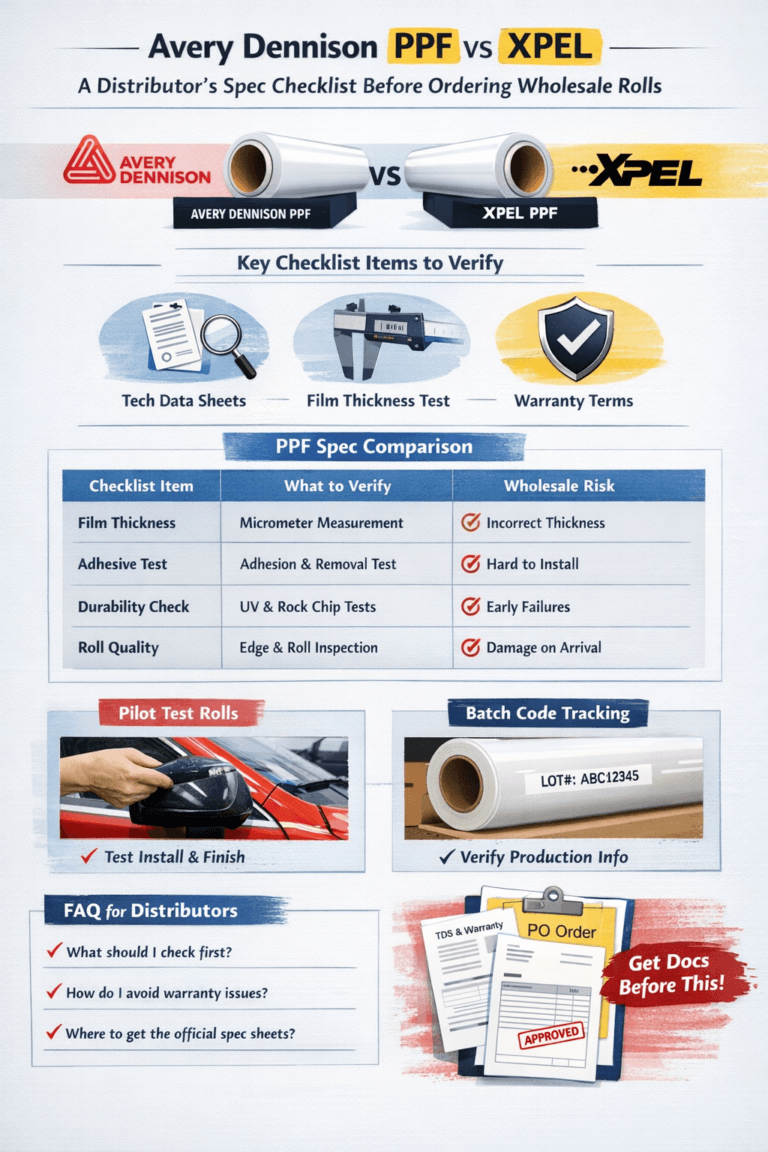
- XPEL — One of the high-end benchmarks. ULTIMATE PLUS is often used as a comparison baseline; their official FAQs state ULTIMATE PLUS is 8 mil thick [8], and technical data emphasizes “low surface energy, stain resistance & gloss retention, self-healing clear coat” as engineering narratives [6].
- LLumar — Another high-end benchmark line. Platinum Gloss emphasizes a self-healing surface and HydroGard™ hydrophobicity, offering a 10-year limited warranty (subject to dealer terms) [2].
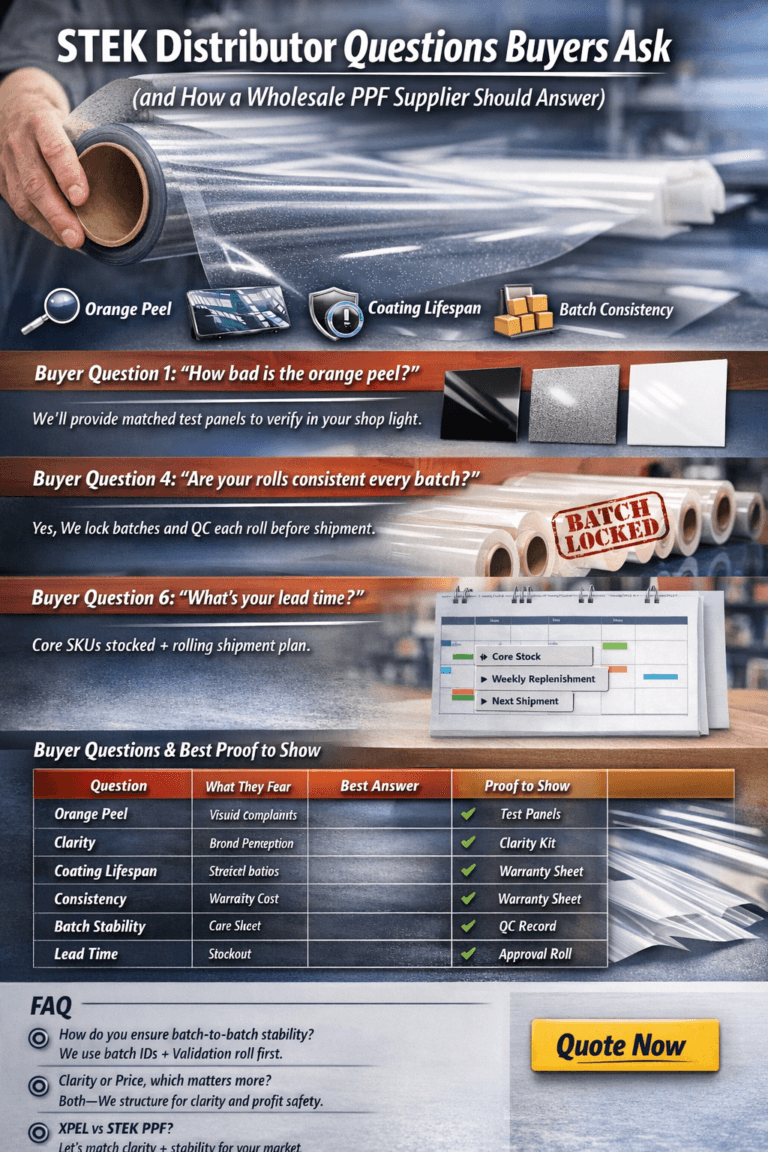
- SunTek — A high-end comparison brand, with strong channels and installation ecosystems in certain markets.
- STEK — Leaner towards the enthusiast circle and high-end personalized aesthetic needs.
- 3M — Strong brand recognition, still frequently included in comparisons.
- Avery Dennison — Highly recognized in the automotive film sector.
- PremiumShield — Frequently appears in best ppf brands content.
- ClearPro — Common in comparison articles and has published brand comparison content; their content is useful for understanding “market comparison frameworks,” but conclusions on different brands’ performance should still rely on official data and independent testing [7].
- MIC Film — Targets “rational value” clients: emphasizes verifying goods using high-end benchmark logic and using supply chain efficiency to reduce brand premiums.
- Regional Strong Brands/Installation Systems — In many places, the answer to “what is the best” depends on local installation and after-sales execution rather than global fame.
The significance of this list is to clarify “what the market is comparing.” What truly decides which one to choose is the next section: the underlying logic of a good film.
The True Logic Behind “Best PPF”: Four Certainties
Most articles only mention “self-healing, hydrophobic, high gloss, X years warranty.” These words are easy to write but hard to use for decision-making. The truly effective framework for judging the best auto paint protection film is to break PPF down into four certainties:
1) Experience Certainty: Does it look “High-End” after installation?
The goal isn’t “bright when just installed,” but “looks high-end, details are clean, and overall texture is stable.” The gap is often reflected in:
- Does it easily amplify installation marks?
- Does the surface easily show dirt, water spots, or fine lines?
- Is daily cleaning easy?
These are not guaranteed by a simple sentence about “high gloss/hydrophobic,” but depend on product design + delivery consistency.
2) Installation Certainty: Is it Easy to Install? Is Tolerance High?
The final quality of PPF relies heavily on installation. Even if the film itself is good, as long as the installation process is “hard to control,” the actual effect will fail. The reason high-end brands are expensive includes not just the product itself, but the delivery ecosystem: training, processes, construction habits, and feedback loops.
More critically: The match between the adhesive (PSA) and the installation fluid system directly decides if “positioning is smooth, squeegeeing is smooth, and rework rate is high.” Eastman writes on its product page for “urethane film with pressure sensitive adhesive”: this is a 6–8 mil transparent elastic urethane film with pressure sensitive mounting adhesive; installation uses “surfactant-containing aqueous solution or dedicated application gel” [4]. This narrative proves that “ease of installation” is not magic; it is an engineering condition.
3) Lifecycle Certainty: Will it “Degrade” After a While?
Many “alternatives” fail here: they look good in the short term but have long-term issues. “Long-term” refers to performance under real-world environments like city commuting, car washes, dust, rain, and road film. The key is: Does the brand/supplier have clear explanations and support capabilities for real-world boundaries and maintenance, rather than just slogans?
For example, LLumar includes “self-healing + HydroGard™ hydrophobicity + warranty” as part of its long-term experience narrative (subject to dealer terms) [2].
4) Batch Consistency: Is Every Roll the “Same Product”?
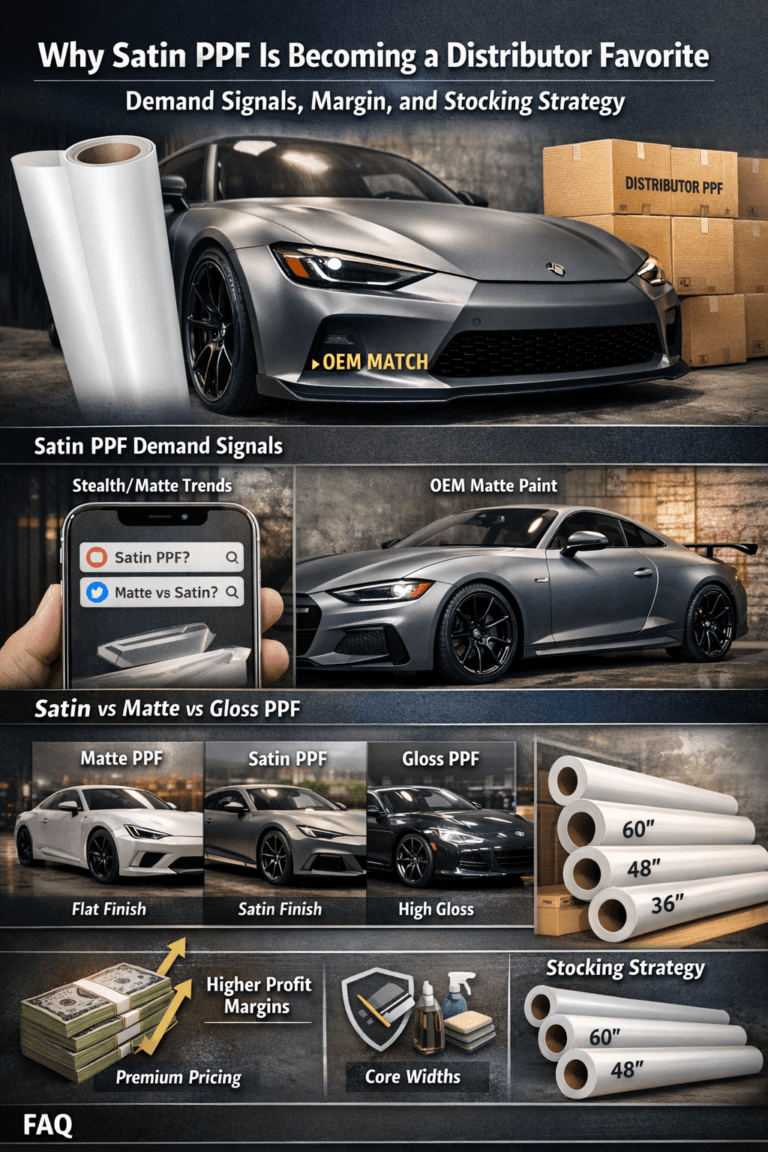
This is the point B2B clients care about most, but consumer articles often ignore. For distributors, installation shops, and wholesale clients:
- One batch drift can bring a string of customer complaints.
- One change in installation feel can lead to dropped efficiency and exploded rework costs.
- One after-sales dispute can directly hurt reputation and repeat purchases.
Therefore, best paint protection film in a commercial context essentially means: The most predictable supply.
Why XPEL / LLumar Alternatives Exist
The “Alternative” Demand: Where does the premium come from?
XPEL and LLumar became benchmarks for a reason: product lines, brand trust, channels, and after-sales systems. However, the price often includes a portion of “system costs,” such as:
- Channel tiers and brand operations.
- Installation network construction and training.
- Retail-end warranty and management.
This is why many people search for xpel alternative or llumar alternative: the demand isn’t just “cheaper,” but to invest the budget more into “where the experience is truly determined,” rather than into system overhead.
The Core of an “Alternative”: Shifting from “Brand” to “Structural System”
PPF can be broken down into three core components, judged by Mechanism → Risk → Transaction Consequence.
I. Adhesive (Adhesive / PSA): Decides Efficiency, Edge Stability & Removability
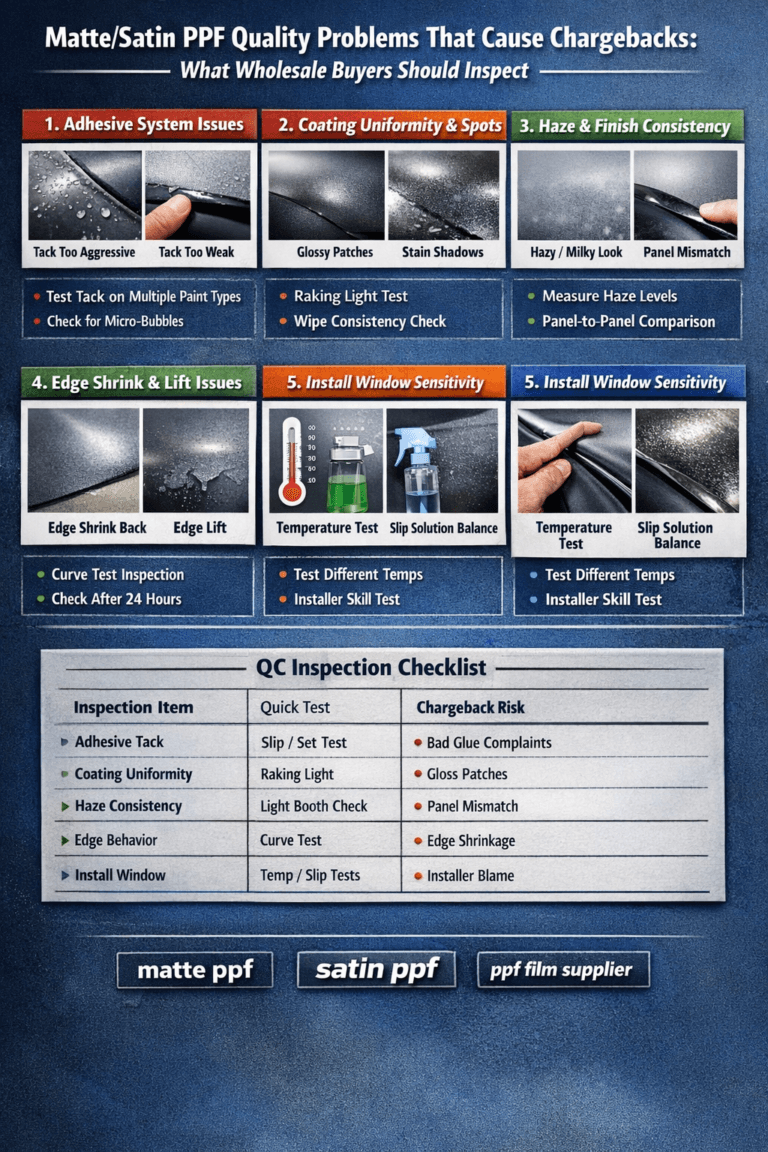
Many people only stare at the “film body,” but in a shop’s real costs, the Adhesive (PSA) is the variable determining delivery success. The difference between “controllable” and “uncontrollable” glue for the same roll of film will eventually be reflected in labor hours, rework rates, edge stability, and the client’s judgment of whether the “delivery is reliable.”
Eastman describes typical PPF directly: PPF is a transparent elastic urethane film with pressure sensitive mounting adhesive; installation uses “surfactant-containing aqueous solution or dedicated application gel” [4]. This implies the adhesive must simultaneously satisfy three things:
1) Wet Application Stage: Able to Position, Drain, and Leave No Marks When installation fluid is present, the glue cannot “bite immediately,” otherwise:
- Position is hard to fine-tune (requires rework).
- Drainage is slow, easily trapping water (prone to “water marks/silvering”).
- Corners and complex curves are more likely to pull stress lines (looks “dirty and marked” after installation).
- Transaction Consequence: Installation time is dragged out, rework increases, installation costs rise—the material price saved by the alternative may be eaten back up by “labor hours and rework.”
2) Curing Stage: Able to Establish Stable Bonding, Edges Don’t Lift Long-term The glue must “build adhesion stably” after curing, otherwise common issues include:
- Edge/gap rebound, lifting, and trapping dirt.
- “Shrinkage” appearance at edges after car washing.
- Local bubbling (not due to incomplete drainage, but insufficient long-term stability).
- Transaction Consequence: Issues appear weeks to months later, and the after-sales cost is often far higher than the price difference saved initially.
3) Removal Stage: Able to Remove Cleanly, Without Transferring Risk to Client Eastman notes on the same page that it is not recommended for “damaged paint or repainted surfaces” because removal risk is higher [4]. This means “removability” itself is a conditional, bounded engineering problem.
- Transaction Consequence: For the installer, it is a dispute risk; for the channel, it is a brand and reputation risk.
II. Topcoat: Decides How Long it “Looks High-End,” Not Just How Bright it Starts
Many articles write about topcoat as a “Self-healing, Hydrophobic, High Gloss” trio, but what truly determines satisfaction isn’t “having it,” but: how long these experiences last, what they look like after decaying, and how after-sales boundaries are defined.
LLumar Platinum Gloss official pages emphasize self-healing surfaces and HydroGard™ hydrophobicity, offering a 10-year limited warranty (subject to shop terms) [2]. Its value is not in the nouns, but in the “long-term body feel,” which can be broken into three results:
1) Self-healing: Combating High-Frequency Micro-Damage, Not Covering All Scratches The core value of self-healing is reducing the visualization of “wash swirls,” making it easier for the vehicle to remain “like new.” But deep scratches, cuts, and permanent deformation caused by sharp impacts will not disappear just because of “self-healing.”
- Transaction Consequence: Packaging “fine line fading” as “all scratches can be fixed” makes for easy sales in the short term, but leads to complaints in the long term.
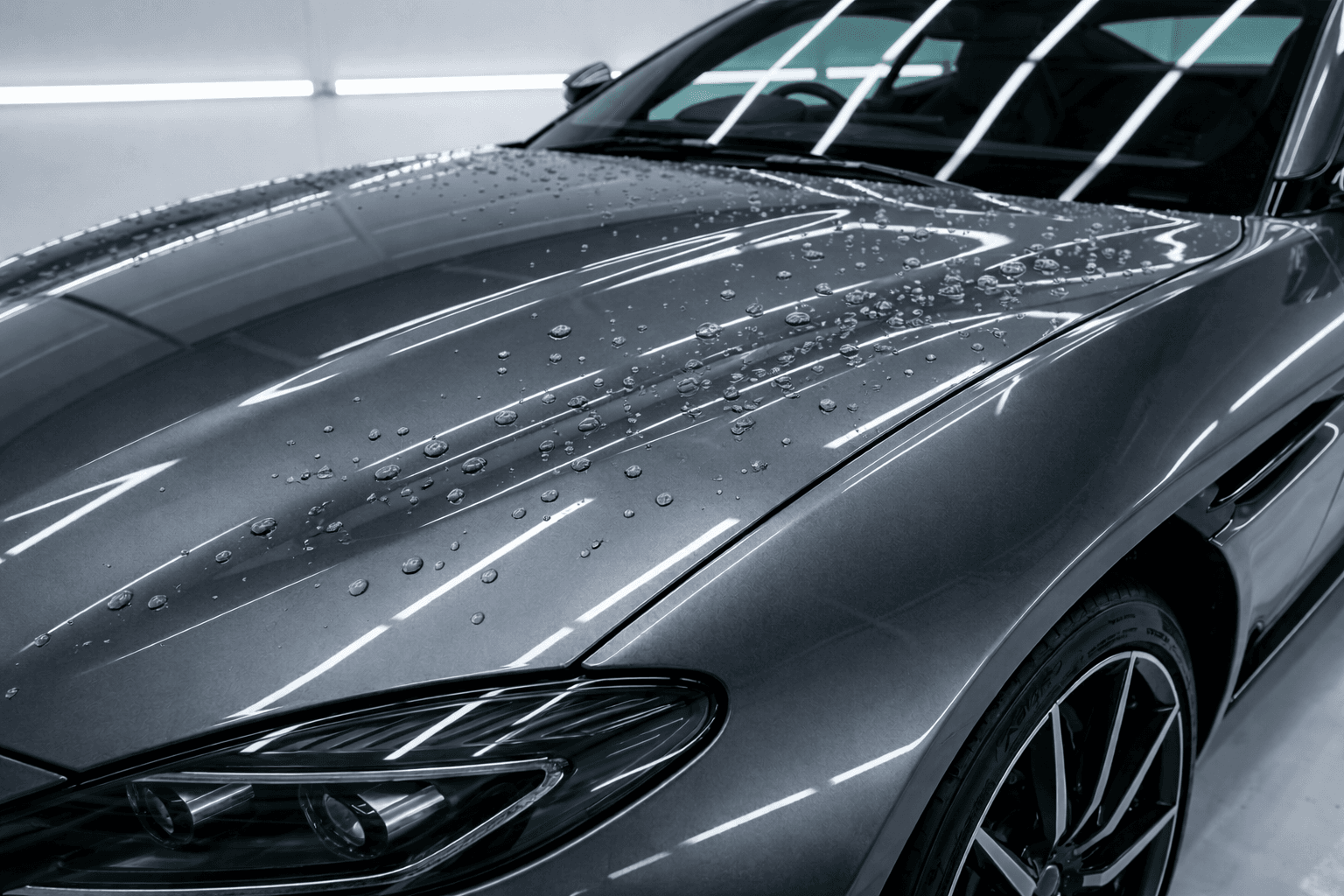
2) Hydrophobic Anti-stain: Reducing Maintenance Costs, Not Staying Clean Forever The value of descriptions like HydroGard™ lies in making water spots, road film, and insect corpses easier to clean, reducing maintenance difficulty [2]. But hydrophobic experience is affected by dust, road film, and washing methods. Hydrophobicity is not an eternal attribute; it is a surface state that can be polluted, restored, and may gradually decay.
- Transaction Consequence: Whether the supplier can clearly explain maintenance and boundaries is an important signal for users to judge professionalism.
3) Warranty Narrative: Essentially Writing Long-term Experience into Boundaries The significance of a warranty is not just the number of years, but whether the rules are clear and executable: what counts as a quality issue, what counts as usage/maintenance factors, how to judge, and how to handle it (subject to shop terms) [2].
III. Substrate (TPU / Urethane): The Chassis for Impact, Fit, and Long-term Look
If topcoat decides “feel” and PSA decides “delivery,” then the TPU substrate decides the chassis: impact resistance, smooth fit, long-term stability, and whether it can form a replicable supply and delivery.
Mainstream PPF substrate is thermoplastic urethane (TPU/urethane). Lubrizol’s material content emphasizes the importance of TPU in PPF solutions and the material support path [3].
1) The Core of TPU is “Balance,” Not Maxing Out One Item Pursuing a limit in one item (harder, more scratch-resistant) often sacrifices another dimension (harder to fit, higher stress, higher installation risk). Therefore, the standard for a “good substrate” is not “the harder the better,” but: achieving a reasonable balance between impact resistance, flexible fit, and long-term stability under real installation and usage scenarios.
- Transaction Consequence: The most fatal thing isn’t “one batch is very good,” but “the next batch is suddenly different”—if the substrate system is unstable, follow-up experience and delivery will be out of control.
2) Substrate Decides the Ceiling of Long-term Appearance: Clarity / Haze / Yellowing Trend Yellowing and haze are often attributed to the environment or washing, but the substrate system (and its match with the coating/glue) determines the ceiling of long-term appearance:
- The more stable the substrate system, the more predictable the long-term look.
- Poor matching amplifies “decay” and issues of “showing dirt and marks.”
- True high-end experience comes from system matching, not single-point marketing.
3) Substrate Stability Decides if it Can Be a “Repeatable Supply” The stability of the substrate determines whether the product can be a “repeatable supply” rather than a “batch based on luck.” This is also the direction MIC Film emphasizes: using a more stable chassis and consistent delivery to turn “alternatives” from marketing talk into sustainable cooperation.
How to Judge a “True Alternative”: Use an Evidence Chain Instead of Slogans
Facing the choice of an xpel alternative or llumar alternative, you can use the following evidence chain to filter:
1) Is the Official Narrative Clear? High-end brands usually state their flagship line’s propositions clearly, and official pages and technical data directly reflect positioning and boundaries [2][6][8]. If an alternative supplier cannot even explain “product line positioning, applicable scenarios, after-sales boundaries” clearly, and relies only on “we are also high-end” scripts, the risk is high.
2) Is Installation Feedback Replicable? A reliable alternative is not “one shop said it’s easy to use,” but consistent feedback across multiple installation scenarios and different technicians, with predictable and replicable results.
3) Is There a Management Mechanism for Batch Consistency? You don’t need to see internal secrets, but you need to see the basic logic of consistency control: able to locate causes, able to review, able to correct; the attitude towards batch fluctuations is not “blaming the installation,” but establishing a closed loop.
4) Are After-sales Rules Executable? An alternative is a commercial choice with higher cost-performance. The key lies in whether rules are clear and executable: how cross-region delivery collaborates, how disputes are judged and handled, and whether verifiable handling methods are provided.
MIC Film: Position in the “Alternative Evidence Chain”
MIC Film is suitable to be considered as a more rational option after completing the best ppf brands comparison and entering the xpel alternative / llumar alternative screening phase. It emphasizes not a single sentence of “benchmarking,” but proving via an evidence chain: clear product line positioning, replicable installation results, controllable batch consistency, and executable after-sales rules. For channel clients, its value leans more towards “predictable supply + replicable experience,” thereby reducing rework and reputation risks.
PPF Manufacturers USA: Origin is a Reference, Not a Decision Item
Quite a few people search for ppf manufacturers usa, hoping to use “origin” as a shortcut for quality. But PPF is a material engineering system: what truly decides quality is usually the material system, process control, and consistency management. A safer way to judge is: Instead of asking “where is it made,” ask “who can prove the standard and deliver consistently.”
Final Recommendation: How to Choose the Best PPF for Cars?
- If you seek “Market Benchmark & Strongest Mindshare,” and accept the brand premium: XPEL / LLumar are common choices [2][6][8].
- If you seek “High-End Results + Better Cost Performance,” and are willing to verify via the evidence chain: Filter along the xpel alternative / llumar alternative path.
- If you are a Channel Client (Installation Shop, Dealer, Wholesaler): Put “Batch Consistency & Delivery Stability” as the first priority; it decides whether you make money long-term or spend your time putting out fires.
One sentence summary: Good film is not “advertised out,” it is “verified, replicated, and sustainably delivered out.”
FAQ
1) Why are many “best ppf brands” articles not very helpful? Because they only talk about brands, not the four certainties that truly affect risk: Experience, Installation, Lifecycle, and Batch Consistency.
2) How should I judge a true xpel alternative? Use the evidence chain: Is positioning clear? Is the installation result replicable? Is batch consistency controllable? Are after-sales rules executable?
3) Is a llumar alternative worth considering? Yes. Many buyers pursue “high-end effects + higher cost performance.” The prerequisite is still a complete evidence chain; otherwise, the alternative easily becomes a “luck-based substitute.”
4) Why should channel clients pay more attention to consistency? Because the customer complaints, rework, and reputation loss caused by one batch drift are far greater than the price difference of a single roll between brands.
5) What kind of client is MIC Film suitable for? It is suitable for clients who pursue high-end results but value cost-performance and supply stability more; especially suitable for channel clients shifting risk from “relying on big brand premiums” to “verifying suppliers via evidence chains.”
References
- [1] XPEL ULTIMATE PLUS Product Page https://www.xpel.com/products/ultimate-plus
- [2] LLumar Platinum Gloss Paint Protection Film https://llumar.com/na/en/automotive/paint-protection-film/platinum-gloss/
- [3] Lubrizol Automotive Materials: Paint Protection Film https://www.lubrizol.com/industries/transportation-machinery-and-equipment/automotive-materials/paint-protection-film
- [4] Eastman Chemical: Urethane Paint Protection Films https://www.eastman.com/en/products/product-detail/71100690/films-urethane-paint-protection-with-pressure-sensitive-adhesive
- [5] Eastman Automotive Exterior Solutions https://www.eastman.com/en/products/industries/transportation/automotive/auto-exterior
- [6] XPEL ULTIMATE PLUS Technical Data Sheet (PDF) https://www.xpel.com/web-assets/downloads/XPEL-ULTIMATE-PLUS-TDS-82019-V1-1.pdf
- [7] ClearPro: PPF Brands Guide for Car Owners https://www.clearpro.com/ppf-brands-for-car-owners/
- [8] XPEL Frequently Asked Questions https://www.xpel.com/faqs